
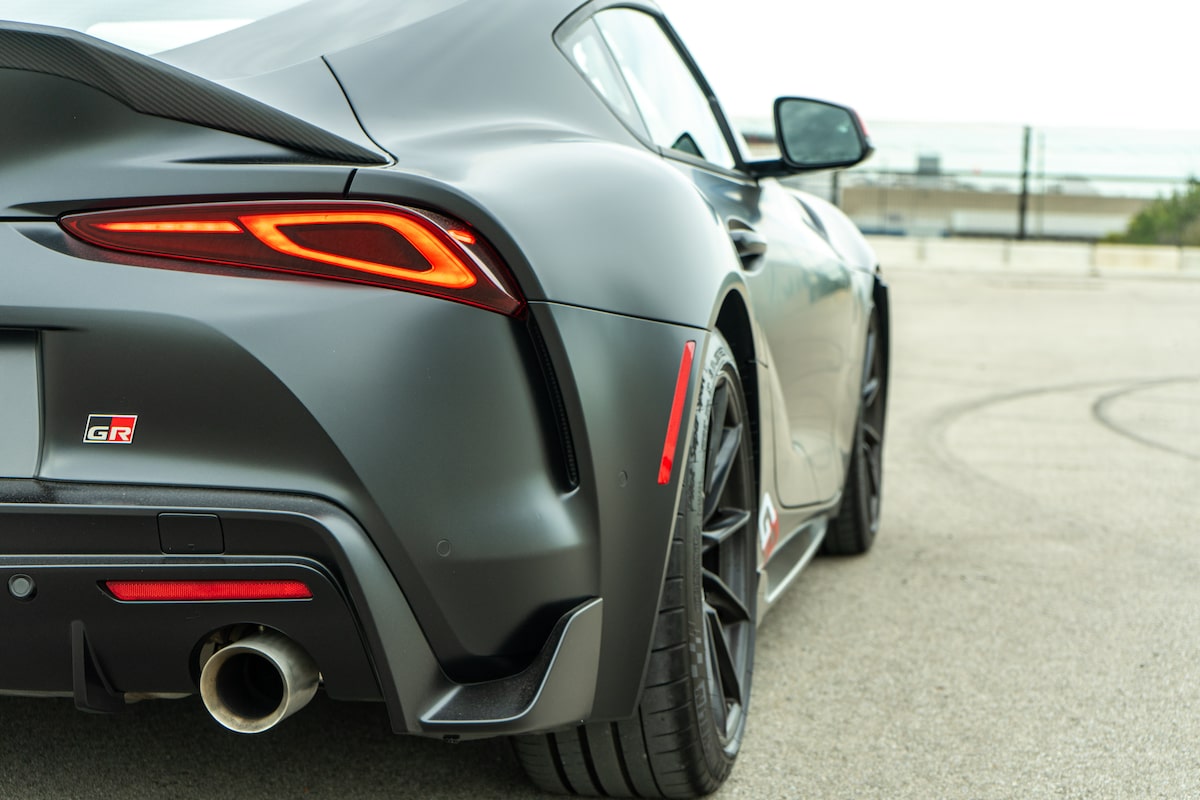
The MkV Final Edition has larger front brakes, revised rear differential control and dampers and stronger underbody bracing.Kunal D’souza/The Globe and Mail
The Lexus LC 500 and relaunched Toyota Supra brought a new wave of enthusiasts to the Japanese automaker in the late 2010s and early 2020s, as the brands worked to reinvent themselves from makers of so-called “boring” cars to ones that prioritized driving enjoyment ahead of maximizing volume and profits.
However, at the end of this year, both will be discontinued, marking the end of the line for two of the best performance cars of the last decade.
The Lexus LC500 enters its final production with this limited-run Inspiration Series.Kunal D’souza/The Globe and Mail
The dash of the LC500 with white and brown leather all around.Kunal D’souza/The Globe and Mail
The LC 500 is a cross between Lexus’s stately luxury sedans and a spaceship, nearly unchanged from the LF-LC concept shown at the Detroit auto show in 2012. It’s a car that looks like it costs a million dollars, but retailed for a 10th of that.
Even eight years on, it hasn’t aged a day and its ability to turn heads remains unchanged. Under the hood sits a sonorous five-litre, naturally aspirated V8 that sends 471 horsepower to the rear wheels, complementing an exquisite interior that looks and feels like it was tailored by the finest artisans in the industry.
Instead of pounding rough pavement into oblivion, the LC is engineered to gently waft occupants to their destination. The V8 engine, noted for its complex and glorious acoustic range, burbles quietly during a cruise but barks to life the second you start to get more friendly with the throttle.
The LC 500 is a cross between Lexus’s stately luxury sedans and a spaceship.Kunal D’souza/The Globe and Mail
The LC 500 is a cross between Lexus’s stately luxury sedans and a spaceship.Kunal D’souza/The Globe and Mail
In the sportiest setting, the suspension and steering firm up just enough to give you the confidence to flow through a twisty back road, but the LC 500 never forgets its main mission of delivering a luxury experience. There’s a wonderful duality here that’s only enhanced with the convertible version, as the V8 becomes more audible with the roof down and takes centre stage.
The final Inspiration Series is limited to just 550 units for North America. The convertible, which I recently drove for a few days, featured a spectacular white and brown leather interior and sat on gorgeous 21-inch forged wheels. The Mark Levinson sound system was designed to perform beautifully even with the roof down, leading to one of the best open-air experiences I’ve had in a car.
Flagship grand tourers like this Lexus are rare now, with BMW also discontinuing its 8 Series this year, leaving just the Mercedes-Benz SL. There are other options if you’re willing to climb the price ladder, but at about $120,000, the usual suspect for a sports car is the BMW M4 – or the Porsche 911 if the budget can stretch a bit further. But those cars were honed on the Nürburgring and have rock-hard suspensions designed to liquefy your spine if the road is anything less than billiard-smooth.
In 2025, Toyota sold 427 Supras compared to more than 75,000 RAV4s.Kunal D’souza/The Globe and Mail
The Supra has exaggerated curves, an extra-long hood and stubby rear deck topped with a duckbill spoiler.Kunal D’souza/The Globe and Mail
Sports cars for less than $100,000 are even scarcer, especially two-seaters like the Supra, which gained a cult-like status after it was discontinued in 2002. If it weren’t for a partnership with BMW, the current generation might never have seen the light of day.
BMW builds it on the same production line as the BMW Z4 convertible in Graz, Austria, using the same platform, engine and transmission, with the biggest difference being that the Z4 is a convertible. The Z4 is also officially dead after this model year, with no confirmed plans for a replacement.
You’d never be able to tell they were the same car either, given the Supra’s exaggerated curves, extra-long hood and stubby rear deck topped with a duckbill spoiler, compared with the Z4’s cleaner, more understated design. The matte-black paint of the MkV Final Edition Supra gives off the same vibe I got from Tim Burton’s Batmobile.
It feels nothing like the Z4 either, with sharper steering, a louder, more aggressive exhaust note and suspension tuning that gives it an edgier, more agile driving feel. The MkV Final Edition – limited to just 25 cars across Canada – retains the signature 382-horsepower three-litre inline-six but introduces larger front brakes, revised rear differential control and dampers, and stronger underbody bracing.
The Supra can be equipped with a six-speed manual transmission.Kunal D’souza/The Globe and Mail
The MkV Final Edition is limited to just 25 cars across Canada.Kunal D’souza/The Globe and Mail
The Supra is incredibly fun to drive and can be equipped with a six-speed manual transmission. And, just like the last generation, the tuning crowd has found massive potential in modifying them.
Sporty cars like the LC 500 and Supra represent a tiny fraction of the market but make large contributions to brand image. Even the Sienna minivan – arguably Toyota’s least sporty vehicle – adopted the Supra’s bulging rear fenders, taillights and wide stance to forge its own signature appearance.
Sports cars are risky business for automakers. Though they are expensive to engineer and sell in low volumes, they are vital for attracting new buyers to the brand. Ford axed its cars in North America, opting to sell only trucks and SUVs – save for the Mustang, which is the best-selling sports car globally. Ford even leveraged the iconic Mustang nameplate for its first mass-market electric vehicle, the Mustang Mach-E.
In 2025, Toyota sold 427 Supras and even fewer LC 500s in Canada, versus 25,000 Corollas and more than 75,000 RAV4s – the real moneymakers for the company. But the Supra has quickly become a social media legend, and Toyota has confirmed it’s going to make a new one, this time without BMW.
No such successor is planned for the LC 500, a holdout from a bygone era when big personal luxury coupes were more common. At its price point in today’s world, it makes little sense. But it proved that Toyota could build cars with soul rather than just boring, sensible appliances.
Racing-style seats on the Final Edition.Kunal D’souza/The Globe and Mail