
Penn made a racket over the weekend.
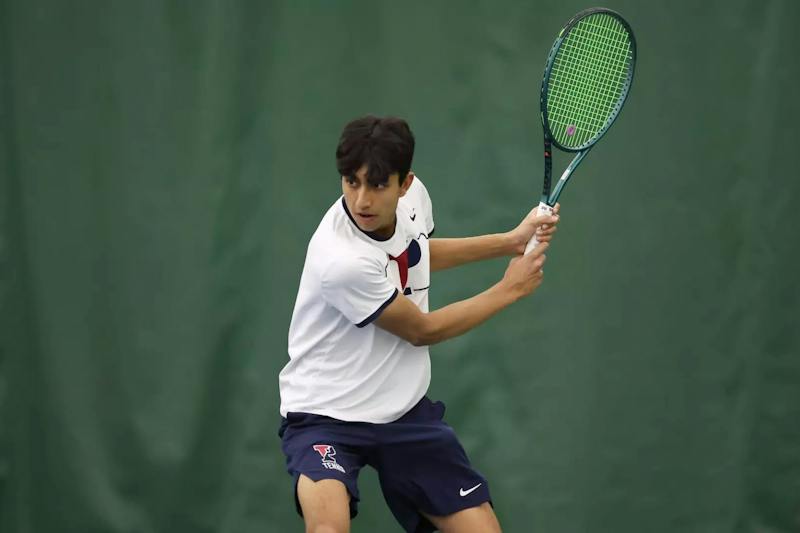
Penn men’s tennis traveled to Princeton for the Intercollegiate Tennis Association Ivy Masters tournament this past weekend, with No. 3 tournament seed junior Shaurya Bharadwaj advancing to the championship match for the second year in a row before falling short. The women’s team took a trip up to Columbia for the ITA Ivy League Invitational. Freshman pair Emma Tomova and Peien Deng also made it to the finals before losing to the No. 1 tournament seed from Dartmouth.
Here’s how the teams fared in the two tournaments.
Ivy League Masters
Four Quakers qualified for the Ivy League Masters, with Bharadwaj setting the tone. After falling short against then-No. 1 ITA-ranked Michael Zheng in last year’s finals, Bharadwaj was determined to clinch the Ivy Masters title.
Get the DP delivered straight to your inbox.
The Charlotte, N.C., native got off to a strong start, winning in straight sets against Columbia’s Junhee You. Bharadwaj faced more of a challenge in the round of 16, where he split the first two sets against Felipe Pinzon of Cornell. The Quaker pulled through in the third set to reach the quarterfinals, where he beat Dartmouth’s Denny Bao in straight sets, 6-3, 6-4.
Bharadwaj would take on his toughest competition yet — No. 1 tournament seed and No. 92 ITA-ranked Simeon Stankovic of Princeton — in the semifinals. Facing an uphill battle against a seasoned opponent with a home court advantage, Bharadwaj fought to win a close first set, 7-6 (7-4). He kept the momentum going, with a convincing 6-1 victory in the second set to reach the championship.
In the championship final, Bharadwaj met No. 2 tournament seed Rethin Pranav Senthil Kumar of Cornell, who hadn’t dropped a set all tournament. Despite the momentum of taking down a ranked opponent in the previous match, securing the Ivy Masters title and a berth to the ITA Masters tournament proved too tall a task for Bharadwaj, who fell short, 6-2, 6-1, in straight sets.
As for the rest of the Quaker men, No. 5 tournament seed junior Zaid Al Mashni won his first two matches in straight sets. Al Mashni would put up a strong effort in the quarterfinal, but he was ultimately defeated by Stankovic. On the other side of the bracket, sophomore Vojtech Vales and junior Callum Markowitz’s tournaments ended in two-set defeats to the eventual champion in the quarterfinals and semifinals, respectively.
In doubles, the same four Quakers paired up, with No. 2 tournament seed Bharadwaj and Vales being bumped to the No. 1 seed, earning a bye in the first round. This added rest proved to be the difference in the next round, as they narrowly beat Dartmouth 8-7 (8-6) in the quarterfinals to advance to the semifinals. However, the Quaker pair fell in the match’s tiebreak, 8-5, to eventual champions Stankovic and Aleksandar Mitric of Princeton.
Markowitz and Mashni received the No. 4 tournament seed, and their opening match went the distance with a close 8-7 (14-12) victory. They made just a run to the semifinals, and with all four seeded teams still in play, the Penn duo lost 8-3 to the No. 2 tournament seed from Harvard.
Ivy League Invitational
Penn women’s tennis had just as much success in the Ivy League Invitational, with junior Lara Stojanovski making the farthest run of any Quaker in the singles. She breezed through her first opponent in straight sets, then beat sixth seed Ziye Liu of Yale in a nail-biter. It looked like Stojanovski was on her way out when she dropped the first set, 6-2, but she rebounded in the next set and won the tiebreak to move on to the quarterfinals.
Coach Sanela Kunovac praised her player’s poise, despite the difficult match.
“She’s getting to know more about the capabilities in her game,” Kunovac said. “She had calmness in this tournament that I feel comes with maturity, and it was really nice to see that even in moments when it was difficult, she had this calmness about her.”
In the quarterfinals, however, Stojanovski couldn’t get rolling, losing to No. 4 tournament seed Gayathri Krishnan of Columbia. Sophomore Joleen Saw, the only seeded player out of her teammates, made it to the round of 16 before losing, 6-4, 7-5.
The doubles tournament is where the Quakers made the most noise, as freshmen Emma Tomova and Peien Deng found themselves in the championship after an incredible showing in the Big Apple.
“I think if you ask them what’s special about them, they’ll say energy,” Kunovac said. “They have this thing that they really like playing with each other. I think what makes them special is that they’re both very good competitors. They like to be on the court.”
This energy was on full display from the start as they were able to get through two tough matches against pairs from Princeton and Harvard, 8-6 and 8-5, respectively. In the semifinals, they faced Yale’s Erin Han and Angela Chen, with the Quakers winning two close sets, 6-4, 7-5, on route to the championship match.
Their opponents in the final, Michela Moore and Peyton Capuano of Dartmouth, were on the opposite end of their collegiate careers, competing in their final Ivy Invitational as seniors. Although there was a seeding difference, both teams had looked equally dominant throughout the tournament.
Still, Tomova knew it would be a tough task.
“What made them difficult opponents was the experience they’ve had over the past three years playing together, which is important for a doubles pair,” Tomova said.
Despite the difference in age, it looked like Tomova and Deng could pull off the upset despite narrowly losing the first set, 7-6 (7-5). However, the experience of the Dartmouth duo proved too much, as the Quakers went on to lose the next set, 6-1. It was still a great learning moment for the freshman duo that they can take with them to future tournaments.
“I am very proud of how me and Peien competed, and with our connection on the court getting better and better,” Tomova said.
Kunovac echoed that statement.
“When you pair them up together,” Kunovac said. “It’s just like a beautiful catalyst. They’re like a wonderful example of that cliché that people say … the whole is greater than the sum of its parts.”