
A new single-detached home in Metro Vancouver sells for more than four-and-a-half times what it costs to build—a gap more than two-and-a-half times wider than in any other Canadian city, according to a new Fraser study.
The report, by Austin Thompson and Milagros Palacios, compares the average sale prices of newly built single-detached homes with their average building permit values—a proxy for construction costs—across 33 census metropolitan areas (CMAs) from 2018 to 2025.
Vancouver’s average annual gap was 367.4 percent. In 2025 alone, the average new detached home there sold for about $3.15 million, while the average permit value was roughly $608,000.
The next three largest gaps were also in B.C.: Victoria at 138.7 percent, Chilliwack at 128.9 percent, and Abbotsford-Mission at 123 percent. Kingston, Ont., at 104 percent, was the only CMA outside B.C. where new homes typically sold for more than double their construction value.
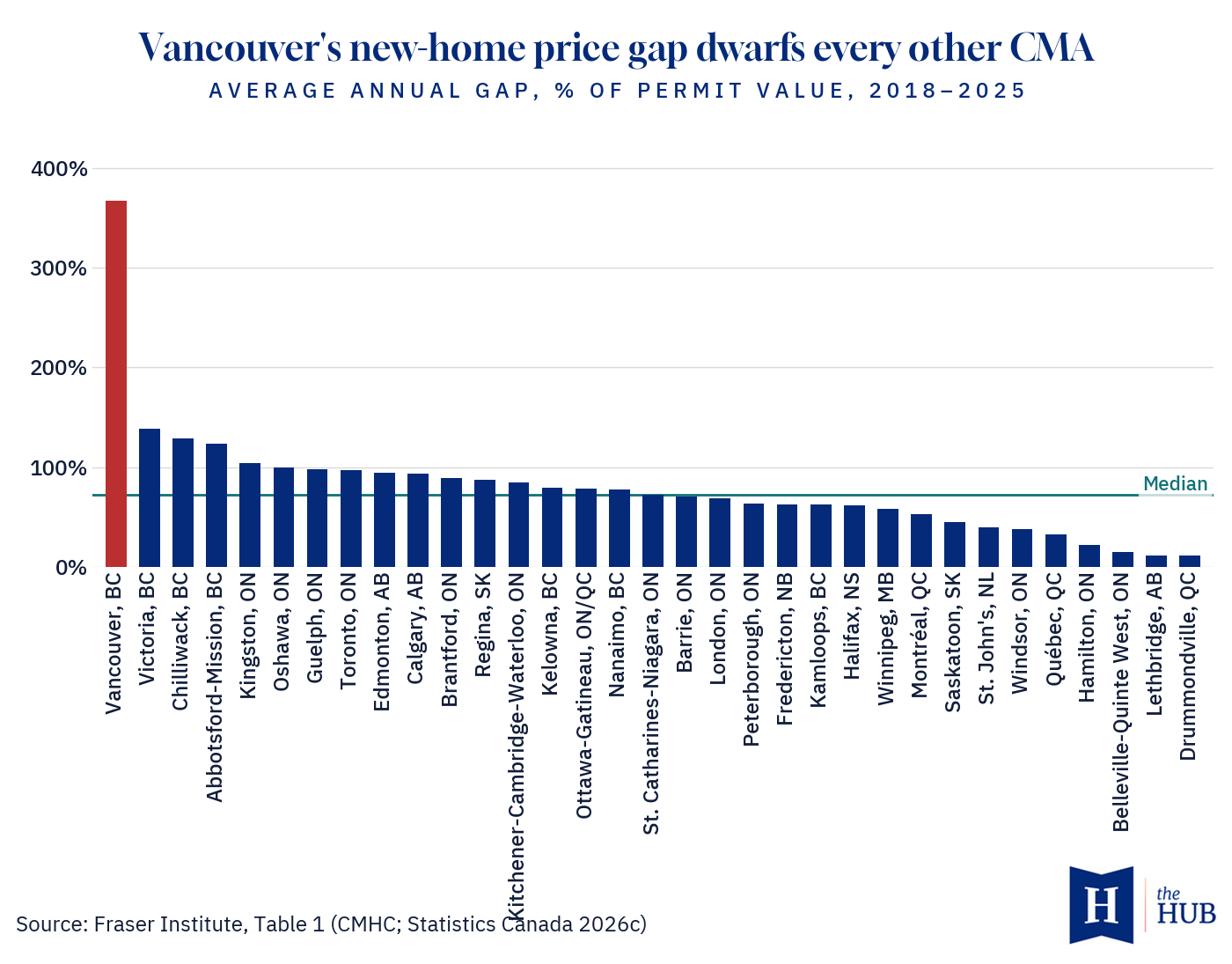
At the other end of the scale, Lethbridge, Alta., and Drummondville, Que., recorded the smallest gaps, both at 11.1 percent. Eight CMAs came in below 50 percent, including Hamilton at 22.3 percent, Quebec City at 32.5 percent, and Saskatoon at 44.4 percent. The median across all 33 was 72.4 percent.
Canada’s other big cities landed in the middle of the pack. Toronto’s average gap was 96.6 percent, Edmonton’s was 94.2 percent, Calgary’s was 93.5 percent, and Ottawa-Gatineau’s was 78.7 percent. Montreal came in at 52.6 percent.
The dollar figures show just how far Vancouver sits apart. Its average permit value over the period, about $617,000 in 2025 dollars, was actually lower than Toronto’s at roughly $826,000. Yet the average sale price of a new detached home in Vancouver was about $2.88 million, compared with $1.58 million in Toronto.
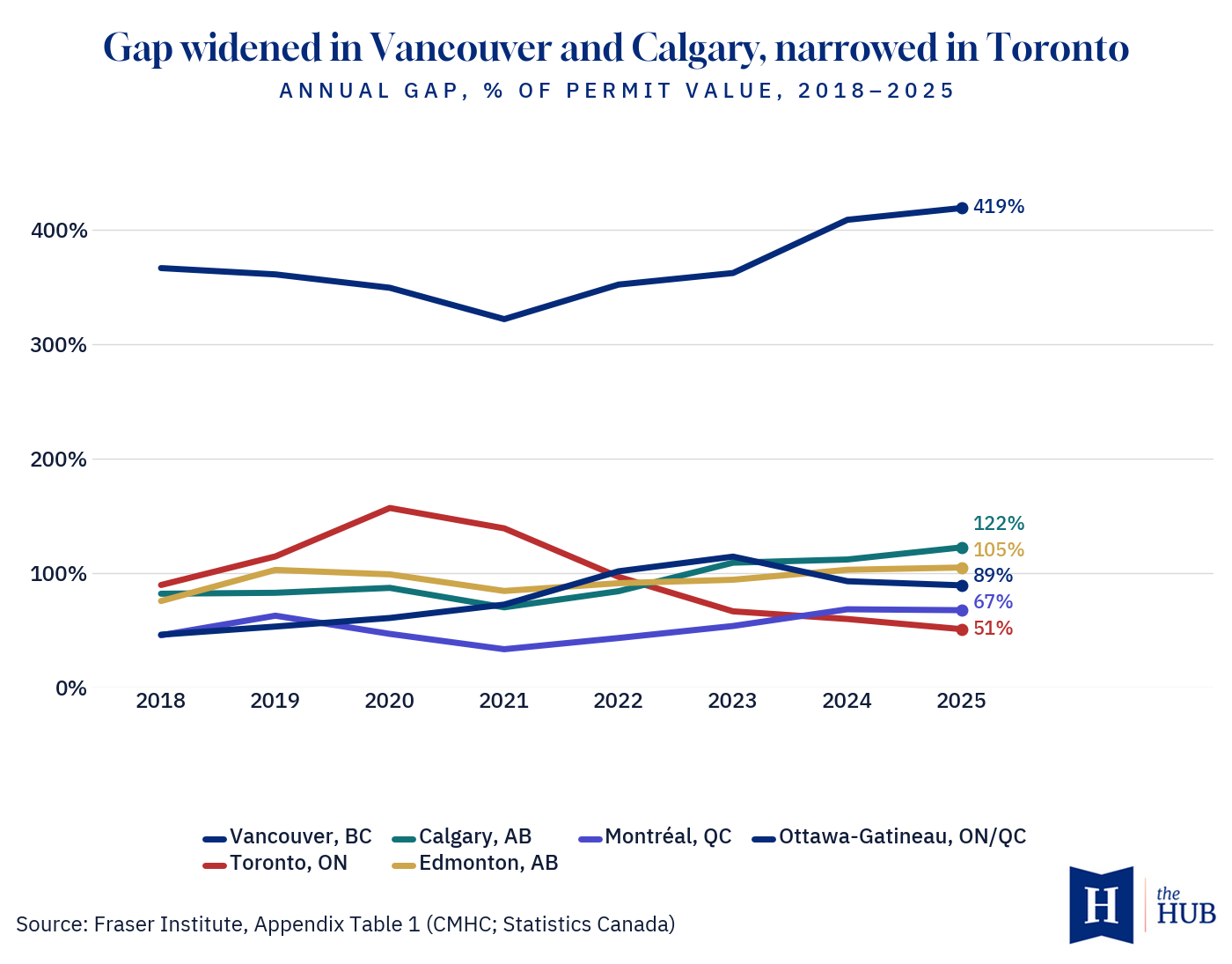
The sale prices come from Canada Mortgage and Housing Corporation’s “absorbed” price series, which reflects what buyers actually paid for a completed home, including land, development charges, and net GST/HST. Permit values, by contrast, are meant to capture only materials, labour, and construction-related overhead.
The trends are also diverging. Vancouver’s gap dipped to 321.7 percent in 2021 before climbing to 408.5 percent in 2024 and 418.8 percent in 2025, its highest level of the study period. Calgary’s gap rose from 81.8 percent in 2018 to 122.3 percent last year.
Toronto moved the other way. After peaking at 156.7 percent in 2020, its gap fell to 50.8 percent in 2025, as permit values climbed and sale prices levelled off.
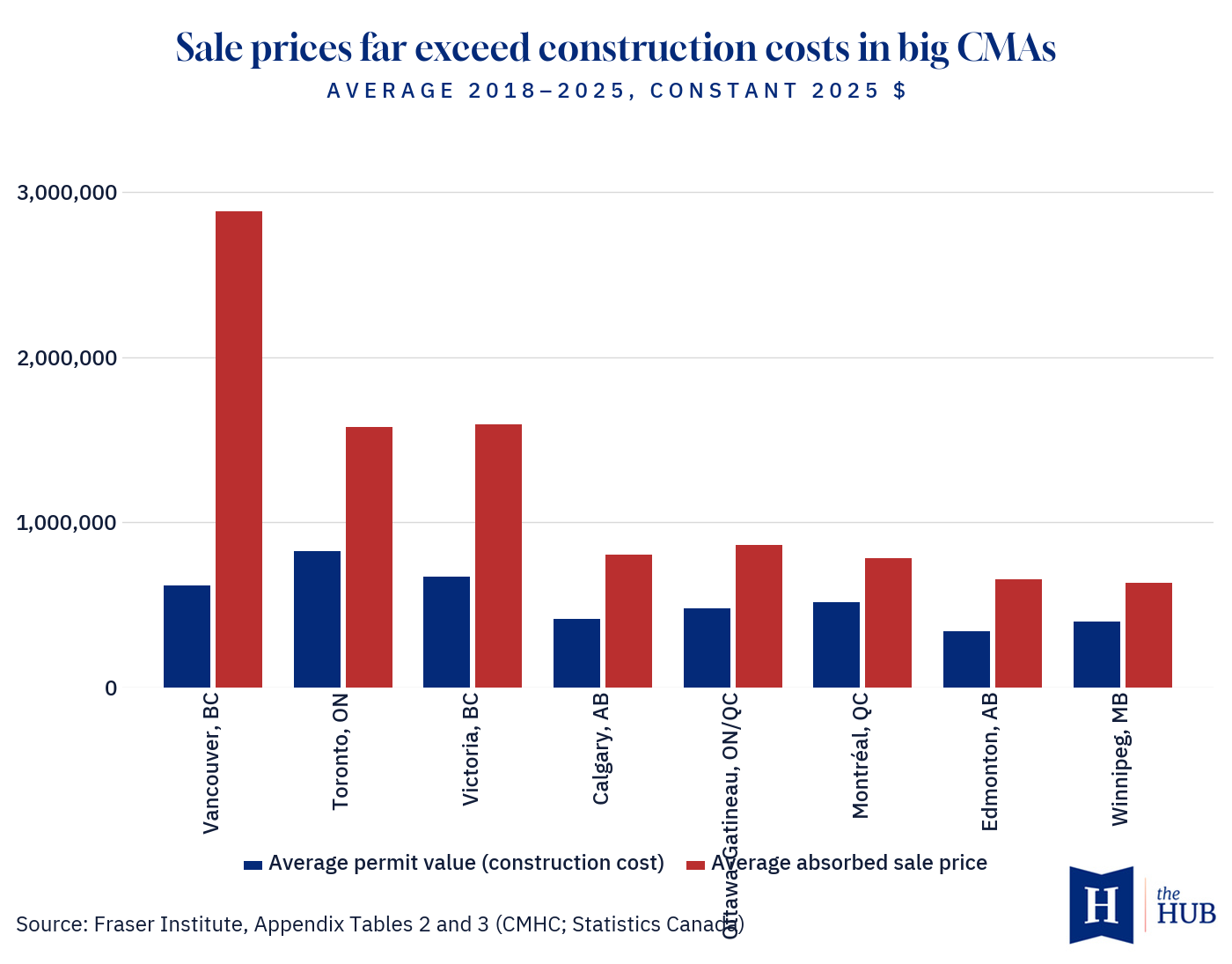
In Vancouver, construction values barely moved over the eight years, slipping from about $661,000 in 2018 to $608,000 in 2025 in constant dollars. Sale prices fell during the pandemic before rising back above $3.1 million.
The authors caution against reading the gap as pure waste. Because it includes land value and normal developer returns, it would not fall to zero even in a competitive, supply-responsive market, and the study does not pin it on any single cause. But large and persistent gaps, they argue, flag markets where barriers to new supply, taxes, and charges, or some combination, are pushing prices well above what it costs to build.
The report points to stark differences in what municipalities add. Citing Altus Group research for the Canadian Home Builders’ Association, it notes per-home development charges of $180,300 for a typical low-rise project in Toronto and $97,400 in Vancouver, compared with $31,600 in Edmonton and $9,900 in Winnipeg. Approval timelines ranged from 25 months in Toronto to 3.4 months in Edmonton.
In high-gap CMAs, the authors conclude, policies on developable land, zoning and building approvals, and taxes and charges on new homes deserve a hard look.
The findings line up with a recent Hub DeepDive on why new housing costs so much in Canada. It found cities have drifted into a system that loads the upfront cost of long-lived infrastructure directly onto the price of new homes, paid by the people who buy them—and noted that CMHC says resale prices rise too, as sellers price off the higher cost of new builds.
Demand has also played a part. The Bank of Canada has acknowledged that the rapid population growth of recent years, driven largely by immigration, boosted demand for housing and added to pressure on house prices and rents, because newcomers add to demand sooner than they add to supply. Ottawa has let in more than 2.5 million newcomers since 2023, including temporary residents.
That pace has since slowed sharply. Statistics Canada reports population growth of just 0.5 percent in the year to July 1, 2026, the slowest since 1915–16. However, Prime Minister Mark Carney has suggested his government may start increasing immigration levels again with the impending revised immigration levels plan set to be released by Nov. 1.
Still, the Fraser authors argue strong demand alone can’t explain persistent gaps. In a responsive market, rising demand should draw in new supply that limits how far prices can run above costs. In Vancouver, where the gap has only widened, that supply response has yet to show up.

Graeme Gordon is The Hub’s Senior Editor and Podcast Producer. He has worked as a journalist contributing to a variety of publications, including CBC,…
Read more
A recent Fraser study reveals that new single-detached homes in Metro Vancouver sell for over four-and-a-half times their construction costs, significantly higher than any other Canadian city. The average sale price in Vancouver reached approximately $3.15 million in 2025, while the average building permit value was around $608,000. Other cities like Toronto, Calgary, and Edmonton also show substantial gaps, but none as extreme as Vancouver’s. The report highlights the impact of development charges, approval timelines, and market dynamics, suggesting that persistent price gaps indicate barriers to new housing supply and rising demand.