
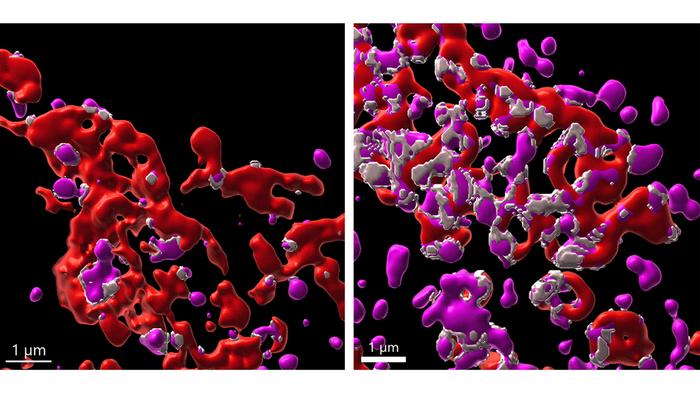
 Perforin increases endosomal-mitochondrial contact sites in tumor cells. Left has no perforin; right is with perforin
Credit University of Michigan Rogel Cancer Center
Research from the University of Michigan Health Rogel Cancer Centre overturns decades of accepted immunological science by showing that perforin, a protein produced by T cells and natural killer (NK) cells, can destroy tumour cells on its own, without requiring digestive enzymes known as granzymes
The study, published in Cell, reveals that perforin alone triggers ferroptosis, an iron-dependent form of programmed cell death, identifying a previously unknown pathway for anti-tumour immunity.
The ferroptosis mechanism and cellular disruption
For decades, textbook immunology posited that perforin merely functioned as a pore-forming delivery tool (“the weapon”) designed to inject granzymes (“the ammunition”) into cancer cells to initiate apoptosis.
The U-M research team, led by Dr Weiping Zou, Dr Ilona Kryczek, and Harvard’s Dr Judy Lieberman, proved that perforin initiates an independent lethal cascade:
Membrane and iron uptake disruption:
In addition to punching holes in the plasma membrane, perforin alters cellular iron regulation, causing an abnormal influx and accumulation of iron inside the host cell and its mitochondria.
Mitochondrial lipid peroxidation:
Excess intra-mitochondrial iron triggers rapid oxidation of lipids (fats), causing catastrophic organelle dysfunction.
Ferroptotic cascade:
The accumulation of toxic lipid peroxides drives the cell into ferroptosis, an iron-dependent form of cell death distinct from traditional apoptosis or pyroptosis.
Experimental validation and clinical observations
The research team established perforin’s independent cytotoxicity across three distinct experimental frameworks:
In vitro genetic manipulations:
Biochemical assays confirmed that tumour cells lacking granzyme activity still underwent rapid cell death when exposed to isolated perforin via ferroptosis.
In vivo animal models:
Mouse models on controlled iron diets showed significant reductions in tumour growth rates directly correlated with T-cell perforin expression.
Human patient cohorts:
Analysis of clinical data revealed that cancer patients with higher perforin levels had better overall survival and significantly stronger responses to immune checkpoint blockade therapies.
Editor’s Recommended Articles