
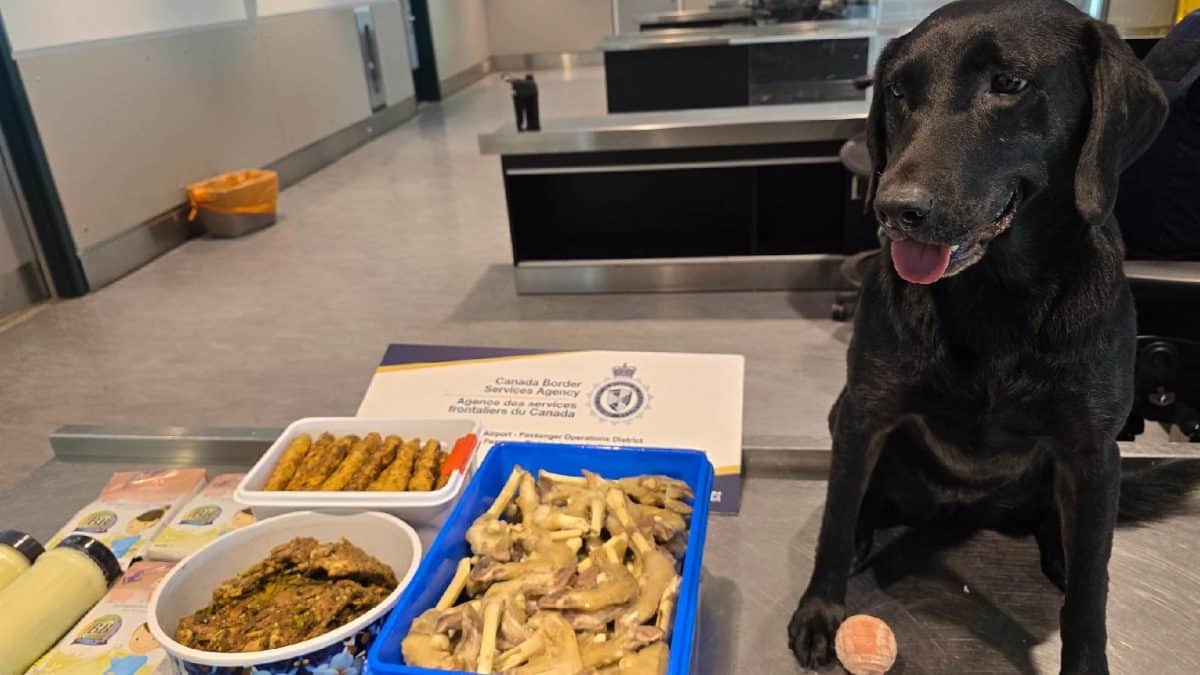
Canada Border Services Agency detector dog Aggie uncovered a large amount of undeclared food items that arrived on a flight from Pakistan recently at Toronto Pearson Airport. (Photo: Canada Border Services Agency X)
Border services officers at Toronto Pearson Airport in Mississauga, including a four-legged customs official, have seized another large shipment of undeclared food items being brought into Canada from abroad.
The Canada Border Services Agency said the latest stash of undeclared food and animal products, which included 16 kilograms of goat feet, chicken, ghee and milk powder, was recently intercepted by CBSA detector dog Aggie.
Agency officials said the undeclared items arrived on a flight at Pearson along with a group of travellers from Pakistan.
The travellers were fined $1,350, the Canada Border Services Agency said.
The incident is the latest seizure of meat, poultry and other food items made at Pearson and publicized by the CBSA in 2026.
The Canadian government reminds travellers they are required by law to declare all food, plant and animal products being brought into the country.
For instance, travellers must declare:
Live animals and animal products such as cooked or raw meats, hides, skins, trophies, milk, fat, butter, cheese, eggs, fish and seafood.
Plant products such as fruits, vegetables, seeds, nuts, trees, houseplants, wood (and wood products such as furniture, carvings, bark), firewood, roots, vines, herbs, flowers, insects, bulbs and soil.
CBSA officials say failure to declare any of these products or to provide required permits/certificates can lead to:
Detention of the products
A penalty up to $1,350
Prosecution
“Inadmissible goods may be confiscated and disposed of, or ordered removed from Canada,” the border services agency said in an online update to travellers. “Travellers may also be held responsible for any costs related to the disposal, quarantine, treatment or removal of these items from Canada.”
The CBSA noted many travellers fail to declare items such as:
Processed or canned foods
Homemade food
Handmade crafts, such as wooden items
Firewood
Cooked or cured meats
Soil
Bait for recreational fishing
Plants used for homeopathic or medicinal purposes
Milk products, such as butter, yogurt, kefir
Fruits and vegetables
“Travellers may not realize the hazards associated with food, plant and animal products. These products may carry invasive species and diseases and may cause risks to Canada’s food supply, economy, environment and our health.”
All in a day’s work for Aggie and other detector dogs
For Aggie, the Black Labrador retriever who sniffed out the undeclared goods that had arrived from Pakistan, it was business as usual at Canada’s biggest and busiest airport.
The border services agency released details back in June about a shipment of 2,100 undeclared Cuban cigars that arrived along with a passenger from the Caribbean.
Aggie quickly detected the cigars inside luggage and the tobacco products were seized by the CBSA.
The incidents are among a number of similar seizures involving detector dogs at Pearson and publicized by the CBSA so far in 2026.
A spokesperson for the federal agency told INSAUGA Canada earlier this year the CBSA “continuously tries to raise awareness regarding the need to declare items when entering Canada.”
All travellers are subject to CBSA examinations and “are required to make accurate and truthful declarations when entering Canada,” the spokesperson said. “Highlighting seizures done by CBSA detector dogs is another effort to raise awareness and remind travellers of this.”
In addition to the Cuban cigars, other goods — some declared, most not — intercepted by the team of well-trained CBSA detector dogs at Pearson this year include sausages, salami and butter in addition to stashes of raw beef, chicken, duck, pigeon and rabbit.
The dogs are also trained to detect “a wide range of contraband such as drugs, guns, money (in addition to) food, plant and animal products,” the CBSA said.
CBSA detector dogs work alongside their handlers at Pearson in addition to other airports across the country. The border services agency said that for security reasons it cannot disclose the number of dogs on duty at any given time at the airports.
The canine law enforcement officers “are trained to detect and sit beside the source of the odour to indicate possible prohibited items to their handler,” the CBSA told INSAUGA Canada earlier.
Previously, according to an online description of the detector dog program, all dogs were trained to scratch, dig, bite and bark at the source of a contraband odour.
“Today, the primary method of training is for dogs to give a subtle signal to their handler when detecting contraband,” the CBSA said.
INSAUGA Canada’s Editorial Standards and Policies
Last 30 Days: 51,941 Votes
All Time: 1,600,307 Votes
1477 VOTES
Are you happy with the election results in your town or city?
Stay in the know.
Subscribe now to receive our daily email of today’s top stories in your city!