

Listen to this article
Estimated 4 minutes
The audio version of this article is generated by AI-based technology. Mispronunciations can occur. We are working with our partners to continually review and improve the results.
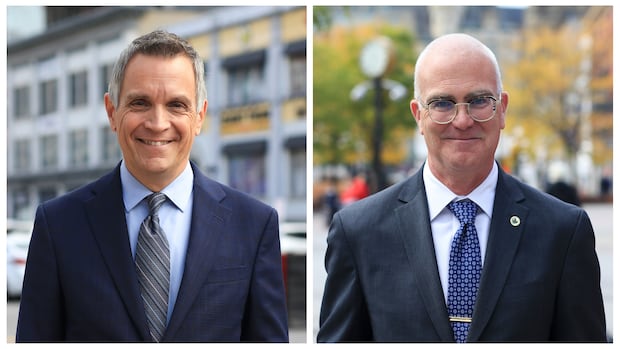
Just three days before election day on Monday, mayoral challenger Jeff Leiper acknowledged a simple truth about Ottawa city politics.
“We know that we can’t win this election if it is entirely centred on the downtown,” he said. “We have to win right across the city”
But Leiper didn’t win right across the city. Incumbent Mark Sutcliffe won 20 wards.
Detailed results from Monday’s city election show a repeat of a split that’s defined recent mayoral races in Ottawa: The winner carries the suburbs and rural areas, while the runner-up does better in the centre.
Leiper won only the central wards of Somerset, Kitchissippi, Rideau-Vanier and Capital, where he ran up large margins.
Sutcliffe led everywhere else, but posted his strongest results outside the Greenbelt. In the outer suburbs of Barrhaven, Stittsville, Kanata, Riverside South and Orléans, his margins ranged from 15 to 28 percentage points. In three rural wards, he led by around 40 points.
Leiper was stronger inside the Greenbelt. He trailed Sutcliffe by less than one percentage point in Bay and River wards, and wasn’t far off in Rideau-Rockcliffe.
The inner suburban wards of Knoxdale-Merivale, College, Alta Vista, Beacon-Hill Cyrville and Gloucester-Southgate were also comparatively close battlegrounds between the two front-runners, with the gap under 15 points.
The data was posted with official election results on Friday. The ward-by-ward results do not include mail-in or special advance ballots, but do include advance ballots cast on Oct. 16.
Pattern continues trend from 2022
Citywide, the official results show that Sutcliffe won 44.7 per cent of the vote to Leiper’s 33.9 per cent, a lead of just under 11 points.
But only 36 per cent of eligible voters actually cast a ballot, the lowest turnout in more than two decades.
This year’s gap was a bit closer than the 13.5-point margin in 2022, when Sutcliffe took 51.4 per cent to Catherine McKenney’s 37.9 per cent.
That race showed a similar geographic breakdown, with McKenney performing strongly in the same downtown and central wards as Leiper, while Sutcliffe ran away with the outer suburbs and rural areas.
It’s a familiar pattern. Though Jim Watson won every ward in 2018, his rival Clive Doucet performed best in the same places as McKenney and Leiper. Just like them, Doucet had represented a central ward on council.
Erin Tolley, a political scientist at Carleton University and researcher with the Canadian Municipal Barometer, called that pattern a “cautionary tale” for future candidates.
“If voters perceive you as a ‘downtown’ candidate, recent elections suggest you face an uphill battle,” she said.
Tolley said amalgamation shifted the electoral map in 2001. When suburbs and rural townships fused with the central city, she said it put those farther from the city centre in the majority.
“In this context, the mayoral candidates who do best will be the ones who campaign on issues that are popular with suburban voters,” she said.
“So amalgamation really shifted the electoral landscape in favour of mayoral candidates who appeal to voters living outside the city’s centre.”
Saravanamuttoo and Lawson strongholds
But the 2026 election had the added complication of not two but four candidates who posted relatively strong results. Economist Neil Saravanamuttoo garnered 11 per cent of the vote while homebuilder Alex Lawson got 7.6 per cent.
While neither led or placed second in any ward, both had their own areas of strength.
Lawson was strongest in the west and in rural Ottawa, especially the rural ward of West Carleton-March that includes his home community of Dunrobin.
Saravanamuttoo’s strongest wards were more scattered. He posted his best result in Capital Ward, which includes his own neighbourhood of the Glebe and the Lansdowne 2.0 project he crusaded against, but he was also strong in south-end suburban wards outside the Greenbelt.
The disappointing turnout in Monday’s election was already apparent from unofficial results. It didn’t follow the same geographic patterns.
Some central wards, such as Kitchissippi, posted comparatively high turnout numbers, while Rideau-Vanier again came in near the back of the pack.
The suburbs also had a mix, with Gloucester-Southgate showing the lowest turnout in the city.
But no ward cracked 50 per cent. The overall turnout this time around was the lowest for any Ottawa city election in 23 years.