
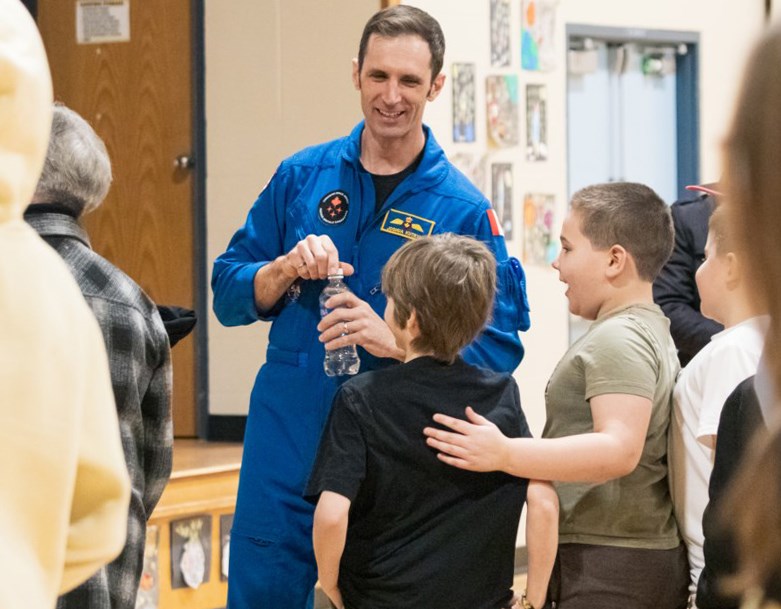
Students in Elk Point are preparing their questions for an 11-minute conversation with Canadian astronaut Joshua Kutryk aboard the International Space Station.
LAKELAND – How do astronauts go to the bathroom in space? What time zone does an astronaut use when they decide to go to sleep?
Those are just some of the questions students in Elk Point have been developing as they prepare to speak with Canadian astronaut Joshua Kutryk aboard the International Space Station (ISS) sometime in mid-December.
Elk Point Elementary School and F.G. Miller Junior/Senior High School have been organizing the event, which is going to be a live conversation with Kutryk, which is expected to last about 11 minutes, with students gathering in the F.G. Miller gym for the occasion.
“It’s really exciting for our whole community, not just to talk to any astronaut, but one that is really connected to our area here,” said Elk Point Elementary principal Garth Finlay. In his youth, Kutryk spent some time in Elk Point, and even attended Elk Point Elementary.
Finlay said contact is tentatively planned between Dec. 14 to 18, although the exact date and time will be confirmed closer to the event.
In the meantime, the students’ questions are already giving teachers opportunities to explore the vastness of space in the classroom. “The thing that’s most exciting is how excited the kids are,” and how curious they are, Finlay said.
Science beyond the classroom

Elk Point Elementary School student Jaxson Bateman in front of the elementary school’s Crew 13 exhibit during its STEAM Day on Oct. 20. File provided
At F.G. Miller, students are developing their questions for Kutryk in science classes, said F.G. Miller Principal Colin Bjorkman. Their submissions will be compiled with those from the elementary school.
When Bjorkman had been looking through some of the submissions, one student’s question caught his attention.
“How do you know when you should go to sleep?” he said. “That’s interesting . . . and there’s all sorts of interesting questions that kids have come up with.”
Beyond developing questions, students have also sparked stronger interest in science as a whole, he added. Older students are studying the physics involved in keeping someone in orbit, for example.
“They talk about circular motion, they calculate orbits, and those kind of things,” Bjorkman said. “They talk about energy and
momentum . . . about gravity.” And to be able to speak with someone orbiting Earth gives them a practical connection to calculations they would otherwise be working through in a textbook.
Finlay agreed. At the elementary school, some of the things students have been doing include comparing the growth of tomato seeds that have been in space to seeds that have remained on Earth.
“How do seeds in space grow differently than seeds that have never been off of our planet? . . . It’s opening up other opportunities,” for scientific conversation and exploration, “just because of how excited we are about it,” Finlay said.
Someone who went to their school
The opportunity to connect to Kutryk is also particularly special given the astronaut’s connection to the area. “Just because you’re from Elk Point, it doesn’t mean you’re limited in any way at all,” said Finlay.
Kutryk’s story inspires students to consider careers they might not otherwise picture themselves pursuing, including working as astronauts, engineers or technicians.
“Honestly, I don’t think most students would think that they could have a career as an astronaut or anything related to that, whether it’s the technical part like being technicians, [or] engineers,” said Bjorkman. “That’s just not something that kids in small rural Alberta town think about.”
“And yet, here we’ve got a guy that they’re going to be able to talk to who went to school at Elk Point Elementary for a few years, [which] just goes to show that a little kid from a small town in Alberta can do amazing things.”
Radio
Local amateur radio operator Craig Hellquist shares a similar hope, as he helps arrange the contact to the schools through the Amateur Radio on the International Space Station (ARISS), which connects students with astronauts aboard the International Space Station (ISS).
Hellquist, who also grew up in Elk Point, said Kutryk’s connection to the elementary school was one reason he and another local operator, Murray Boratynec, wanted to help arrange the contact. They hope that Kutryk will help inspire the kids.
They also want to encourage students’ further curiosity about science and show students that scientific pursuit is always possible.
“It’s all about the kids. It’s a once in a lifetime thing for kids to be able to communicate directly to an astronaut,” while they are aboard the ISS, said Hellquist.
How does contact work?
Asked how ISS to Earth contact will be conducted, Hellquist said communication will use a telebridge system.
During contact, there will be an amateur radio ground station that will have a direct link with the ISS. And depending on the ISS’ position above Earth, the ground radio ground station could be located anywhere on the planet, relaying its communication to Elk Point via the internet.
Hellquist and Boratynec will then provide background support during contact. Because the ISS is moving at such a high speed, students have a limited time available to speak with Kutryk. Hellquist estimates that students will have roughly 11 minutes of communication.
The schools hope to livestream the conversation for parents, community members and other schools. Those arrangements are still being developed, with details to be shared closer to the date.
A memory to look back on
Bjorkman hopes the conversation becomes one of the experiences students remember when they look back on their school years. Everyone always remembers something fond of when they were in school, like a trip they went on to.
“Hopefully this will be something that these kids can look back on,” he said. Perhaps in the future, “They’re going to be able to tell their kids, ‘Hey, when I was in school, we got to talk to an astronaut on the International Space Station. Isn’t that cool’?”