

Listen to this article
Estimated 5 minutes
The audio version of this article is generated by AI-based technology. Mispronunciations can occur. We are working with our partners to continually review and improve the results.
The City of Edmonton says its snow and ice control operations will pay closer attention to accessibility this winter, particularly when it comes to minimizing barriers for people with mobility challenges.
In a news release this week, the city said accessibility is now a “core pillar” of its snow and ice removal strategy. That approach was detailed in a news conference held by city officials at the Southwest District Yard on Friday.
“We updated the city’s snow and ice control policy to add accessibility as a fourth and equal outcome of our service, alongside safety, reliability and connectivity,” Cheryl Fereday, the city’s director of mobility infrastructure services, told reporters.
“Elevating accessibility formalizes our commitment to inclusive mobility across all travel modes. This helps our active pathways team to work towards accessible winter walking, cycling and public transit where it’s needed most.”
Valerie Dacyk, the city’s general supervisor of mobility infrastructure operations, said while service levels will remain the same, improving accessibility will require a targeted approach.
“As with all of our active pathways, we are ensuring that pedestrian, routing and transportation in those affected neighbourhoods are done to a safe and cleared level.”
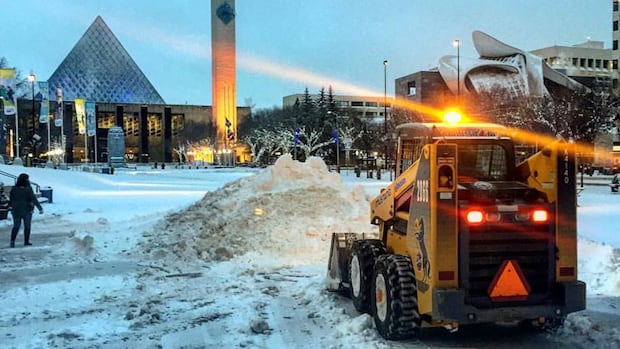
In response to this week’s early snowfall, snow-removal crews proactively adjusted their schedules ahead of their standard operational timeline, city officials said.
Crews have been working a 24-hour schedule since Tuesday afternoon and will transition to standard winter shift rotations this weekend, officials said.
Other changes the city is making to its snow and ice removal plans this winter are:
Fleet optimization.Multilingual messaging to inform residents about operations.Increased communication with community leagues, school boards and business improvement areas to reach more groups affected by operations.
The city said while service levels remain unchanged from last year, scheduling adjustments and fleet optimization will improve service and reduce the length of time that equipment may be out of service.
The city will continue clearing areas in Edmonton according to its existing protocols for prioritization.
Priorities are determined by a variety of factors, including safety, traffic speed and traffic volume.
The city’s road-clearing priorities are:
Priority 1 – Essential roads like main freeways, major arterial roadways and main business districts. The city says these spaces are to be cleared to bare pavement within one day after a snow event ends. Priority 2 – Secondary arterial roads, collector roads, transit routes, and Park and Ride access roads. The city says these spaces are to be cleared within five days after a snow event ends. Priority 3 – Industrial routes and rural roads. The city says these spaces are to be “addressed” within six days after a snow event ends. Priority 4 – Local and residential roads. The city says these streets “are targeted to be cleared within 14 days” once a residential — or Phase 2 — parking ban has been activated. The city notes that “residential parking bans are declared as needed, based on snow accumulation. They do not occur after every snow event.”
The prioritization protocols for active pathways are:
Priority 1 – Core facility pathways, transit centres, LRT stations, wheelchair ramps and the Winter Priority Bike Loop. The city says these spaces are “targeted to be completed” within one day after a snow event ends. Priority 2 – City-maintained sidewalks, shared-use pathways, parking lots and bridge decks. The city says these spaces are “targeted to be completed” within three days after a snow event ends. Priority 3 – Manually cleared areas such as neighbourhood breezeways, public benches and fire hydrants. The city says these spaces are “targeted to be completed” within 14 days after a snow event ends. Priority 4 – Community sandboxes and safe mobility devices. The city says these spaces are “addressed as resources allow.”Parking bans
The city said not every snowfall will lead to a parking ban and reminded Edmontonians that they are put in place in two distinct phases.
Phase 1 applies to major routes and transit corridors while Phase 2 applies to residential and industrial roads.
Phase 1 bans are active 24 hours a day and usually last four or five days, while city officials note Phase 2 bans are “only active in any single neighbourhood for approximately 72 hours, depending on conditions.”
“Municipal enforcement officers will be on-site as city crews work to remove the snow,” said Keith Scott, deputy chief with the city’s community standards team. “Vehicles must be removed for the duration of the ban in the area, not only when clearing crews have made the first pass.
“Crews sometimes need to return to do additional work. If you fail to move your vehicle during a parking ban, you could receive a $250 ticket from the city.”