
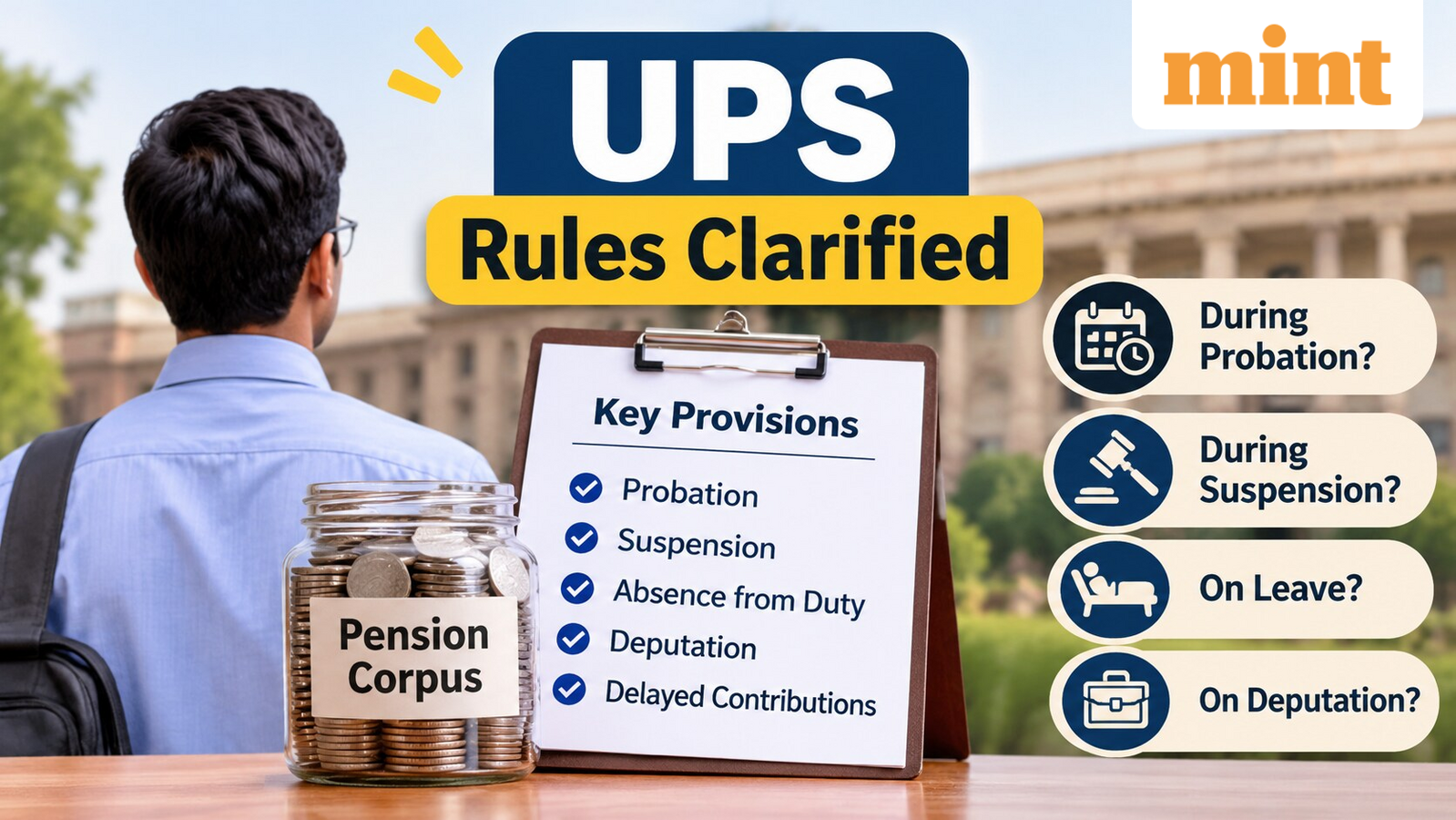
The pension contributions and benefits of central government employees enrolled in the Unified Pension Scheme (UPS) are governed by specific rules depending on their service conditions, including probation, suspension, absence from duty, and deputation.
The Department of Pension and Pensioners’ Welfare (DoPPW) under the Ministry of Personnel, Public Grievances and Pensions, through multiple office memorandums dated 27 October 2026, has explained how these provisions will apply under the Central Civil Services (Implementation of Unified Pension Scheme under the National Pension System) Rules, 2025.
The clarifications explain when central government civil employees and the government must contribute to the pension corpus, how delayed contributions will be addressed, and who will authorise retirement benefits for employees retiring on deputation.
Do UPS contributions continue during probation?
Yes. Employees joining government service under UPS must contribute from the probation period itself. They cannot wait until confirmation of their services to start making payments.
The DoPPW memorandum states, “Rule 6 (6) provides that the subscriber shall contribute to the Unified Pension Scheme during the period of probation.”
The department has directed ministries and departments to ensure that personnel handling UPS and NPS matters implement this provision strictly.
Also Read | 5 key money changes from 1 November: Life certificate, ITR, GST, bank chargesCan employees stop contributions during suspension?
Yes. An employee can choose whether to contribute to UPS while under suspension. The government’s contribution will also depend on this decision.
The memorandum states: “Contribution may be made by the subscriber, at his option, during the period of suspension.”
If the employee continues contributing, the government will contribute based on the subsistence allowance paid during suspension. However, if the employee opts out, the government will not contribute either.
If the suspension period is subsequently treated as duty or leave carrying leave salary, contributions will be recalculated based on the emoluments payable. The difference will be credited to the employee’s individual pension corpus.
What happens to contributions during absence without pay?
Employees who remain absent from duty without being entitled to pay or leave salary will not have to make UPS contributions for that period. The government will also not contribute to their pension corpus.
The memorandum clarifies, “No contribution shall be made by the subscriber during the period of absence from duty (whether on leave or otherwise) for which no pay or leave salary is payable.”
This provision applies under Rules 6(3) and 7(2) of the 2025 rules.
Will employees get compensation for delayed UPS contributions?
Yes. If contributions are delayed for reasons not attributable to the employee, the corresponding investment units must be restored to their individual pension corpus.
This provision covers delays in starting monthly contributions due to late UPS enrolment, deducting employees’ contributions from their salaries, or crediting employee and government contributions to the subscriber’s individual pension corpus beyond the prescribed timelines.
The memorandum states: “The units which would have been credited in the absence of such delay are duly restored to the subscriber’s account.”
The units will be calculated using the net asset value (NAV) of the default investment pattern on the last working day of the month in which the contributions are adjusted.
Also Read | PFRDA launches UPS Jeewan Setu Digital Life Certificate facility for pensionersHow will UPS benefits be processed if an employee retires on deputation?
Deputation is when a government employee is temporarily assigned to work in another government department, organisation or institution while retaining their parent cadre or department.
The memorandum states: “In the case of a subscriber who retires while on deputation to another Central Government department, action to authorise benefits shall be taken by the Head of Office of the borrowing department.”
Under Rule 27, if an employee retires while on deputation to another Central Government department, the borrowing department (the department where the employee is temporarily posted) will have its head of office authorise their UPS benefits.
For deputation to a State government or foreign service, this responsibility will rest with the head of office or cadre authority that sanctioned the deputation.
Disclaimer: This is for informational purposes only. Please visit the official DoPPW website for the latest updates.