
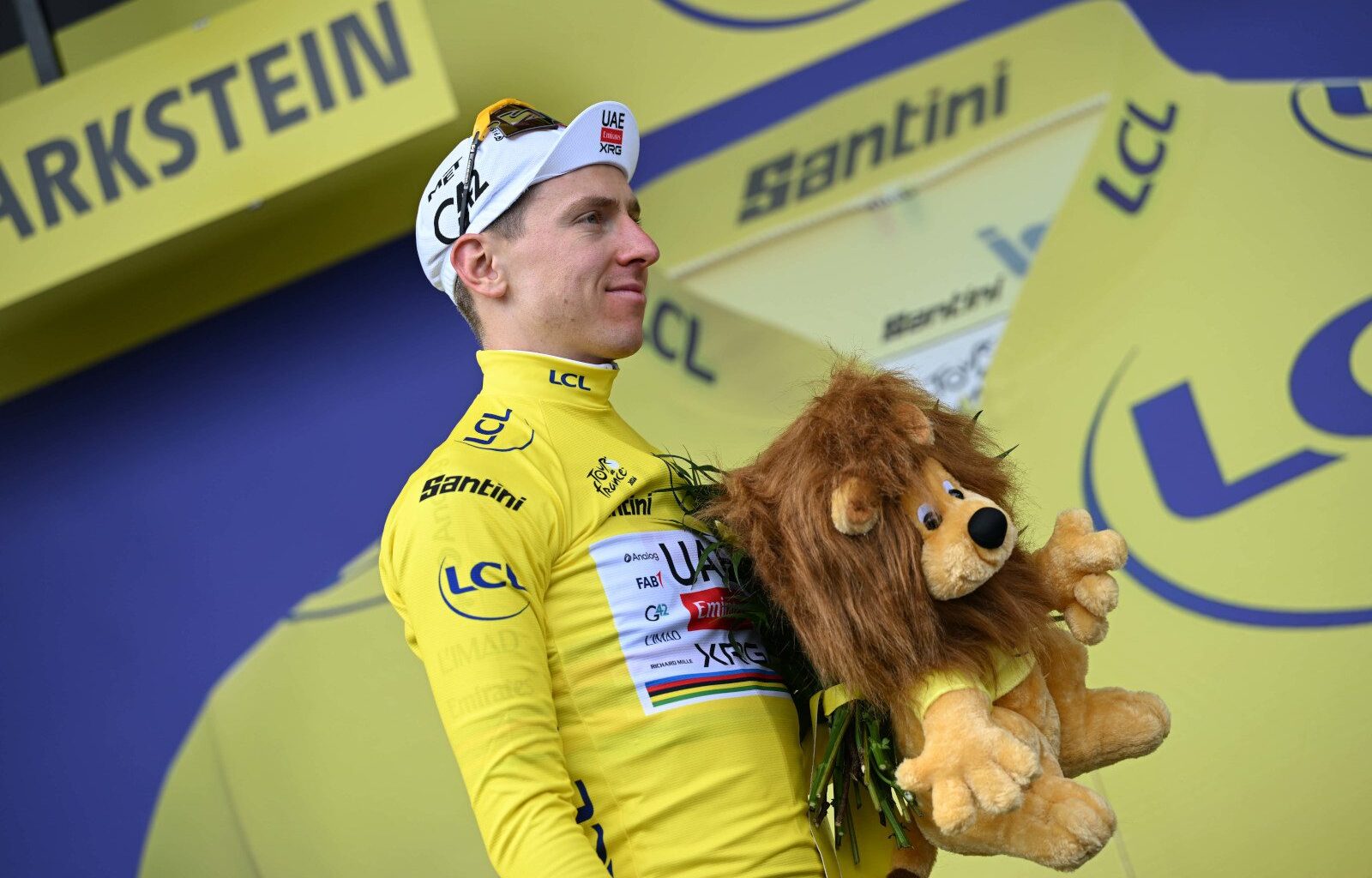
Can you really Pogačar-proof a bike race? It’s a question worth asking when you’re designing a Tour de France route in an era when Tadej Pogačar keeps winning just about everything he enters. The former (and might very well have been three-time, were it not for his crash during Stage 8 of La Vuelta A España) world champion doesn’t follow any traditional playbook when he wins races.
Racing à la Pogačar
Here’s a guy who won Strade Bianche after riding solo for 81 km, then went on to win back-to-back world titles with solo efforts of roughly 67 km in Kigali and 52 km in Zurich. Pogačar doesn’t exactly need a perfectly tailored course to make a race interesting. Sometimes he just needs a road, a bike and a frankly ridiculous amount of time between him and the finish line.
Here’s a guy who weighs around 66 kg–a climber’s build, and not a “beefy” Classics body like Mathieu van der Poel or Wout van Aert, and still almost wins Paris-Roubaix.
The 2027 Tour
The 2027 Tour de France features 71 km of time trials, a hefty amount of racing against the clock that could help shape the general classification. But whether that’s enough to put the Slovenian in difficulty remains to be seen. When the route was announced recently, there was much chatter that the TT kilometres–much more than in recent years–were there to throw a curveball into Pogi’s attempt to take a record (yeah, yeah, someone else won seven once) sixth win. But, it’s not like he sucks at time trials. It’s just that a guy like the world and Euro TT champ is better. But remember, Pogacar still put 6 minutes into him at this year’s Tour. Sure, there was only one contre le montre (apart from the TTT) and he was only 30 seconds behind the Belgian.
Alex Carera on the route
That’s why his agent, Alex Carera, isn’t convinced the race should be labelled as some sort of attempt to try and turn the screws on him.
Might Paul Seixas have surprising 2027 Grand Tour plans?
“I don’t know if you can call the Tour de France ‘anti-Pogacar’,” Carera said in an interview with Radio Corsa, as reported by CyclingUpToDate. “Whether these time trials will put him in difficulty or not, we’ll see. He’s still the rider to beat.”
I mean, let’s face it. Pogačar has shown he can win on all sorts of terrain. On flats, up hills, down hills, on cobbles, on dirt, whatever.
Adding more TT kilometres doesn’t automatically mean the Tour has found a way to stop him.
Tour director Christian Prudhomme has also defended the route right after it was announced. Despite lots of folks suggesting otherwise, the intention isn’t to build a course specifically to frustrate the four-time winner. (Although it may create a bit more suspense, he admitted.)
Prudhomme defends 2027 TdF
“This is not an anti-Pogačar strategy,” Christian Prudhomme said. “Pogačar likes challenges,” Prudhomme said, adding that the Tour wants to keep the overall contest alive for as long as possible. The route gives riders plenty to think about beyond the time trials, with the Pyrenees featuring climbs such as the Tourmalet and the Portet. The Basque Country will also host the race’s queen stage. And once again the final stage in Paris includes Montmartre. (Where, Pogi, despite being in yellow, still tried to win the stage the past few years, even though he didn’t need to, speaking of challenges.)
Whether all those time trials will produce a closer fight for yellow is another question. Sure, a course can be designed to encourage an exciting race. But truthfully, as we’ve seen so many times there’s only so much organizers can do when one rider is so consistently dominant. Just look at how he won Milan-San Remo–an impossible win, as they said. But he made it possible.
The Pogačar effect
Carera also pointed to the wider significance of Pogačar’s presence in the sport. The Slovenian’s influence extends well beyond the results sheet, and the constant discussion about how to beat him is part of that.
“If every rider interviewed gets asked about Pogačar, if organizers are changing their routes to make things interesting against Tadej, and if sponsors keep referring to him, it means he matters enormously to cycling,” Carera said.
It’s difficult to argue with that. Pogačar has become the reference point for the sport, whether organizers are trying to make races harder for him or simply hoping he’ll show up.
And the Tour isn’t the only Grand Tour on his mind.
On La Vuelta
Carera said Pogačar still has unfinished business with the Vuelta a España, the only Grand Tour he has yet to win.
“He clearly has unfinished business with the Vuelta, and he doesn’t like leaving things unfinished,” Carera said. He was well on his way to winning the Spanish Grand Tour–and it was only his second attempt at it. It was back in 2019–his breakthrough year–that he did it the first time.
There, he finished third overall, won three stages and the white jersey. He was well on his way to crushing the competition at the 2026 edition. The rate he was going–with almost 4 minutes on Enric Mas, who inherited the red jersey after Pogi crashed out during Stage 8, hell, he might have had 15 minutes by the time they reached Granada.
Don’t pencil him in for a particular race just yet, though. According to his agent, Pogačar’s programme for 2027 won’t be settled until December, when he joins his UAE Team Emirates-XRG teammates for a training camp in the United Arab Emirates. But knowing his goal to win everything in cycling (apart from maybe Cycle Ball and BMX), it seems highly plausible he’ll be in Spain next year.
So, is it possible to Pogačar-proof the Tour? Maybe the better question is whether it matters what the organizers try. With 71 km against the clock and some serious climbing on the menu, the 2027 route should offer a different test.
Sure, the Tour is still eight months away–but as Carera points out, Pogačar remains the rider everyone else has to beat. No course announcement changes that.