
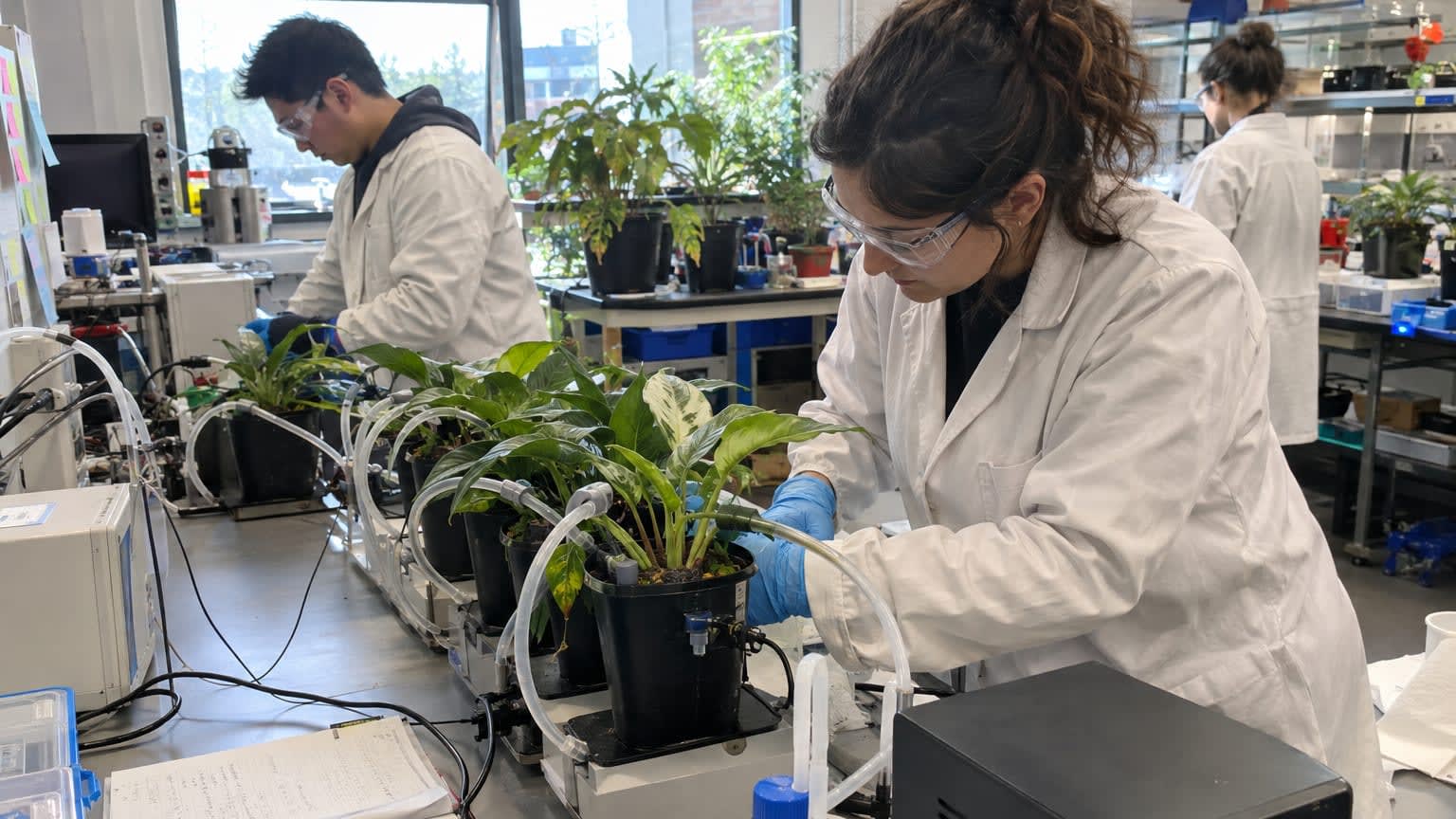
A University of Surrey-led review found that systems drawing air through plants and their growing materials often removed more VOCs than passive greening, such as potted plants and living walls, under controlled conditions. Much of the evidence comes from lab studies. Indoor greenery was also linked to cooling of about 0.5 to 4.5°C near the plants.
Its core findings are specific. Passive greening, meaning potted plants and living walls, can help remove volatile organic compounds (VOCs), the gases given off by paints, furniture and cleaning products. Systems that actively draw air through plants and their growing materials were often more effective overall under controlled conditions. And indoor greening was associated with temperature drops of roughly 0.5 to 4.5°C near the plants.
That split matters to anyone who signs off on plant spending in a commercial building. A pot on a desk and an air-moving green wall are different purchases with different evidence behind them, and the review is candid that most of that evidence comes from small lab chambers rather than occupied floors.
Where the cleaning actually happens
The review doesn’t hand the credit to leaves alone. Its distinction between passive and active systems lines up with an older observation about where pollutant removal happens. Cornell Cooperative Extension in Warren County, summarizing NASA’s original houseplant experiments, notes that roots and potting soil were important contributors, and that plants continuously exposed to pollutants such as benzene got better at removing them over time. That pattern suggests the microbes in the soil were adapting.
Neschune Henry, writing in CRE Insight Journal, made the same point about living walls: microorganisms in the growth medium break organic compounds down into harmless substances.
Passive greening means plants sitting in ordinary room air: pots, planters and conventional living walls. Active systems move room air through the plants and their growing medium, the category the Surrey review found often more effective at removing VOCs in controlled tests.
The review also lists what makes results swing: ventilation, lighting, plant species and the type of system. For a facilities team, that list reads like a set of variables to pin down before believing any single performance number. A species that scored well in a chamber under grow lights may behave differently in a north-facing lobby with a high air change rate.
The 680-plant arithmeticHow many plants it takes
10, 1,000
Plants per square meter of floor needed to match lab VOC removal, per a 2019 meta-analysis
680 plants
The meta-analysis example for a 1,500 sq ft home or office
1 per 100 sq ft
NASA’s often-cited guideline, one plant in a 6, 8 inch pot
American Lung Association (summarizing a 2019 meta-analysis); Cornell Cooperative Extension Warren County
The sharpest reality check comes from a 2019 meta-analysis titled “Potted plants do not improve indoor air quality,” which the American Lung Association summarized in February 2024. The researchers standardized decades of chamber results and extrapolated them to real rooms and larger plant counts. Their conclusion: in an ordinary building, natural ventilation does most of the work of removing VOCs, unless the space is packed with plants.
The American Lung Association says few studies have tested plants in real indoor settings. Those that did struggled with inaccurate measuring equipment and with controlling or measuring the air exchange rate, so their small VOC reductions can’t be cleanly credited to the plants.
Cooling near the leaves, water in the air
The cooling result is the one most likely to catch the eye of whoever pays the power bill. The review links indoor greening to drops of about 0.5 to 4.5°C near the plants and says this could improve comfort and reduce reliance on air conditioning. The phrase “near the plants” carries weight. It describes a local effect, which suggests greenery is best judged by the comfort of the people sitting beside it, not as a substitute for a zone setpoint.
Moisture from plants needs managing. The Surrey team warned that during extreme heat and humidity, poorly managed moisture could raise the risk of condensation and mold.
For operators running a building automation system, a large plant wall is a moisture source worth knowing about. That matters most in humid regions and in spaces where dehumidification already takes up a big share of cooling capacity. In a dry, overheated office, the same wall could be doing exactly what the occupants want.
The case that rests on people
The strongest argument against reading this review as an air-cleaning verdict is that many buildings don’t buy plants to clean air. Writing in IFMA’s FMJ Magazine in February 2026, Aykean Forde and Izzat Ali Khan cited University of Technology Sydney research in which office plants cut tension and anxiety by 37%, depression by 58% and fatigue by nearly 40%.
If occupant wellbeing is the goal, the VOC debate matters less to the purchase decision, though it still matters to how the purchase is described. Henry’s projects show the purpose-first approach. One living wall was built as a focal point to draw the eye up through a tall-ceilinged space. It did not rely on a pollutant-removal claim to win approval.
Turning plants into measured equipment
The Surrey team’s proposed fix is a conceptual framework that pairs monitoring with numerical modeling, so greenery’s performance can be predicted under different conditions and used in building design, management and policy. GCARE researchers Elisa Valentim Goulart and Hao Sun called the gap in monitoring and modeling substantial. Prashant Kumar, GCARE’s founding director, described the review as a preliminary benchmark for deciding where and how indoor plants work best.
Benchmark is the right word, and preliminary is the honest one. The review gives operators a vocabulary for specifying greenery as equipment: passive or active, airflow through the medium, local temperature effect, moisture contribution. Buildings that already log temperature and humidity zone by zone would be well placed to test those claims on their own floors.
Before an air-quality claim for a plant system goes into a business case, ask whether it was measured in an occupied space with real ventilation or in a test chamber. Both the Surrey review and the 2019 meta-analysis trace the evidence gap to that difference.
The signal that would firm up this read is field data from the framework the Surrey team proposed, especially from buildings measured through hot, humid stretches. If active systems keep their edge outside the chamber, plant walls start to look like a line item for mechanical engineers. If they don’t, they stay in the interior design budget, where the wellbeing case already holds up.