
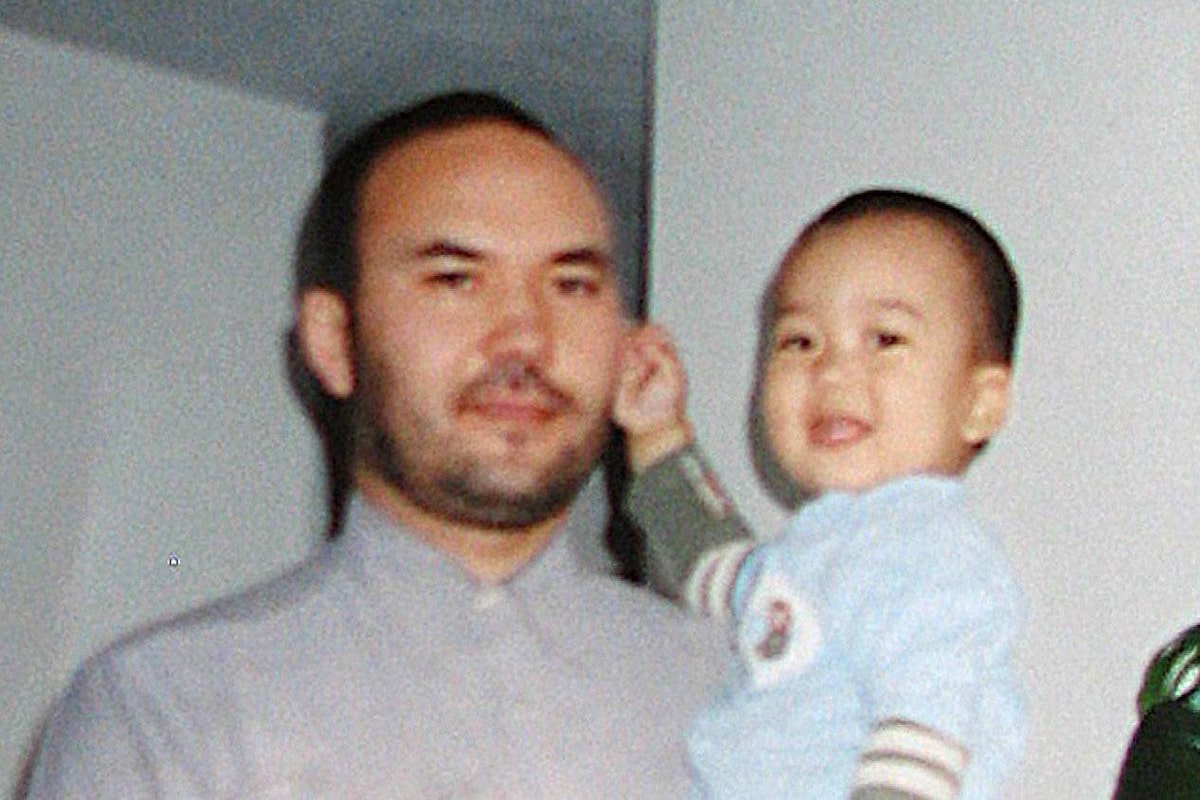
Huseyin Celil and one of his youngest children in a photo taken shortly before his arrest in 2006.
It has been 20 years since Canadian Huseyin Celil was detained in Uzbekistan and ultimately deported to China, where he has been jailed ever since, a legal and diplomatic saga that has bedevilled three consecutive Canadian governments.
A Uyghur political activist who grew up in China’s northwestern Xinjiang region, Mr. Celil was convicted on charges of terrorism and separatism in 2007 over the staunch objections of Ottawa and human-rights groups. Beijing has always refused to recognize his Canadian citizenship, despite supporters saying Mr. Celil renounced his Chinese passport prior to his arrest.
Originally sentenced to life, in 2016 he was among a group of 11 Uyghurs who saw their sentences reduced − in his case to 20 years, starting in 2018 − after they “had confessed their crimes and shown remorse,” according to a contemporaneous Chinese state media report, which held them up as an example of a successful “deradicalization” program.
The following year, that “deradicalization” approach would be applied across Xinjiang as a whole, as hundreds of thousands of Uyghurs were processed through a sprawling network of what the Chinese government would ultimately term “vocational educational and employment training centres,” but which outside observers have denounced as re-education facilities.
Opinion: Visa-free visits to China are a risk for Canadians
In 2021, Parliament voted unanimously to declare that China’s actions in Xinjiang constituted a genocide against the Uyghur population. The vote, along with the detention of two other Canadians, Michael Kovrig and Michael Spavor, saw relations with China enter a deep freeze, which has only begun to thaw since Mark Carney became Prime Minister.
With Mr. Carney due to travel to the southern Chinese city of Shenzhen next month for the Asia-Pacific Economic Cooperation (APEC) conference, after a hugely successful state visit to Beijing in January, supporters of Mr. Celil see this as an ideal opportunity to push the Chinese government on his case, which has been largely dormant for a decade now since his resentencing.
“The campaign to free Huseyin Celil is as vibrant as ever, because of his family’s refusal to give up and their supporters’ insistence on invoking his name any chance they get,” said Ketty Nivyabandi, secretary-general of Amnesty International Canada. “They have kept the flame of hope alive and sent Canadian officials an unequivocal message: We will demand justice and answers for as long as it takes, and we expect our leaders to do the same on the world stage.”
Huseyin Celil’s sister, 39-year-old Heyrigul Celil, and his mother, 75-year-old Shalehan Spander.Geoffrey York/The Globe and Mail
Wilf Ruland, a co-ordinator of the Huseyin Celil Action Network, which lobbies on behalf of Mr. Celil’s family in Canada, said Ottawa’s engagement “has waxed and waned over the 20 years since his arrest and sentencing.”
“We can only see what the government tells us it is doing on the case − we don’t know what is happening behind the scenes in terms of the Canadian government putting pressure on China to release Mr. Celil,” he said. “Certainly, the Harper government was very active and engaged in pressuring China on this case, probably more so than any government since then.”
Thida Ith, a spokesperson for Global Affairs Canada, said Ottawa continues to advocate on behalf of Mr. Celil with Chinese officials and provides consular assistance to his family in Canada. She declined to provide any further details, citing privacy considerations.
The Canadian government was similarly reticent about Mr. Celil’s situation when podcaster Yusuf Zine began working on a series about his detention for broadcaster TVO, which brought renewed attention to the case upon its release in 2024.
“It’s jumping through hoops that lead you to nowhere,” Mr. Zine said of trying to get information out of Global Affairs. “We expected it from the Chinese government. We certainly didn’t expect it as much from the Canadian government.”
Kamila Telendibaeva leads a protest for the release of her husband Huseyin Celil in front of the Chinese Consulate in Toronto in July, 2006.Kevin Van Paassen/The Globe and Mail
With so much uncertainty surrounding the case − Mr. Zine and his producers didn’t even know if Mr. Celil was still alive − they were able to track him down to a prison in Xinjiang, where a member of the staff appeared to confirm he was still being held, though he refused to allow anyone but members of Mr. Celil’s family to send him a message.
“Part of the goal of the podcast was to create enough noise. We hoped the Canadian government would sort of say, ‘We have to look into this,’” he said. “If they did, we have not heard about it.”
Similarly, Conservative MP Garnett Genuis, a long-time critic of consecutive Liberal governments’ approach to China and an advocate for Mr. Celil, said he has received “no additional information” about what Ottawa is doing on his behalf.
“Our office is in the process of submitting a written question to the Canadian government on his case, identifying the Carney government’s intended approach going forward,” Mr. Genuis said.
“Unfortunately, the government’s response to this case does not match the intensity of their response to the detention of the Two Michaels. My view is that a Canadian is a Canadian, and the government should be fully and sharply engaged to secure Mr. Celil’s release.”