
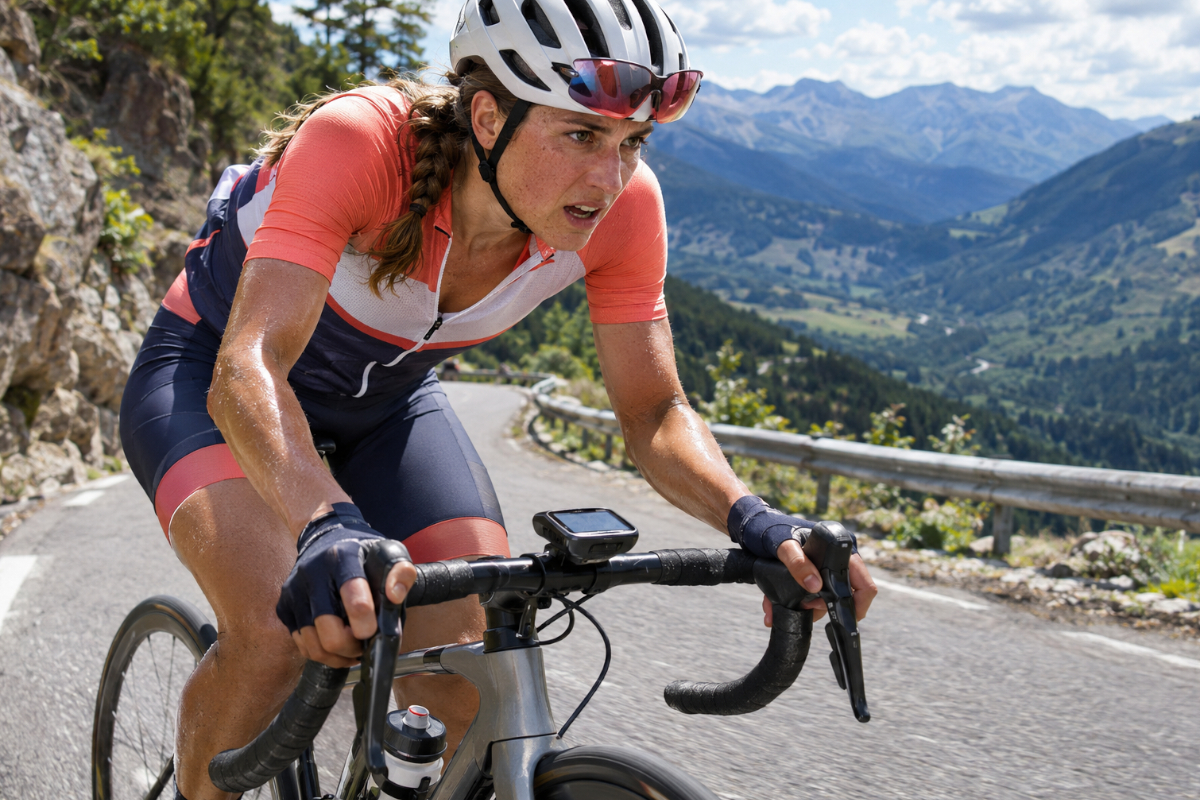
Imagine two cyclists with identical FTP values of 300 watts approaching the final climb of a five-hour race. One can still respond to an attack, while the other struggles to maintain a pace that felt comfortable earlier in the day. Their threshold power may be the same, but their ability to preserve performance under fatigue is clearly different. A new study involving 50 professional cyclists suggests that a mathematical index developed nearly four decades ago could help explain that difference, potentially revealing information that traditional power metrics fail to capture.
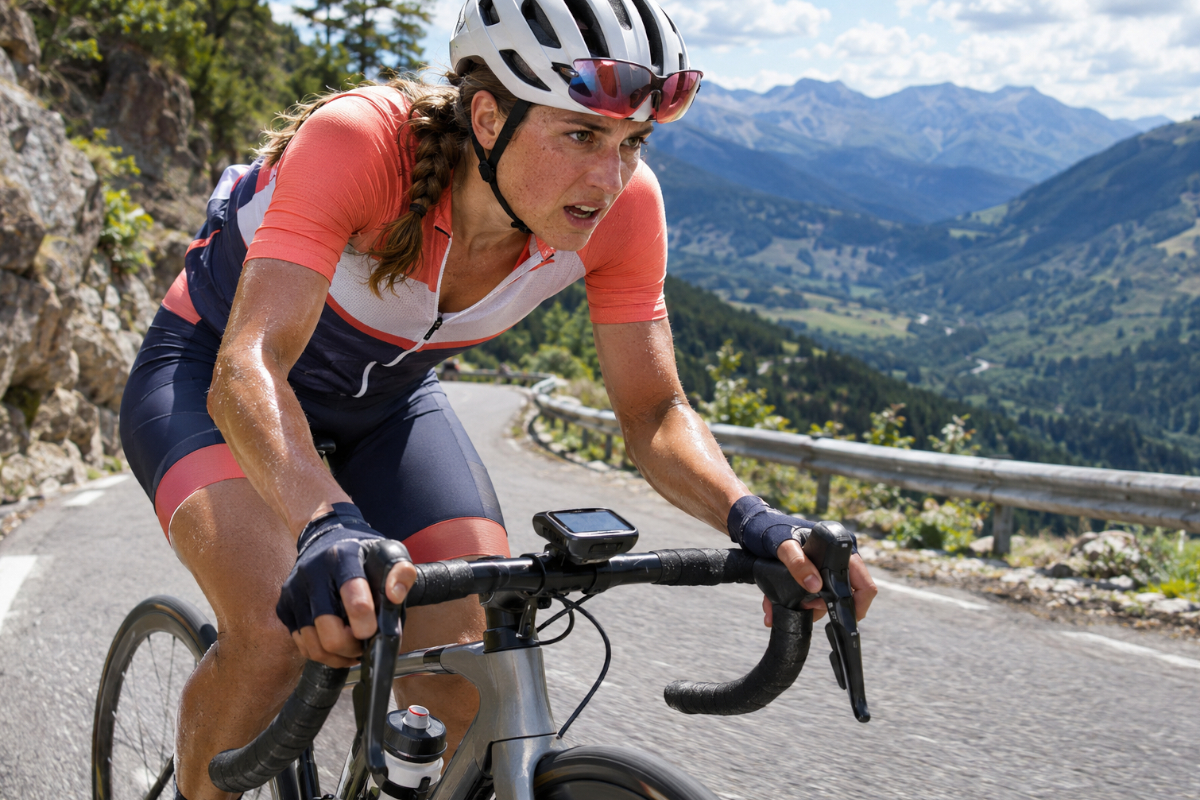 Road cyclist showing signs of fatigue while climbing a mountain road. Image: TodoMountainBikeProfessional cyclists lost substantial aerobic power after accumulating 50 kJ/kg of work
The research, published October 29, 2026, in the Journal of Science and Cycling, was conducted by scientists from the Université de Montréal and researchers associated with the Groupama-FDJ United professional cycling team. The study, titled Péronnet and Thibault’s endurance index predicts maximal aerobic power deterioration over prolonged cycling duration, examined how accumulated workload affects the ability to produce power during prolonged exercise.
The researchers analyzed peak power records from 50 male professional cyclists, whose average age was 23 years. Their average body mass was 67.8 kg (149.5 lb), and their mean VO₂ max was 74.8 mL/kg/min, reflecting the high aerobic fitness of the athletes included in the analysis.
Power-duration profiles were evaluated across efforts ranging from 15 seconds to 60 minutes, using four levels of accumulated mechanical work: 0, 30, 40, and 50 kilojoules per kilogram of body weight. For a cyclist weighing approximately 154 pounds (70 kg), the highest workload corresponds to 3,500 kJ, an amount of mechanical work that can accumulate during a demanding, multi-hour ride.
The results showed a progressive decline in maximal aerobic power under accumulated fatigue. Average estimated maximal aerobic power dropped from 396 watts with no prior work to 349 watts after 50 kJ/kg. That represents a 47-watt difference between the two group averages, a potentially meaningful reduction when a rider needs to sustain a hard climb, bridge a gap, or respond to repeated accelerations late in a race.
The researchers also reported an average individual percentage decline of 13.9%, with substantial variation between riders. The distinction matters: the percentage calculated directly from the two group averages is approximately 11.9%, while 13.9% represents the mean of the individual reductions. Neither figure should be interpreted as an equivalent drop in FTP, since maximal aerobic power and functional threshold power are different physiological performance indicators.
A mathematical model from 1989 offers another way to evaluate cycling durability
The most interesting finding concerns how the researchers analyzed the power data. Rather than developing an entirely new performance metric, they revisited mathematical equations introduced by François Péronnet and Guy Thibault in 1989 to describe the relationship between power output and exercise duration.
The model estimates several performance characteristics from an athlete’s peak power records, including anaerobic capacity, maximal aerobic power, and an endurance index known as E. This index characterizes how sustainable aerobic power declines as exercise duration increases.
The researchers wanted to determine whether that index could also help characterize cycling durability and fatigue resistance, particularly the reduction in maximal aerobic power after substantial work had already been performed.
Their analysis produced encouraging results. The mathematical model fitted the recorded power-duration profiles with mean absolute percentage errors ranging from 1.6% to 2.2%, indicating a close correspondence between the modeled curves and the observed peak power records.
More importantly, statistical models combining maximal aerobic power with the endurance index explained between 53% and 68% of the observed variation in maximal aerobic power deterioration. The endurance index also remained significantly associated with the percentage decline after accounting for its relationship with baseline maximal aerobic power.
Those findings suggest that the shape of a cyclist’s power-duration curve contains information about how well that rider maintains performance under fatigue. However, the results do not mean the method can predict an individual’s late-race power output within 2%. The small fitting errors describe how accurately the model represents the power records, not the accuracy of an independent prediction of future performance.
The study was published as a scientific conference abstract, so the publicly available report provides a summary of the methods and results rather than the detail expected from a full research paper. Independent validation will be necessary before its predictive performance can be established more broadly.
Why FTP alone cannot tell you how much power you’ll have after five hours
Functional threshold power remains one of the most widely used measurements in cycling training. It helps athletes establish training zones, monitor progress, and evaluate their ability to sustain relatively high aerobic workloads. But FTP measured while fresh cannot independently describe how much power an athlete will retain after several hours of racing.
Consider two riders with an FTP of 300 watts. Both might produce comparable numbers during a controlled test, yet their performance could diverge substantially after a long period of sustained exercise. Differences in their ability to resist physiological deterioration may become increasingly important as the accumulated workload increases.
This is where cycling durability versus FTP becomes an important distinction. FTP primarily provides a reference for sustained power production, while durability describes how physiological and performance characteristics change as exercise continues. A cyclist can have an impressive threshold power without necessarily being equally effective during the final hour of a long event.
The concept is supported by previous research, including the 2021 review The Importance of ‘Durability’ in the Physiological Profiling of Endurance Athletes, published in Sports Medicine. That paper examined why traditional physiological measurements obtained under rested conditions may provide an incomplete picture of performance during prolonged endurance exercise.
The newer study extends this discussion by examining whether an established endurance index derived from power-duration data can help characterize the deterioration associated with accumulated workload. Its potential value lies in extracting additional information from power records rather than relying exclusively on demanding fatigue-testing protocols.
For American cyclists competing in long gravel races, mountain bike marathons, road races, and endurance events, the distinction has obvious practical relevance. A rider’s ability to maintain performance after several hours can matter more than a relatively small advantage in fresh FTP, particularly when a decisive climb or sustained effort arrives late in the event.
It could also influence how coaches interpret power meter data for endurance training. Two athletes with similar threshold values might require different performance assessments because their power-duration characteristics and responses to accumulated fatigue differ.
However, the findings should not be treated as a ready-made training prescription. The researchers examined relationships between existing performance characteristics and observed power deterioration. They did not establish that directly targeting the endurance index through a particular workout would improve durability, nor did they test a specific training intervention.
The limitations are also important. All 50 participants were male professional cyclists, a highly trained population whose physiological characteristics differ considerably from those of recreational riders. It remains unclear whether the same relationships would apply to female cyclists, amateur racers, or athletes with substantially lower aerobic fitness.
Accumulated mechanical work also represents only one part of the fatigue equation. Riding intensity, carbohydrate availability, hydration, environmental temperature, and recovery can all influence how a cyclist responds to prolonged exercise. Two riders who have completed the same amount of mechanical work may not necessarily experience the same physiological strain.
Another unresolved question concerns the quality and completeness of the data. Professional cyclists generally accumulate extensive power records, but recreational athletes may have gaps in their training history, inconsistent maximal efforts, or measurements from different devices. The reliability of this approach under those conditions has not yet been established.
Still, the research offers a potentially useful direction for predicting cycling performance after long rides. Instead of treating a single FTP value as a complete representation of fitness, future analytical methods may be able to extract more information from the power-duration profiles cyclists already record.
The immediate finding is more specific: among 50 male professionals, a mathematical endurance index was associated with how much estimated maximal aerobic power deteriorated after accumulated work. Whether that relationship can be turned into a reliable tool for everyday cyclists remains a question for further research.