

Listen to this article
Estimated 3 minutes
The audio version of this article is generated by AI-based technology. Mispronunciations can occur. We are working with our partners to continually review and improve the results.
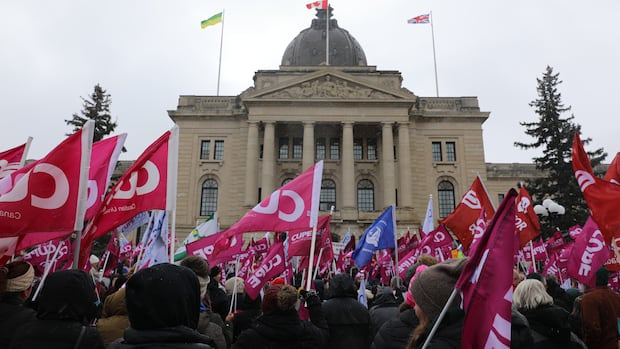
Hundreds of unionized health-care workers rallied outside the Saskatchewan legislature on Wednesday, calling on the government to agree to a deal.
“To this government, our message is clear. Our members have waited long enough,” said Bashir Jalloh, president of Canadian Union of Public Employees (CUPE) Local 5430.
The local represents health-care workers including those in clerical, technical, nursing and support roles. Its roughly 14,000 members have been without a contract since 2023 and have not received a wage increase in more than four years.
Jalloh said wages remain a focus in the union’s ongoing negotiations for a new contract.
“Saskatchewan currently is last in all provinces in Canada. Historically we have been paid based on the Western Canada average. Right now, if you take any classification, our wages are way below,” Jalloh said.
Last month, 99 per cent of the union’s members voted in favour of job action.
Jalloh said it’s a tool CUPE 5430 doesn’t want to have to use but it is now part of the organization’s leverage.
WATCH | Hundreds of unionized health-care workers rally outside legislature: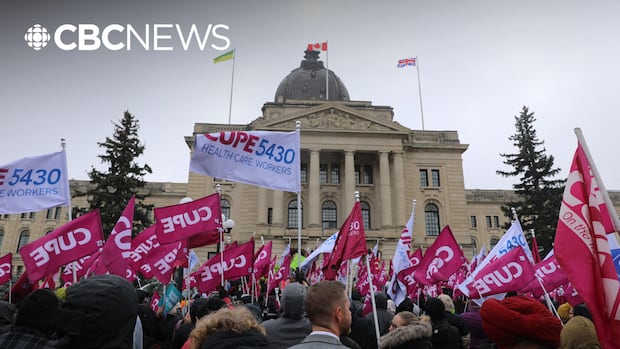
Hundreds of unionized health-care workers rally outside legislature
At least two health-care unions have gone three and a half years without a contract. On Wednesday, hundreds rallied outside the legislature demanding the government take action.
“We will use that mandate we got as a last resort because we all live in these communities, we all have family members who need the care.”
In a news conference after Wednesday’s question period, Health Minister Jeremy Cockrill said he’s concerned any time delivery of health services is threatened.
Cockrill said the vote is just one step in the process of declaring job action and that any potential strike has “quite a process.”
WATCH | What the Sask. government is planning to do this legislative session: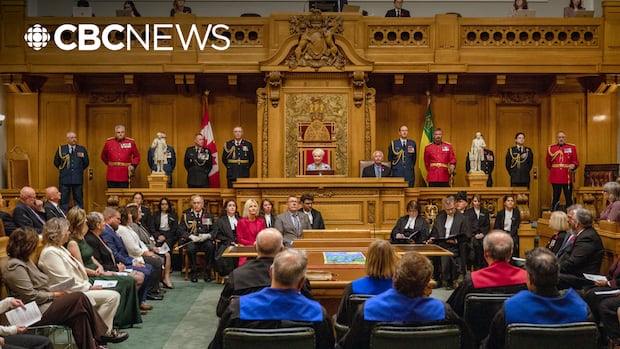
What the Sask. government is planning for the fall legislative session
For the first time in 166 days, the Saskatchewan Legislature is back in session. Here’s what the government announced in the speech from the throne.
Cockrill met with Jalloh and other health-care union leaders Wednesday morning before the rally. He said they had productive discussions.
Cockrill added that he is not personally responsible for negotiating contracts. Instead, it’s in the hands of the government’s bargaining agent, the Saskatchewan Association of Health Organizations (SAHO).
“We have to allow the bargaining teams for both union partners and for SAHO to have those detailed discussions. Certainly wages are always a topic of discussion,” he said.
Service Employees International Union (SEIU) West is another union that represents health-care workers. Like CUPE Local 5430, its members have also been without a contract since 2023.
Lisa Zunti, the organization’s president, said the health minister needs to take responsibility after very little progress at the bargaining table.
“When you bring so many proposals to the table, we know it’s a ploy to slow down bargaining. So again, stop hiding behind the bargaining agent and take responsibility for ending this contract and getting these people a proper wage increase,” Zunti said.
Cockrill said he wants to get a deal with all health-care unions currently negotiating with the province.
He pointed to the recent tentative agreement with health-care workers represented by the Saskatchewan Government Employees’ Union (SGEU) as an example of recent success.
Cockrill said the province wants to make sure that health-care compensation stays competitive compared to the Western Canadian average.