
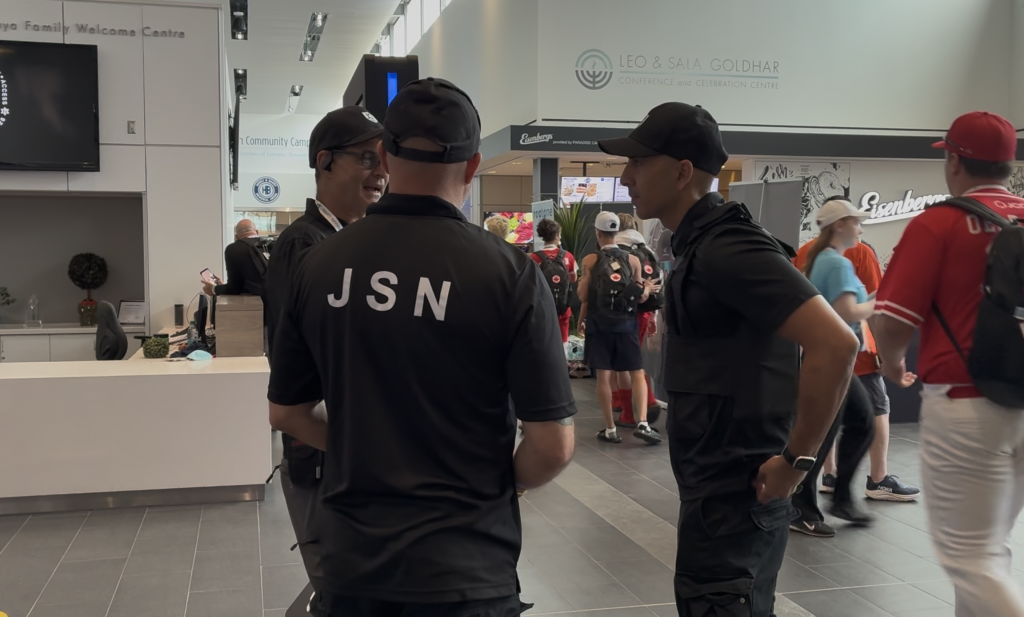
Jewish leaders across Canada are looking to Ottawa later this week to see whether the Nov. 5 federal budget contains substantial funding increases and other commitments to protect Jewish communities from violent attacks.
While the community has been sounding the alarm since Oct. 7, 2023, this is the first budget since a synagogue in Belleville, Ont., was attacked on Yom Kippur. It also comes amid recurring vandalism and threats, including the latest suspected hate crime at Montreal’s Temple Emanu-El-Beth Sholom on Oct. 29, when five windows were broken, likely by pellets fired from a gun.
Last week, Canada announced its new National Security Strategy, although antisemitism was not mentioned. Just a month earlier, however, the government said “antisemitism could be a national security threat”. After three Toronto synagogues were shot at in March, Ottawa transferred $5.8 million to the Jewish Security Network (JSN). Then, in April, the federal fiscal update pledged $75 million over five years for community safety grants to at-risk faith communities across Canada.
Toronto’s Jewish Security Network CEO, Jevon Greenblatt, says the community is “substantially safer” than it was when the organization launched in September 2024. It now has a 24/7 command centre and 30 staff, while $15 million has been spent upgrading security at the community’s 180 Jewish schools, camps, offices and synagogues. But Greenblatt also says there is “a long, long way to go.”
Closing that gap will require tens of millions more, he says: about $50 million for physical security infrastructure, on top of the $20 million to $40 million “fortune” the community is already spending annually on security guards. But he’s optimistic the money will be forthcoming.
On today’s episode of The CJN’s North Star, host Ellin Bessner speaks with Greenblatt about the behind-the-scenes work being done to keep Toronto’s Jews safe, where the threats are coming from, and how smaller Jewish communities can better prepare for attacks.
Related links
Learn how to contact the Jewish Security Network in Toronto to report suspicious activity or to ask for training or funding. Their emergency number is (437) 222-3999.Read about the $75 million for security funding announced in the April 2025 fiscal update, in The CJN.Read about the various official and allied Jewish civilian security firms keeping Toronto’s Jewish community safe after Oct. 7, 2023, in The CJN.Transcript
Jevon Greenblatt
To guard this community would be $30 to $40 million a year. The physical upgrades, we would probably be looking at about $50 million to get the community institutions to the level that we want them. Now they’re much better than they were.
Ellin Bessner
Jevon Greenblatt is CEO of the new Jewish Security Network, or JSN for short, UJA Toronto’s centralized community security organization with its own 24/7 operations center, a staff of 30, including trained intelligence and a network of hundreds of trained community volunteers.
The JSN was launched two years ago in reaction to October 7th and the explosion of antisemitism in Canada. They hired Greenblatt to build it. He’d been in charge of security for South Africa’s main Jewish communities and he’d also worked in Israel.
Greenblatt says he wants to create a future for Jews in Canada and to do that, he says, requires a whole new mindset. Canadian Jews needed to wake up to what other diaspora communities already long knew, lessons they should have learned after the deadliest antisemitic attack in U.S. history at the Tree of Life synagogue in Pittsburgh by an extreme right-wing neo-Nazi gunman which killed 11 people in 2018, including a Canadian. And decades before that, the Iran-backed Hezbollah car bomb at the Jewish Community Centre in Argentina that killed 85 people.
Greenblatt says the threats against the Jewish community here are still coming from both the left and the right, even though it’s now young guns for hire who carried out the three synagogue shootings in Toronto in March, police think, and most recently it was a former army sniper who perpetrated the Belleville synagogue attack on Yom Kippur.
JSN gets money from UJA Federation and also from the government. So far, Greenblatt says the agency has handed out $15 million in security grants.
But closing the gap to make all 180 Jewish buildings in the GTA physically much safer than they are now would, he says, cost another $50 million. And that’s on top of what it already cost the community just to pay for security guards each year.
Which is why he and many Jewish leaders are looking to Ottawa later this week when the 2026 federal budget is released, hoping there’ll be substantially more money and commitments to protect the Jewish community.
I’m Ellin Bessner, and this is what Jewish Canada sounds like for Monday, November 2nd, 2026. Welcome to North Star, the flagship podcast of The Canadian Jewish News, and made possible thanks to the Ira Gluskin and Maxine Granovsky Gluskin Charitable Foundation.
You’ve likely spotted the uniformed unarmed JSN security experts at major community events since 2024 like the Walk with Israel, and their trained volunteers at synagogues every week. But behind the scenes, there’s a lot that we don’t see: their command center in North York, their eyes and ears now at 50 Toronto schools and institutions linked up by closed circuit TV to headquarters, liaisons with police, and sharing intel and best practices with other Jewish communities already operating their own agencies like in Montreal, and from coast to coast, from Vancouver to Halifax, and those who have much fewer resources.
Ahead of the anticipated federal budget this week, Jevon Greenblatt joins us now to discuss how safe is Toronto.
Jevon Greenblatt
Thank you, Ellin, and great to finally be here.
Ellin Bessner
So let’s just start by why you wanted to take this job and what was your goal.
Jevon Greenblatt
This was the next evolution of my personal journey. This is what I want to do and want to continue doing, in some ways serving our community. And I have the skill set and the experience born over many years of volunteering and leading an organization that hopefully can really make a significant difference to the Canadian Jewish community and to create a future for Jews in Canada.
It’s very sad that I have to do this. It’s very sad that anyone has to do this kind of job. It’s very sad that organizations like JSN and its counterparts around the world exist or have to exist.
Coming here, it was not formalized structure. I think that there was an understanding that something had to be done to build for the future and that the world was changing. But I think to a large degree, it hadn’t changed significantly in Canada. October the 7th, although we saw shifts a little before that, October the 7th, 2023 really was, October the 8th was like the real shift that the community and the leadership saw.
So any organization like ours is born out of necessity. And although it should be born out of proactive, build during times of peace so that you’re ready during times of crisis, whether it’s us or the CST in the UK or the CSG in Australia or South Africa, they were all born out of necessity. So although I always say that this was 20 years too late, it wasn’t possible in the time because this is as much a cultural shift amongst Canadian Jewry and Canadian society as it is building a security structure. Where should our money be going to? Education, feeding the needy, those kinds of things. But the reality is that security is and for a little while has been and will continue to be a major feature of Canadian Jewish life going forward. And now we need to understand that we need to build for the future. We are building for the future.
Ellin Bessner
Okay, let’s talk practicalities. What does it look like? And I know not to give away operational secrets, of course, for security reasons, but we have this vision when we watch TV of these big screens and the war room and the generals walking in, but obviously you have something.
Jevon Greenblatt
JSN is built on five foundational pillars. Those pillars are: empowering the community. There alone, we have 200 active volunteers that have been trained through a 10-week course. We have over 1,000 community members trained as eyes and ears. We’ve done multiple training sessions with teachers and staff members of institutions because security is as much about vigilance, awareness, reporting, proactive prevention as it is responding to and dealing with things. We have a long way to go, but we’re moving ahead and we’re really making a difference.
2) The other element is hardening our institutions. That’s the physical protection of our institutions, the gates, the fences, the camera systems, the film of the windows, the bollards, all the things, the locks on the doors, all those things that are put in place. But not only that, it’s also the protocols and procedures, because I’ve said it many times, It’s great to spend $1,000,000 in upgrading the physical security of your institution, but defeating that with a $10 brick on a Saturday morning to prop a door open doesn’t help. So it’s not only the physical security, it’s the protocols and procedures of someone ringing a doorbell and it not being buzzed in, but someone sitting there going, “Who are you? What are you doing here? Who are you here to see?”
All of those processes to prevent something from happening. And of course, God forbid, something does happen to actually then react to it, like the emergency protocols and procedures. We’ve engaged with more than 150 institutions at varying levels to build teams to share protocols and procedures, help work with them to implement those protocols and procedures. and to harden the institutions through their funding, our funding, and government funding.
3) The next thing is our 24-hour command and control centre. There was nothing there beforehand. There probably wasn’t even a telephone number, and if there was, it wasn’t very well known. From our point of now, there is a 24-hour command and control center. It’s called the SOC, or Integrated Security Operations Center. There’s people inside it 24-7, 365 working in shifts. We are receiving phone calls. We have dealt with over 1,000 incidents since its inception.
And then also we are feeding through camera systems, CCTV systems from multiple institutions. We’ve just started this process. We have over 50 institutions that are feeding through to this control room. And we’re monitoring those, utilizing all the latest technologies that are available to them. We’re not sitting staring at screens hoping that we’ll catch something. We have technology that identifies the anomalies and brings it to us. Does it look like a 911 phone as a call centre? Yes, it does. It really does. There are desks and screens and big monitors on the wall.
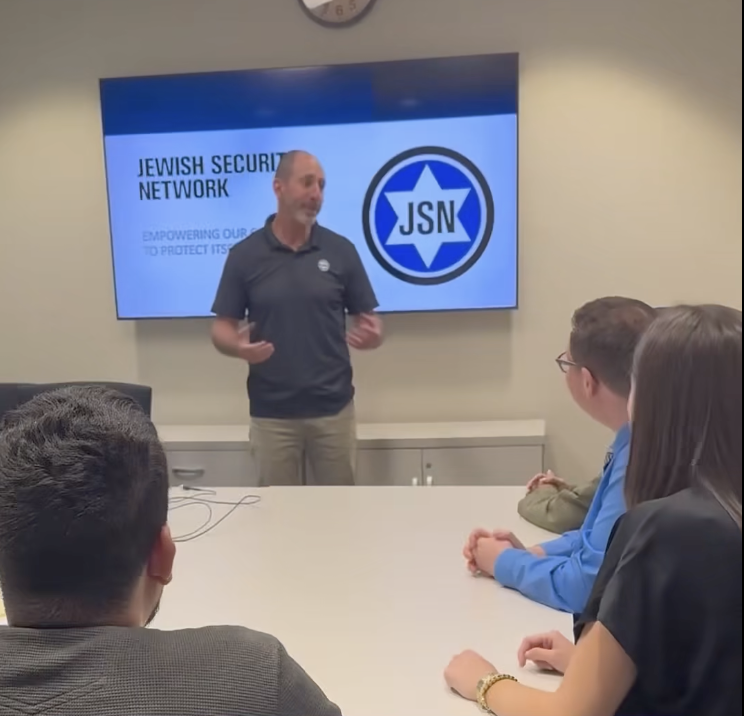 Jevon Greenblatt, CEO of the Jewish Security Network, says about half of the 180 Jewish buildings, camps and schools in the Greater Toronto Area have hardened their security to a Tier 1 or a Tier 2 level against threats. (Credit: UJA Federation of Greater Toronto/Facebook)
But the other two elements are: our research department, understanding the threat environment, understanding the individuals that are threatening the community, the organizations that are instigating violence. building reports out of that, understanding who is just talking and who really actually is a threat to the community. All open source, nothing is done in any other way than what is publicly available information. And we put together these profiles of individuals that are threatening violence against the Jewish community. They are then at a certain level handed over to law enforcement which is then the 5th pillar: those relationships with not only law enforcement, but other organizations within the community and outside. We have relationships with TPS and YRP and Peel Police and OPP and CSIS and RCMP and all that’s just in the GTA, but with an expanding mandate to also be engaging with communities further afield.
Ellin Bessner
What does that mean?
Jevon Greenblatt
That means that we are supporting other communities across Ontario in setting up and establishing structures. We’re working very closely with the Ottawa Jewish community and therefore we need a relationship with local law enforcement in Ottawa, London, Windsor and other communities all over the place. Hamilton, of course, Belleville and places like that. So we are working, although it wasn’t originally under our mandate, we were set up as a GTA organization. Of course, we want to support Jews wherever there is need and community or Jewish spaces where people need to be kept safe wherever that is needed. And we are also working very closely with Western Canada, not directly responsible for, but we have someone here that is working with them and guarding them and helping them set up similar structures in Western Canada.
Ellin Bessner
And what about Montreal? What do you do with them?
Jevon Greenblatt
So Montreal has an established organization that we established long before us. We work very closely with them. We also share information with them. But because they’re already established, they’ve taken responsibility for that region and East. We’re taking responsibility from Ontario through to the West.
Ellin Bessner
You mentioned just now, let’s talk about it, the profiles. In terms of who are the threats, we’re speaking as the federal government announced its national security strategy. Can you share what are the threats?
Jevon Greenblatt
The threats really come from multiple areas. I think the first thing to say is words do turn to actions. This has been seen throughout our history and we watch the progression of allowing certain things to happen. Those things then get the boundaries get pushed, then it becomes hateful speech, et cetera, that also sits within the gray zone. And next thing you know, there is graffiti shooting at empty synagogues and then attacking synagogues with community members inside.
There is no surprise in the progression because this is the way these things go. So the importance of understanding and getting our law enforcement and Crown to understand that words do turn to actions.
So from that point of view, there is no doubt that the threats come from state actors like Iran through IRGC and their proxies that are manipulating the system. And it’s a broader-based thing. But of course, the Jewish communities of the diaspora are often seen as the soft underbelly of Israel. We saw that in 1994 in the AMIA building attack in Argentina. So that’s something we have to be very aware of, and we’re following and monitoring that very closely. And law enforcement is very on top of that, by the way.
The other thing is the right wing. So the radical right wing is another element that we are dealing with on a day-to-day basis. They are collaborating internationally. They are coordinating across North America. And they are radicalizing to a degree where if you look at most of the attacks in North America, in the US, the vast majority of casualties and injuries that were directed specifically at the Jewish community are from the right wing. And we saw that in Belleville. So not saying that he isn’t right wing, but it’s that kind of ideology that we’re stressed about and worried about. So that’s something we’re worrying very closely. The radical left as well, we saw that in DC, the shooting at the embassy.
So the Tree of Life. But what’s interesting about the Tree of Life? And this is something that we’re experiencing here in Canada. It happened when it happened. And six months to the day later, the exact same attack by the same ideology happened across the continent at the Chabad of Poway. And the question was asked, why did you not close your doors? Because you walked through the front doors of Tree of Life because they didn’t want to close their doors. They wanted to be opening and welcome. And six months to the day, the same thing happened across the region with wide open doors. This is the problem and nobody believes it’s going to happen to them. And when it does, it’s too late. And Belleville said the exact same thing. The community said, we just didn’t think it would happen to us. And it did.
Ellin Bessner
When we heard recently that the people who were shooting in Toronto at the synagogues and at the US consulate were paid kids, paid young people, paid shooters for hire with the same guns. How does that change your assessment of the danger? Because maybe ideology isn’t part of it, it’s just money. And so we all thought, it’s antisemites, they’re against the Jews, but maybe not.
Jevon Greenblatt
So I’d say that ideology is still the driving factor. Maybe the tool to commit it is not. And you’re right, it makes it much more complicated to identify and mitigate those things. Everything we do every single day from the day we kicked off and started working was understanding. That may be new to Canada, but it’s not new to Europe. There’s nothing new under the sun, right? These things have been emerging, materializing, growing, progressing for at least the last 15 to 20 years in their current form. So communities around the world have experienced this before. Does it change how we operate? No, it doesn’t. Because everything we are doing is understanding that there are multi-layers to security, government, police, aware community members that are reporting things, because one person at one institution may mean nothing, but that same person at three institutions may be information gathering for a terrorist attack.
It’s not about paranoia. It’s about being empowered and aware and understanding what looks out and reporting it. hardening of our institutions, our SOC, our training of people, all of these elements come together. That’s how we build these organizations and that’s the structure that we have in place to make sure. It’s going to take time. I know people hate hearing that. We started this in crisis, but we’ve come a long way in the two years. I think the community is substantially safer than it was, but we have a long, way to go. And we need all partners and organizing community leadership and community on board to help us get to there because we can only do it together.
Ellin Bessner
If you’re listening to North Star, you can also watch our interviews on The Canadian Jewish News’ YouTube channel.
I heard you speak at a synagogue about the, and a lot of the issues were brought up about after Belleville having paid armed security officers outside Jewish synagogues and institutions, either actual police or allowing security guards in Ontario and elsewhere to be properly licensed and you have to change the legislation. What is your position on that and do you want this?
Jevon Greenblatt
A firearm is a tool. just like a person, a wall, a door, a gate. So do I support firearms if the tool is available and legal and in the right hands? because I don’t want some random security guard carrying a firearm or some individual that’s used to protecting money but doesn’t know how to operate in and amongst community members making decisions around that. So do I support it? Yes, I support it as an additional tool, but there’s no point in having a police officer standing alone outside an institution that can’t tell the difference between who should and shouldn’t either. So of course it’s effective when the guns, when the attack happens. But we want to prevent it before then. Just a community member standing next to that person going, “That doesn’t fit in, it’s not part of our environment. I’m not sure why. Can you go and check it?” could be the difference. Just a closed door of someone driving past and seeing that the door is closed and locked and there’s a security officer there could be the difference between someone saying, “I’m looking for an easy target. Let me go somewhere else. This door is locked.” So that’s a long answer to a short question.
Ellin Bessner
We saw Belleville, we saw in Michigan, there was an armed person and they saved hundreds of lives.
Jevon Greenblatt
But I’d like to just say quickly, there were things that could have been done before then that would have changed the outcome and would have not have got to that circumstance. So we know.
Ellin Bessner
What would you recommend?
Jevon Greenblatt
Vigilance, awareness, training. That’s the first thing. Utilize what you have. If you have a door, close it and lock it. If you don’t have a lock, come to us or raise the money to lock that door. Do the foundational things that can make a difference. If you apply to government for funding, if it’s not available through us, we fund in the GTA and yes, hopefully we can look further afield, but for now it’s the GTA. So apply to government, raise the funding to put the laminate over your windows. If you’ve got exposed areas, put bollards outside. So do those 3Ps. It makes a massive difference. Have vigilant, aware security officers and community members standing next to them.
And we don’t have the time to talk about it, maybe for a later podcast at some stage. But there are multiple, multiple examples of attacks that were foiled before they even started without the protectors and the people there even knowing that they’d done it. Michigan, that guy sat in the parking lot for two hours two hours before he carried out the attack. It would just would have taken one person to walk up to him and say, what you doing? I’m calling the police if you don’t leave.
Ellin Bessner
Let’s talk money. What is the budget you guys have? What are you fundraising and what have you given out?
Jevon Greenblatt
Our funding comes from the UJA. It’s run through the annual campaign. It’s run through the Surge: Secure Our Future campaign as well. They’re still in the process of running, of raising the long-term funding. They’ve raised our annual operational costs for five years and, or are in the process of raising that, and they’ve raised an amount of $25 million for infrastructure upgrades. So that is to support the community in upping their security.
Now, do we want to go and use all the community’s money like immediately? No. We’d rather the government was spending that money. We still sit with a certain portion of that $25 million that is available to us. To date, we’ve spent in the region of about $15 million on infrastructure upgrades. We’d like it to be faster, but we can only move as fast as the institutions allow us to move, the quotes that come in, the availability of the structures. But $15 million is a lot of money to have gone into the infrastructure of institutions, and there’s a lot more work to be done.
Ellin Bessner
How much more do you want? I know like the CST in England, they get funded totally by the UK government, and that’s been an ask for years here.
Jevon Greenblatt
Yeah, so ongoing security guard funding, once again, you know, like the Jewish answer, it depends.
If we want to support institutions who shouldn’t be having to find their own security, security guards cost up to $25 to $30 million a year for all our institutions. It’s a fortune for a community to be spending. I’m saying each individual community spending. That’s… not the surge funding of additional guards and paid duty officers and things like that.
So we’re funding some of that through the CCSP funding, but we’d much rather the money go into wall stores and gates that are going to be there for 10 years, not something that is spent in an hour of that shift or whatever, but it’s a necessary pull in both directions.
Just, we would say that, to guard this community would be $30 to $40 million a year. The physical upgrades, we were probably looking at about $50 million to get the community institutions to the level that we want them. Now, they’re much better than they were. Many are coming a long way. We have two tiers to get to a basic level and then to like a more advanced level that involves gates and fences and those kinds of things. We have multiple institutions. I’m thinking there are 65 institutions that are already sitting at Tier 1, which is a good solid level. And we have over 30 institutions that are sitting at Tier 2 or on their way to Tier 2, like defences and things that we have around there.
I think that government will give us more money. I think they need to test that we are the right partner for them, that we’re doing it responsibly, and they will give us the $20, $30, $40 million that we need to continue this.
Ellin Bessner
Five million [from Public Safety, as part of $10 million response to synagogue shoottings] that came in March. Did you get it yet?
Jevon Greenblatt
Yeah, it arrived immediately.
Ellin Bessner
And it’s spent already?
Jevon Greenblatt
So we’re still spending that, but it’s all accounted for. So there are multiple institutions that have applied for it, more than what we have the funding for. But I’d say close on $2.5 to $2.7 million has already gone out the door. The rest will go out the door very soon.
Ellin Bessner
People have this impression of the JSN in the old days of these nice older people with a vest outside a community centre, not armed, they don’t have any weapons. How is that vision changing now?
Jevon Greenblatt
So we’re doing a lot of work to attract younger people. It’s going to take time. It’s similar to one of the first things I said, culture shift. It seems to be that the older generation are more comfortable with volunteering with, you know, I suppose they have more time. some of them, not always. And when you’re a young person that, raising a family, getting a job, building a career, those kinds of things, you don’t have that time available. And even in South Africa, we had volunteers from 18 to say 22, 23 while they’re at university because no one travels away. Here, they all travel away. Then they would disappear for a couple of years while they were building their careers and families and whatever else they did. But at the age of, say, 30, now suddenly they were enrolling their children into kindergarten and they would then step up, either come back into the organization or for the first time trainer. That’s where we need to be.
Age is not a problem. We’re not trying to train ninjas and soldiers. We’re trying to train people to be vigilant, aware, proactive, and if something God forbid happens, to do the right thing, to get people away from danger and down and away. That’s what we’re doing. So I’m less concerned about age, but we do want to get to the broad base of that 30 to 45-year-old base. We’re slowly but surely going there. We are starting to do training with some of the schools. I won’t mention which ones. And we’re building that pipeline for the future that kids understand: Vigilance, awareness, self-defense, JSN. When I come back from university, I am going to get involved in my community at a security level.
We will have thousands of volunteers if the community steps up and helps us. This community will be substantially better off and and our children will have a better future if we can all work together and get involved in protecting our own, not just relying on others to do it for us.
Ellin Bessner
It’s been really an eye-opener. I really appreciate it, and we’ll talk again. I thank you for coming on the show. Let’s hope we don’t have to speak again too soon.
Jevon Greenblatt
Thank you very much.
Ellin Bessner
And that’s what Jewish Canada sounded like for this episode of North Star, made possible thanks to the Ira Gluskin and Maxine Granovsky Gluskin Charitable Foundation.
To contact the JSN to report suspicious activity, you can call them at 437-222-3999. That’s their emergency number. And the link to their website is in our show notes.
The episode of North Star was produced by Zachary Judah Kauffman and Izzie Helenchilde. Michael Fraiman is the executive producer, and Alicia Richler is the CJN’s editorial director. Do you have questions about the JSN? We’re at [email protected]. Thanks for listening.
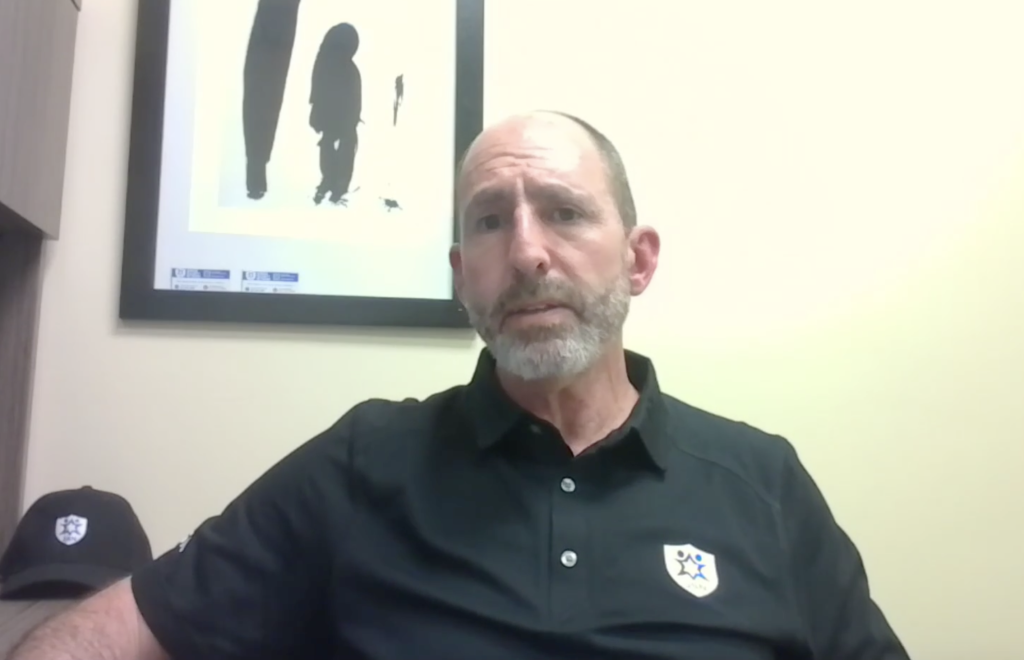 Jevon Greenblatt, the CEO of Toronto’s Jewish Security Network, funded by UJA Federation of Greater Toronto. (Credit: The CJN)Show Notes
Credits
Host and writer: Ellin Bessner (@ebessner )Production team: Zachary Kauffman (senior producer), Izzie Helenchilde (producer and video editor), Michael Fraiman (executive producer), Alicia Richler (editorial director)Music: Bret Higgins
Support our show