
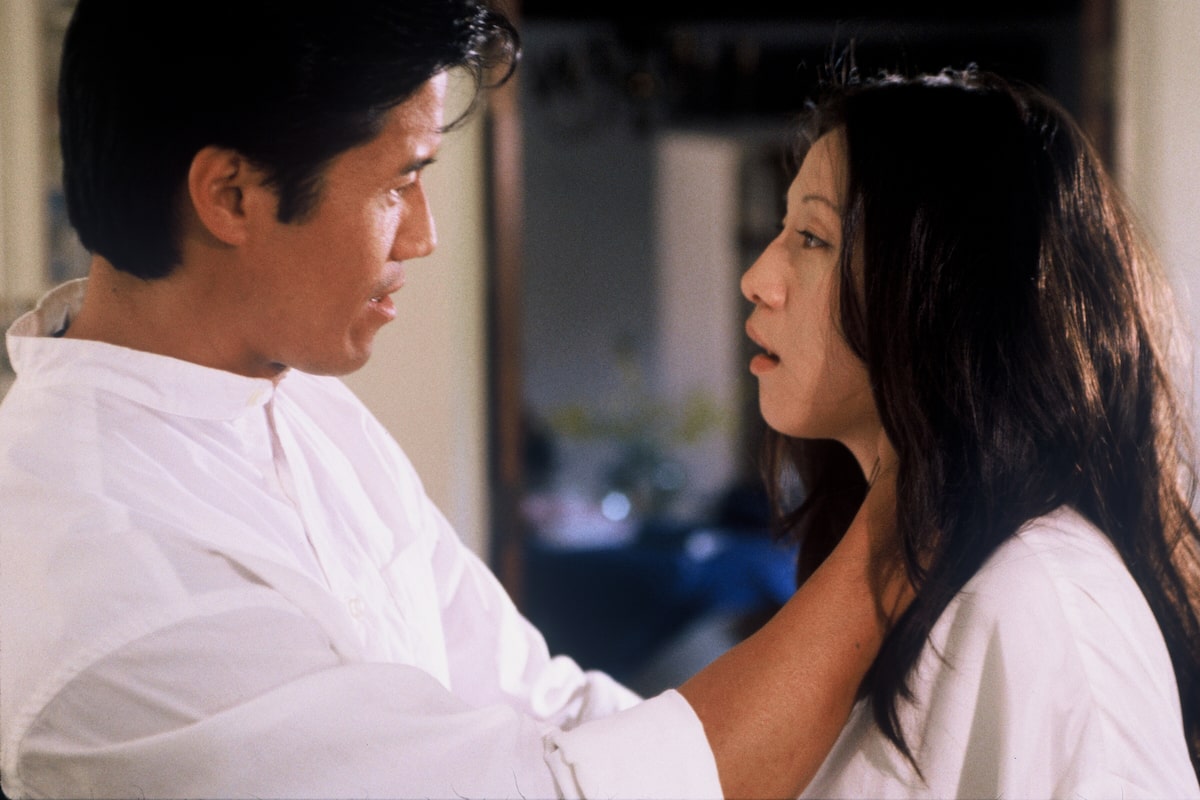
Quentin Lee and Justin Lin’s Shopping for Fangs interweaves two stories of young Los Angelenos reckoning with desire and doom.Vancouver Asian Film Festival/Supplied
If you have ever enjoyed a Fast & Furious movie, then you can thank the Canadian government. Before you crank your car’s nitrous oxide canister and speed away at 150 kilometres an hour à la franchise hero Dominic Toretto, hit the brakes and let me explain.
Today, Quentin Lee and Justin Lin are at the top of their respective cinematic worlds: the former a highly respected indie producer and director based in Vancouver, the latter one of Hollywood’s most sought-after filmmakers for big-budget spectacles, having directed five F&F films, one of the best Star Trek movies and the highly anticipated coming adaptation of Sony’s best-selling video game Helldivers. But back in the mid-1990s, Lee and Lin were just two struggling UCLA film students, constantly anxious that their big-screen dreams were forever just out of reach.
“There was no hope, no opportunity. The idea of going to film school then was that the best you could hope for out of that experience was to teach film afterward,” Lin recalls with a laugh. “I remember going, man, I’d be lucky to make one movie in my entire career.”
But then Lee, whose family had emigrated to Montreal from Hong Kong when he was a teenager, connected with the Canadian producer Camelia Frieberg – a regular collaborator of Atom Egoyan’s – while he was screening a compilation of his short films at the Vancouver International Film Festival. Impressed with Lee’s commitment to getting a feature off the ground while he was still a graduate student, Frieberg encouraged him to apply for a Canada Council for the Arts grant, writing him a recommendation letter to boot.
Soon, Lee and Lin had $50,000 to put toward their micro-budget debut feature Shopping for Fangs, a genre-bending dramedy exploring identity and culture that would put both filmmakers on the map, kick-starting a mini-revolution for Asian American cinema in the process. And now, three decades later, Shopping for Fangs is enjoying a true full-circle moment: After opening the inaugural edition of the Vancouver Asian Film Festival in 1997, a retrospective screening of Lin and Lee’s movie will serve as the opening-night programming for VAFF’s 30th edition this week.
With only a $50,000 budget, Shopping for Fangs kick-started a mini-revolution for Asian American cinema.Vancouver Asian Film Festival/Supplied
Influenced by a rash of early ’90s indie films – from Wong Kar-wai’s seductive, freewheeling romantic drama Chungking Express to Quentin Tarantino’s twisty Pulp Fiction – Shopping for Fangs interweaves two stories of young Los Angelenos reckoning with desire and doom. Lin’s contribution to the film focuses on a timid office clerk who believes that he’s slowly turning into a werewolf (a riff on the cliche that Asian men cannot grow facial hair), while Lee’s part of the narrative pivots around an emotionally abandoned housewife who suffers from amnesiac episodes.
Led by a pan-Asian cast of Chinese, Filipino and Vietnamese actors (including a young John Cho, who would go on to work with Lin twice more), Shopping for Fangs was designed to explore ideas beyond the theme of intergenerational conflict that dominated what little Asian-American cinema existed at the time, namely Wayne Wang’s The Joy Luck Club and Canadian Mina Shum’s Double Happiness.
At the time, some critics clustered Lee and Lin into what was known as the “Class of ’97” – or the slightly catchier portmanteau of “GenerAsian” – which counted a handful of other brash, stereotype-shattering filmmakers including Rea Tajiri (Strawberry Fields), Chris Chan Lee (Yellow), and Michael Aki and Eric Nakamura (Sunsets). But despite any informal grouping, Lee and Lin felt mostly on their own.
“The initial reception to the film, people were so confused. They were like, ‘Why are these characters Asian but they don’t do anything Asian at all? They’re not going to Asian restaurants, they’re not in Chinatown.’ We wanted to play with stereotypes and have a discourse in a more symbolic way,” recalls Lee. “But in some ways, Justin and I felt like outcasts.”
“We were like the two freaks,” adds Lin. “The playbook was, you’re supposed to embrace your identity and celebrate it, and we had a werewolf and all these crazy elements. … It felt a little suffocating when it came to anything Asian American. I grew up in the eighties in Orange County, and there were just so many unsaid rules about being a person of colour, and this was an attempt to say, ‘Hey, why does everybody on screen, if they’re Asian American, have to be there for an Asian American reason?’ We’re saying there’s something happening here where people are starting to shop for their identity.”
Shopping for Fangs was designed to explore ideas beyond the theme of intergenerational conflict that dominated what little Asian-American cinema existed at the timeVancouver Asian Film Festival/Supplied
Putting the notion of sweat equity to practice, Lin and Lee juggled several roles during filming: When Lin was directing a scene, Lee was his assistant director, and vice versa. The pair then endured a punishing round of post-production, alternating 12-hour shifts in the editing room (which was more of a hallway on campus). But that workaholic, little-to-no-sleep process is one that Lin retains today when working on the biggest of blockbusters.
“I grew up working class, and I was told you have to work harder as an immigrant. And then I met Quentin [Lee], who has a very different background but works freaking hard – he had this sense of confidence and entitlement in a good way,” says Lin.
“I was taught if you work hard, maybe someone will give you a chance. That’s bull. Nobody will give me a chance. And one of the biggest life lessons I learned from Quentin is that I work hard and I deserve this. That was a big switch for me.”
The pair’s first taste of mainstream exposure was shortly before their VAFF premiere, when Shopping for Fangs screened at the 1997 edition of the Toronto International Film Festival, playing in the now-defunct Perspectives Canada program.
“Roger Ebert came to our screening and then he left after reel three and never came back. I remember wanting to go up to him and say, ‘Mr. Ebert, hey man, if we had more money, I would’ve done it this way instead,’” recalls Lin. “What I learned from that was it doesn’t matter if you make your movie for $50,000 or $500-million – it’s somebody giving you their two hours. You have to be accountable for that time. That’s the responsibility of a filmmaker.”
After opening the inaugural edition of the Vancouver Asian Film Festival in 1997, a retrospective screening of Lin and Lee’s movie will serve as the opening-night programming for VAFF’s 30th edition this week.Vancouver Asian Film Festival/Supplied
While Shopping for Fangs received a hearty reception on the festival circuit, the hard truth is that it didn’t move too many needles for the pair, at least at first. Shortly after its release, Lin secured a part-time job making documentaries for the Japanese American National Museum in L.A. while still working toward his MFA. Lee, meanwhile, continued with his graduate studies and cobbled together resources to make his 2000 drama Drift.
Eventually, another UCLA student, Ernesto Foronda, would ask Lin for help on a screenplay that would become the crime thriller Better Luck Tomorrow. And it was that movie that would be championed during its 2002 Sundance premiere by Ebert (who sat through the whole screening this time), paving the way for Lin’s entry into the studio system and ultimately the multibillion-dollar F&F universe.
But without his run-and-gun experience with Lee three decades ago, Lin might have just stuck with that initial dream of teaching movies, instead of making them.
“Sometimes when you’re in the studio system, you can take that for granted. But I don’t, and it’s because of my experience on this film, which laid the groundwork and gave me the confidence for Better Luck Tomorrow and everything else,” says Lin. “I’m so grateful to Quentin, but also the Canadian government. I mean, to have that support? That was unbelievable.”
Shopping for Fangs screens Nov. 5 at the Vancouver Asian Film Festival, which runs through Nov. 15 (2026festival.vaff.org).