
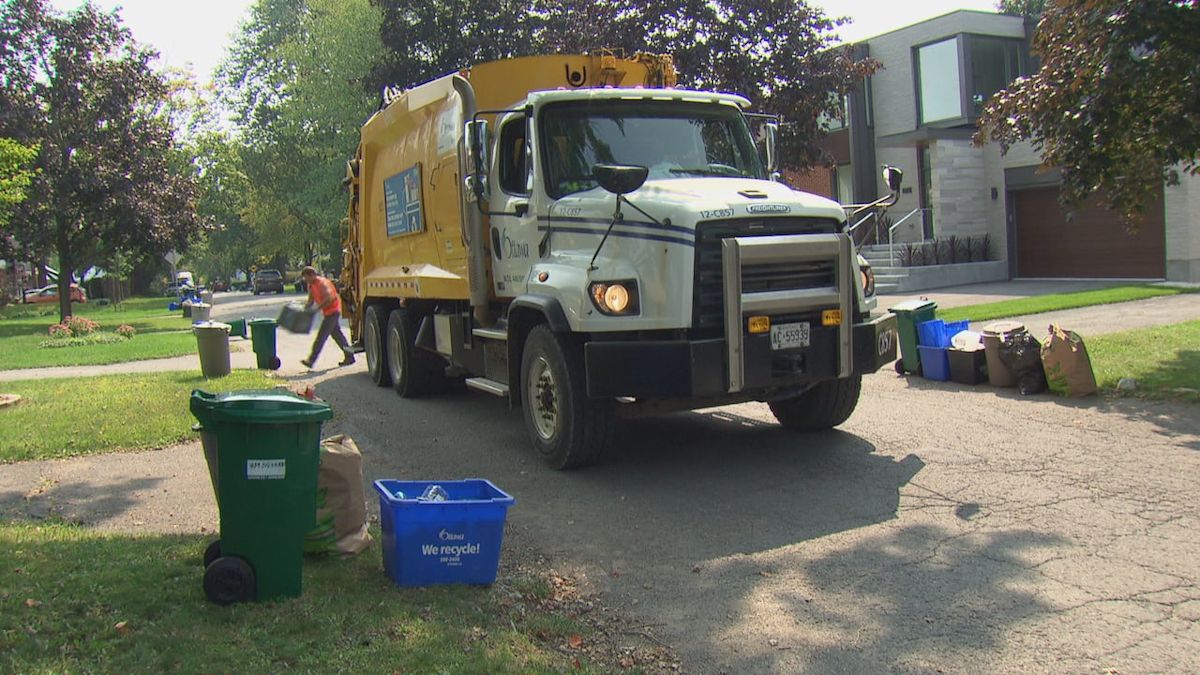
A new audit of the City of Ottawa’s garbage collection program has found inconsistent enforcement of collection rules and insufficient monitoring of its outside contractors.
The audit, conducted between January 2025 and May 2026 by the city’s Auditor General Nathalie Gougeon, looked at whether Ottawa has an effective curbside garbage collection plan that delivers value for money.
Auditors observed 21 garbage collection cases across Ottawa’s three collection zones in May and June 2026. The findings show collectors followed the city’s requirements in just two cases.
“In the other 19 cases, collectors collected ineligible garbage left at the curb by residents or did not issue a courtesy tag to the resident as required by operational guidance and the curbside collection contract,” said Gougeon in the review, released on Monday.
The report also found that complaints were the main method used to monitor contractor and resident compliance with its collection rules. The review says that limits the department’s ability to assess whether collection requirements are applied consistently.
“While we appreciate the City’s focus has been on educating residents … compliance and enforcement tools, including contractual and By-law mechanisms, were found to be infrequently used to address recurring non-compliance by contractors or residents,” Gougeon wrote.
Auditors found that 9,483 addresses received more than five courtesy tags between January 2025 and May 2026. Nearly 2,000 of those addresses were repeatedly tagged for exceeding the three-item garbage limit, but the required follow-up inspections rarely occurred.
Enforcement against contractors, which operate in two of the three collection zones, has also been limited. Despite finding multiple instances where rules weren’t followed, the city has only laid one fine of $282 against its collection contractor.
From an efficiency and value-for-money perspective, the audit found room for improvement in the city’s budgeting practices “by linking expenditures more closely to service cost drivers, such as staffing and fleet costs.”
Gougeon made eight recommendations to improve services, including updated guidelines and training for collectors, a reassessment of compliance inspection methods (including truck-mounted cameras), and the development of a framework to compare the cost and performance of municipal and contracted collection services.
City management agreed with all eight recommendations, with several improvements expected to be implemented through 2027 and 2028.