
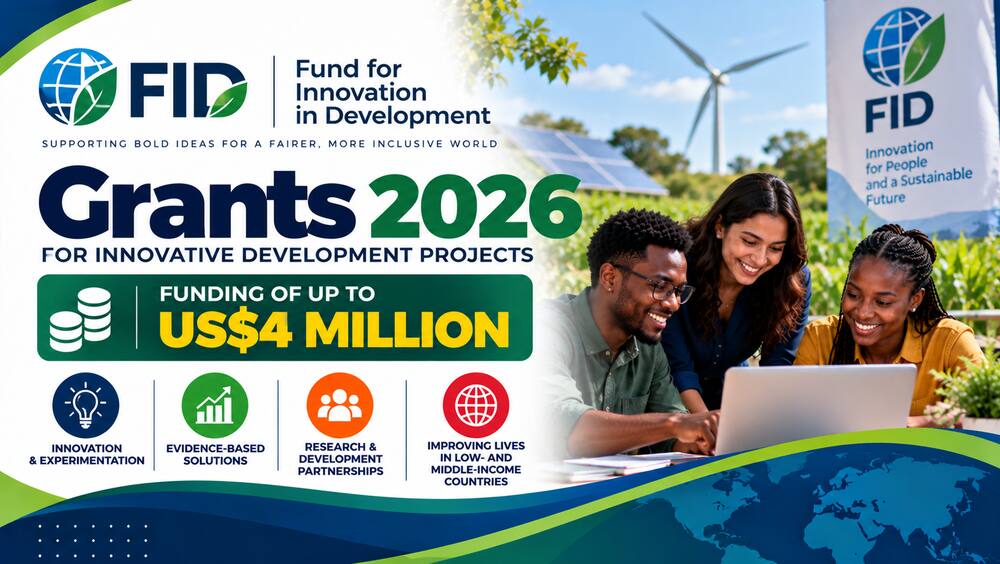
The Fund for Innovation in Development (FID) is inviting organisations to apply for grants to develop, test and scale innovative solutions that address poverty and inequality in low- and middle-income countries.
The fund supports projects across sectors, including agriculture, education, healthcare, climate, digital technology and livelihoods. It provides funding at different stages, from testing an innovation in real-world conditions to evaluating its impact and expanding solutions that have demonstrated results.
Applications are accepted throughout the year. There is no fixed deadline, and organisations can apply directly to the funding stage that matches their project’s level of development.
How Much Funding Is Available?
FID offers grants based on the maturity of the proposed innovation and the evidence available to support it.
Pilot Stage — up to €200,000: For innovations that have completed initial prototyping and are ready to be tested in real-world conditions.
Impact Evaluation Stage — up to €1.5 million: For innovations that have already been piloted and need rigorous evaluation to establish their impact.
Scale-Up Stage — up to €4 million: For innovations with demonstrated impact that are ready to reach more people.
Innovation and Public Policy Stage — up to €500,000: For public entities seeking to integrate an innovation into public policy and generate evidence to inform its wider adoption.
Evidence and Public Policy Stage — up to €500,000: For public entities seeking to strengthen the use of impact evidence in policy decisions and improve the systems supporting evidence-based policymaking.
FID also offers preparation grants of up to €50,000. However, these grants are currently being redesigned, and the next application window is expected to open in 2027.
The maximum amounts are funding ceilings, not guaranteed awards. The amount requested must be justified by the project’s activities, budget and development stage.
What Types of Projects Does FID Support?
FID considers innovations across sectors, provided they have credible potential to improve the lives of people experiencing poverty or vulnerability.
Potential areas include:
Agriculture and food systems: Technologies and business models that improve smallholder productivity, reduce post-harvest losses or strengthen food security.
Education: Solutions that improve learning outcomes, access to education or the effectiveness of education services.
Healthcare: Innovations that improve access to essential health services or deliver better outcomes at a lower cost.
Climate and environmental sustainability: Approaches that help vulnerable communities respond to climate risks or improve environmental outcomes.
Digital technology: Tools that make essential services more accessible, affordable or effective.
Livelihoods and financial inclusion: Solutions that improve income opportunities and access to services for underserved populations.
Governance and public policy: Innovations that help public institutions deliver services more effectively or use evidence to improve decisions.
FID does not fund projects simply because they use new technology. Applicants must explain the development problem they are addressing, how their solution is expected to work and why it could deliver better results than existing alternatives.
The fund does not finance emergency humanitarian aid or infrastructure projects in themselves.
Who Can Apply?
FID accepts applications from legally constituted organisations, including:
Non-governmental organisations and associations.
Social enterprises and private companies.
Universities and research institutions.
Foundations and cooperatives.
Public institutions and government entities.
Eligible organisations working together in a consortium.
Applicants can be registered in different countries, but the project must be implemented in a country eligible for official development assistance under the relevant OECD framework, subject to FID’s geographic restrictions.
Individual applications submitted by people in their personal capacity are not accepted. International and multilateral public institutions, including United Nations organisations and international financial institutions, are also ineligible.
Nigerian organisations can consider applying if their proposed project meets the geographic, organisational and funding-stage requirements.
What Does FID Look for in an Application?
FID assesses applications against three main criteria. The evidence required depends on the funding stage.
1. Potential impact
Applicants must explain the problem their innovation addresses and provide a credible account of how the proposed activities will produce the intended results.
The application should include a clear theory of change, supported by relevant evidence where available. Applicants seeking funding for later-stage projects must provide stronger evidence of actual results.
2. Cost-effectiveness
The proposed innovation should have the potential to improve development outcomes more effectively or at a lower cost than existing approaches.
Applicants should explain the project’s main costs, the results expected from those costs and how cost-effectiveness may change as the solution expands.
3. Potential to scale
FID considers whether the innovation can reach more people and remain financially and operationally sustainable over time.
Applicants should identify the resources, partnerships, funding and operational arrangements required to expand the solution. They should also address the risks that could prevent successful implementation.
What Documents Are Required?
Before starting an application, organisations should prepare the information and documents relevant to their chosen funding stage.
These include:
A project proposal explaining the problem, proposed innovation and planned activities.
A theory of change describing how the project is expected to achieve its intended outcomes.
A project budget using FID’s required budget template.
Information about the applicant organisation and project team.
Available evidence supporting the innovation and its expected impact.
Monitoring, evaluation or research plans where required by the funding stage.
Projects applying for impact evaluation or scale-up funding will need to demonstrate a level of evidence appropriate to those stages. Scale-up applicants must already have demonstrated the innovation’s impact and cost-effectiveness.
FID provides an application form, budget template, call-for-proposals guide and a decision tool to help applicants identify the appropriate funding stage.
How to Apply
Interested organisations can follow these steps:
Visit the FID online application platform.
Read the call-for-proposals guide and frequently asked questions to understand the eligibility rules.
Use FID’s decision tool to identify the funding stage that matches the project’s maturity.
Download and review the application form and budget template.
Prepare the project proposal, budget and supporting evidence.
Complete and submit the application through the online platform.
Applications may be submitted in English or French. The call remains open throughout the year, so organisations can apply when their proposals are ready.
Application deadline: No fixed deadline; applications are accepted year-round.
Funding amount: Up to €200,000 for pilot projects, €1.5 million for impact evaluations and €4 million for scale-up projects. Public policy funding is available up to €500,000.
Application link: Apply to the Fund for Innovation in Development
For technical difficulties with the application platform, contact FID at [email protected]. Applicants should consult the published guidance before contacting the fund about project eligibility, as FID does not conduct individual eligibility assessments before submission.