
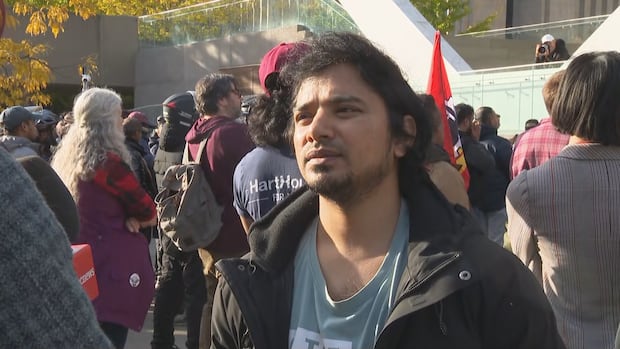
Hundreds of delivery drivers gathered at a protest in downtown Toronto on Monday to demand that their employers provide fair pay, safe working conditions and dignity at work.
A newly formed group, called Delivery Drivers United, organized the protest in Nathan Phillips Square. The group is made up of more than 900 workers who work for such platforms as Uber Eats, Skip and DoorDash.
Ameer Ali, a delivery driver for Uber Eats and DoorDash, among others, said it’s difficult to make a living delivering food. The work involves long hours, lots of traffic and unsafe conditions, he said.
“We are working 24 by seven. We are putting our lives at risk on roads … We are risking our lives to deliver something good for the customers,” Ali said.
“I have delivered an order for $3, which is for six kilometres and it took me 45 minutes to deliver,” Ali said.
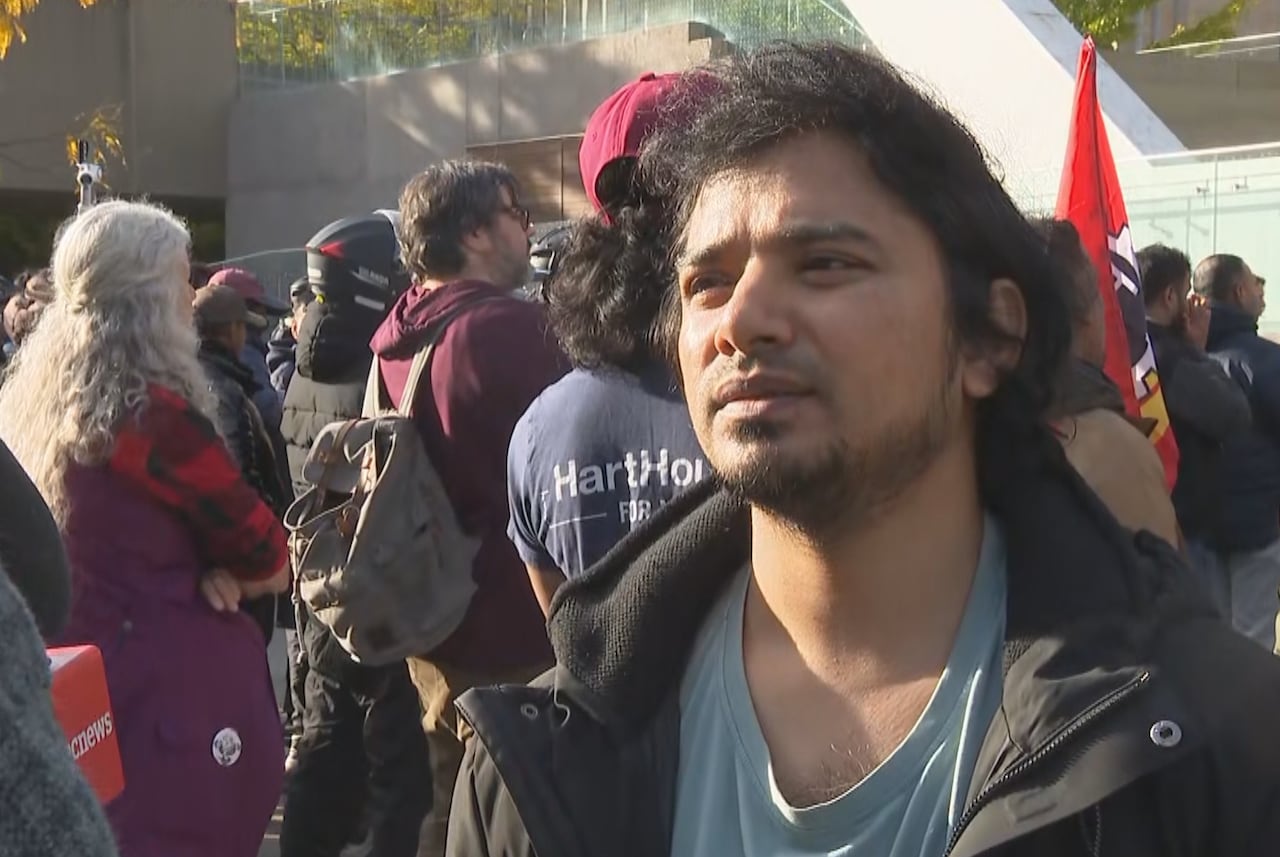
Ameer Ali, a delivery driver for Uber Eats and DoorDash, among others, said it’s difficult to make a living delivering food. The work involves long hours, lots of traffic and unsafe conditions, he said. (Prasanjeet Choudhury/CBC)
After listening to speakers, the drivers made their way to Uber Canada’s headquarters at Bloor and Church streets, to deliver a letter with their demands.
The demands include a living wage, a fair and transparent process for calculating base fare before tips and an explanation of how unexpected wait times are considered in base pay. The drivers also demanded expanded health insurance coverage, including for on-the-job accidents, and guaranteed access to restaurant washrooms and indoor waiting spaces.
“We know we have made Uber immense profits. But those profits come at a great cost to us. We receive unlivable wages, are made to put our health and safety on the line, are treated as though we have no dignity by Uber and the restaurants we deliver for, and can lose our jobs without warning,” the letter says.
“We will no longer tolerate the way Uber and other app-based delivery companies exploit us. We know our power. We know you depend on our labour.”
Most drivers make $1.50 for 30 minutes, organizer says
Samuel Nithiananthan, a community organizer based in Toronto who has been working with Delivery Drivers United, said the group has been meeting for months in parking lots, restaurants and in their apartments.
“The rest of the city needs to see what’s happening,” he said. “Most of these drivers are making $1.50 a delivery for 30 minutes, $3 a delivery — and Uber made $52 billion last year.”
In a statement to CBC Toronto, Uber Canada said it provides pay transparency and meets provincial minimum wage standards while preserving the flexible work model that couriers value. Skip and DoorDash both provided similar statements.
Isha Chaudhuri, spokesperson for Uber Canada, said: “We appreciate delivery people raising what matters to them. We have a common goal of transparency, safe working conditions, and respectful treatment for delivery people.
“Through our work with UFCW Canada (United Food and Commercial Workers Union), we’re supporting delivery people with representation services and advocating for broader benefits and protections while preserving the flexibility they value.”
Skip said it champions a “courier-first model rooted in transparency and autonomy.”
“Skip fully complies with Ontario’s Digital Platform Workers’ Rights Act, upholding minimum wage standards alongside clear pay transparency and fair dispute resolution for couriers on our network. We will continue to collaborate directly with couriers to address feedback,” a spokesperson for Skip said.
DoorDash, for its part, said it’s flexible by design, allowing its workers to choose when, where and whether to worK.
“We respect Dashers’ right to share their views, and we always welcome their feedback. Dashers in Ontario are guaranteed at least the provincial minimum wage of $17.95 per hour while on delivery, before tips. Dashers also keep 100 per cent of their tips.”
But the drivers take issue with the idea that their work is supplemental and flexible.
Nithiananthan said: “We keep on calling it gig work, but many of these guys work 15-hour days, 12-hour days for less than minimum wage.
The drivers also want the general public to be aware that some things are outside their control.
More rallies planned to make companies bargain
Haitham Ali, a delivery driver for more than one year, said orders are sometimes late.
“Sometimes I wait for an order for 30 minutes and the customer thinks that I’m the one wasting time,” he said.
In a statement, Delivery Drivers United said: “Workers further move constantly between apps, chasing orders and short-term promotions to make enough money to live. Drivers say companies offer temporary incentives to attract workers, then reduce rates, leaving them working longer hours for less money.”
Organizers said the rally is their first public demonstration and they’re planning others with the aim of getting delivery platforms to the bargaining table.