
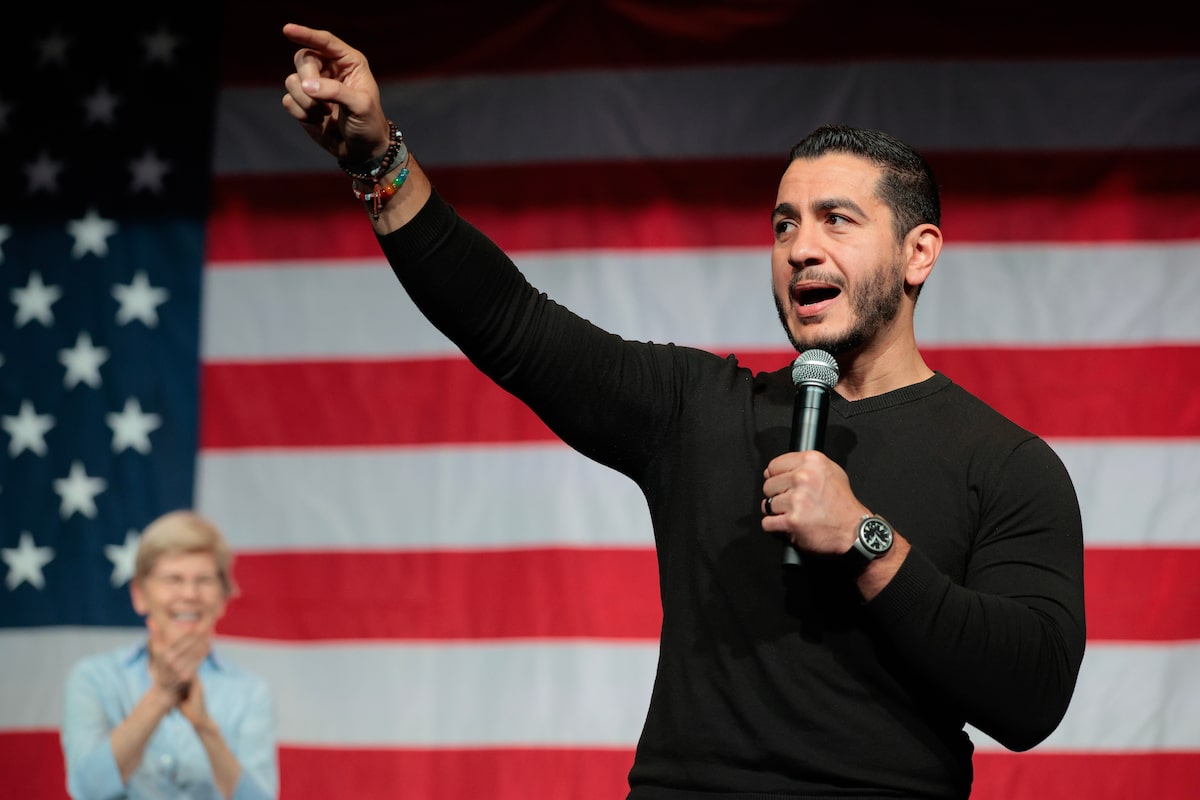
Democratic Senate candidate Abdul El-Sayed speaks during a campaign town hall at Cadillac High School in Michigan earlier this month.Chip Somodevilla/Getty Images
Abdul El-Sayed is a brash millennial leftist. His political agenda includes bringing single-payer health care to the United States and abolishing Immigration and Customs Enforcement. In thundering campaign speeches, he rails against the corruption of the country’s politics by moneyed interests.
But unlike Representative Alexandria Ocasio-Cortez or New York Mayor Zohran Mamdani – the populist progressives whose electoral success he aims to replicate – Mr. El-Sayed is not running in a safely Democratic jurisdiction. Instead, the 41-year-old former public-health official is seeking to become a U.S. senator for Michigan, one of the country’s most competitive swing states.
If he wins decisively on Nov. 3, he would give the left its first evidence that a sweeping reform agenda can appeal to a broader swath of the country. He would also make history as the first Muslim ever elected to the Senate.
And in the dying days of the campaign, U.S. President Donald Trump and his Republicans have focused squarely on attacking Mr. El-Sayed’s religion. Looming over it all are the deep fissures among Michigan Democrats over the Israeli-Palestinian conflict – divisions that helped deliver the state to Mr. Trump in 2024.
David Shribman: Democrats face a crisis of identity. They are not ready for the challenge
It all means that, even amid an expected coast-to-coast Democratic wave, most polls show Mr. El-Sayed running only slightly ahead of his Republican opponent, former congressman Mike Rogers, in a race that could determine control of the upper chamber.
Much of Mr. El-Sayed’s rise has been fuelled by young voters attracted to the ambitious solutions he proposes for rising food, housing and medical costs.
Maddox Rockwell, a 19-year-old student at Wayne State University in Detroit, said he, his single mother and his two siblings are all on Medicaid, a government health care program that Mr. Trump’s Republicans cut back last year. He likes Mr. El-Sayed’s promise of “Medicare for All,” a Canadian-style system that would guarantee public coverage to everyone.
“He’s very genuine, he’s coming from a place of concern and care,” Mr. Rockwell said as he queued for one of the candidate’s rallies. “There’s not enough care for the upcoming generation, what we have to face.”
For Gabriel Farran, Mr. El-Sayed’s appeal is his promise to get money out of politics: He is pledging to put caps on campaign spending and ban the super PACs that flood the airwaves with attack ads.
In Michigan, Trump’s trade war with Canada rankles both Democrats and Republicans
It was enough to get Mr. Farran, a 22-year-old IT student at the University of Michigan, to vote for the first time in his life. “The reason I haven’t voted previously is because I’ve seen corrupt politicians and a lot of money going to the wrong places instead of being spent on people,” he said.
Others are drawn to Mr. El-Sayed’s pugnacious personality. “We need a tough guy like him up against Donald Trump,” said Linda Sarigiannis, a 75-year-old therapist in the Detroit suburbs. “He acts like a man.”
In speeches and interviews, the candidate describes Mr. Trump as an “idiot,” a “fool” and a “nepo baby.” One campaign video has him pumping iron to Muhammad Ali’s “I’ll show you how great I am” riff. In another, he taunts Mr. Rogers over the size of a Democratic campaign rally in a normally conservative small town.
Konrad Yakabuski: Socialist Zohran Mamdani is transforming the Democratic Party
Born in Michigan to Egyptian immigrant parents, Mr. El-Sayed was raised in the affluent Detroit suburb of Bloomfield Hills by his father and stepmother, both university engineering professors. During stints as the public-health director for the city of Detroit and surrounding Wayne County, he started programs to supply free glasses to schoolchildren and eliminate medical debt for low-income residents.
It is Mr. El-Sayed’s Islamic faith that has been the Republicans’ top target. At a rally in Michigan this past weekend, Mr. Trump called the Democrat a “jihadist” who is “on the side of the terrorists.” In a television interview, Mr. Rogers accused Mr. El-Sayed of supporting a “radical Islamic agenda.”
At a Republican campaign office in Bloomfield Hills, Bryan Szmytke, 30, the finance chair for the local party, said “the terrorism angle” is the message that resonates most with voters at the doors. Medicare for All, usually used by the GOP to paint Democratic progressives as anti-capitalist extremists, “hasn’t even come up,” he said.
Standing outside an advance polling station in Dearborn, a Detroit suburb with a large Muslim population, Hala Alaouie said she hoped the sheer brazenness of some of the bigotry would push people to confront it.
“We see more Islamophobia and racism toward him than people think,” said Ms. Alaouie, a 20-year-old university student. “A lot of people are starting to finally wake up and realize this is important.”
At a meeting of local Democrats in Novi, another Detroit suburb, party activists said Mr. El-Sayed is struggling to win over Jewish voters, whose highest concentration in the state is found here in Oakland County. During canvasses, they said, some voters have told them they will vote for the rest of the Democratic slate but leave the Senate portion of the ballot blank.
“It’s split apart friend groups,” said Diane Smith, 65, vice-chair of the Novi Democrats.
Mr. El-Sayed has accused Israel of apartheid and genocide, and supports cutting off the military aid it receives from the U.S. The American Israel Public Affairs Committee backed Haley Stevens, Mr. El-Sayed’s opponent in the Democratic primary, and is now helping fund Mr. Rogers’s campaign.
Republican nominee for U.S. Senate Mike Rogers speaks during a campaign event on Wednesday in Grosse Pointe Woods, Mich.Paul Sancya/The Associated Press
Throughout the campaign, Mr. El-Sayed has been dogged by his decision to make public appearances during the primary with Hasan Piker. The Twitch streamer and left-wing pundit has said the U.S. “deserved” the Sept. 11 terrorist attacks and that it has engaged in more terrorism than al-Qaeda. Mr. El-Sayed has disavowed such comments and said he won’t be campaigning with Mr. Piker again.
The problem facing Democrats now is the mirror image of the one they had in 2024. That year, many in Michigan’s large Arab-American community protested then-president Joe Biden’s support for Israel by voting “uncommitted” in the Democratic primary and for Mr. Trump in the general election.
There is also worry that Black voters won’t turn out in sufficiently high numbers, out of frustration with Arab-Americans over the 2024 election. In the primary, Ms. Stevens won Detroit, a city with a 77-per-cent Black population, as well as most of its suburbs.
Bret Scott, mayor of the Detroit suburb of Pleasant Heights and a member of the Black Mayors of Michigan, said Mr. El-Sayed should not be blamed for Arab-Americans helping tip the state to Mr. Trump two years ago.
“There were historical things that just happened between the two communities and they were applied to him, even though he was not any of the things that people were espousing of him,” Mr. Scott said.
Tony Keller: Clean up in aisle 3! Zohran Mamdani’s misguided recipe for cheaper groceries
Amid all this, Mr. El-Sayed has worked to frame his politics within the U.S. mainstream. Unlike Mr. Mamdani and Ms. Ocasio-Cortez, he explicitly identifies as a capitalist and not a socialist. And he weaves together anti-oligarch populism with bread-and-butter economic messaging and sentimental patriotism.
“It just shouldn’t be this hard in the richest, most powerful country in the history of the world” to get by, he told about 4,000 supporters in the cavernous gymnasium of Cass Technical High School in Detroit this past weekend.
He placed the blame squarely on “the system that allows Big Tech and Big Oil and Big Pharma and big banks to buy politicians and rig the system against the rest of us.”
As a child, he recounted, he would travel to both Egypt and Detroit and find the same gap in life expectancy compared with his well-off suburb.
“No one understands the promise of America like a kid who was born here but for the accident of history,” he said. “I love America. I’m so grateful I get to raise my two daughters here in America. I just love America enough to call on her to be America for all of her kids.”