
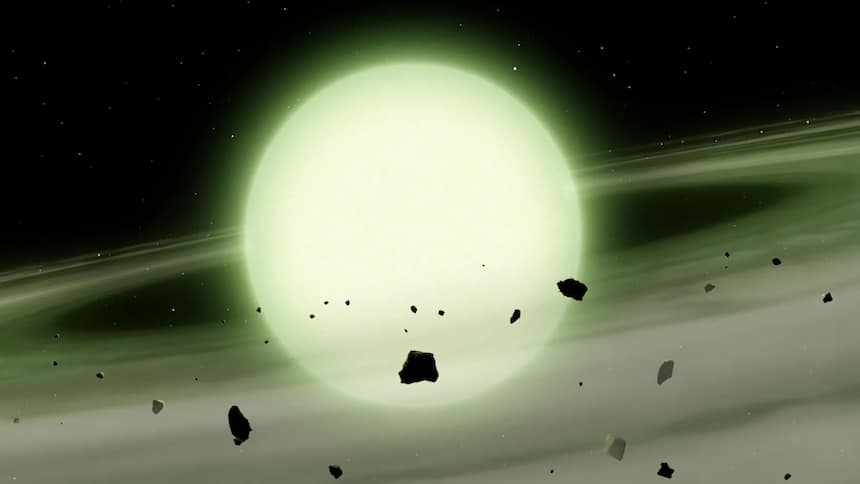
Star’s hue comes from special chemistry in its atmosphere
There’s a star in our night sky that looks a little ill. Or maybe haunted. Or both.
Don’t worry, though — it’s neither of those things. But it does have scientists excited.
For the first time, astronomers have identified a green star — known as WD J1330+6435 — in the Milky Way galaxy about 280 light-years from Earth in the constellation Draco.
It is a type of star called a white dwarf, but glows green due to special chemistry taking place in its atmosphere.
What ‘s behind the colours of stars?
Typically, a star’s colour is based on its temperature, with the hottest stars appearing a pale blue and cooler stars appearing orange. Stars in between are more white.
But then there’s a different kind of white star, called a white dwarf.
They occur when stars die and stop emitting light through nuclear fusion, leaving behind their much smaller cores that instead emit their light through residual heat.
Although they’re typically white, scientists have found that changes in their chemistry over time can turn them into other colours.

Although stars are typically thousands of times the size of Earth, the white dwarf stars they become after death are more akin to the size of Earth, but many times more massive. Image credit: Scott Wiessinger/NASA’s Goddard Space Flight Center)
The green star
With our fastest spaceships, it would take many thousands of years to reach the green star.
But thanks to telescopes, we can get a decent idea of what’s going on with WD J1330+6435.
“We first became interested in this white dwarf because bits of planetary material have fallen onto its surface,” said astrophysicist Mark Hollands of the University of Warwick in England, lead author of the study that identified the star’s green hue.
That planetary material has enriched the star’s atmosphere with elements like calcium, lithium and sodium.
But it’s the sodium that’s the key ingredient to the green glow.
Typically, sodium glows orange when it absorbs light, like the sodium in streetlamps.
But Hollands said the density of the star’s atmosphere is altering the sodium’s structure in a way that causes it to absorb orange, yellow and red wavelengths all at once, mixing them.
“What you’re left with is a star that has a beautiful chartreuse green glow, something that wouldn’t be possible for sun-like stars,” Hollands said.
Other colours identified
The discovery was part of a larger project studying how various white dwarfs — 151 in total — would appear to the human eye.
Turns out green isn’t the only colour scientists found. Depending on the chemistry of the white dwarf, they found stars could be colours like purple, yellow, cyan and even pale blue.
“In the end, it’s all very similar to the mixing of colours in the palette of a painter. They start with a few basic colours, then mix them together to form any colour they need for their painting,” said Boris Gänsicke, a University of Warwick astrophysicist and co-author of the study.
One star they examined— a white dwarf 48 light-years away named WDJ1011+2845 — was even salmon pink.
Unlike the green star, it was carbon that was responsible for its hue, not sodium.
Have more questions? Want to tell us how we’re doing? Use the “send us feedback” link below. ⬇️⬇️⬇️
With files from Reuters