
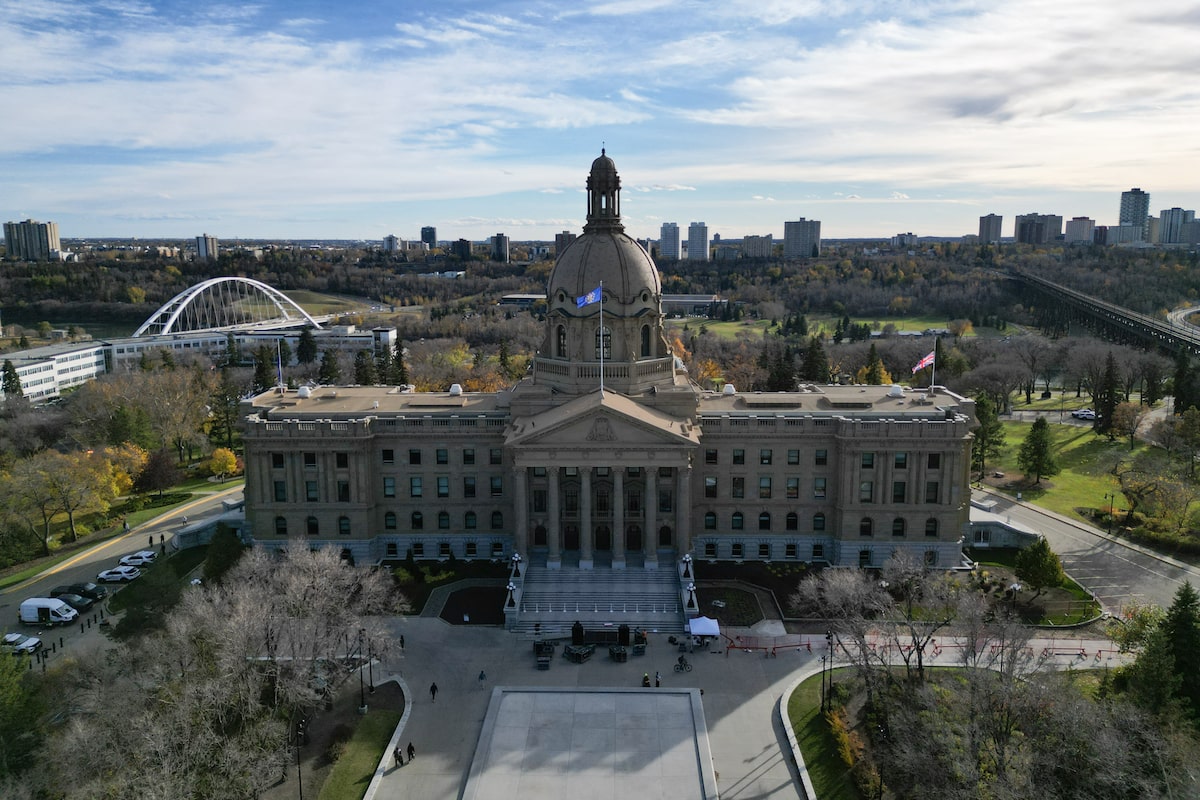
The new electoral map is expected to be debated on Wednesday afternoon in the Alberta Legislature.DAPHNE LEMELIN/AFP/Getty Images
Alberta Premier Danielle Smith is rejecting allegations that an independent panel has torqued the province’s electoral map to favour her United Conservative Party, saying the recommended changes to redraw the boundaries are reasonable and would give voters better representation.
Speaking to reporters on Tuesday, Ms. Smith said she also endorses changes to the electoral map in southern Alberta, which have become the greatest source of contention since the province’s proposed boundaries were released publicly the day before.
The new map proposes eliminating one of Lethbridge’s two urban ridings while creating three new districts that mix the city’s suburban neighbourhoods with swaths of rural southern Alberta.
The change has provoked charges of gerrymandering, the U.S.-style practice of manipulating boundaries to give one party an unfair advantage in elections.
“I think Lethbridge would be very well served by having four representatives,” Ms. Smith said, offering her first thoughts on the proposed map since it was published Monday.
Ms. Smith added that she hopes the Alberta NDP’s promised legal challenge of the map doesn’t come to pass, but that her government would assemble a legal team if necessary. (Alberta NDP Leader Naheed Nenshi said his party can only file a legal challenge if the government adopts the map.)
New Alberta electoral map proposes vast changes to urban ridings
The map is expected to be debated on Wednesday afternoon in the Alberta Legislature, where Ms. Smith’s UCP holds a majority of seats.
The electoral map of Alberta is redrawn every eight to 10 years through a process designed to foster compromise and limit political influence. Adopting the recommendations of independent panels, which are often passed with little public scrutiny, has been the standard for provincial legislatures and federal Parliament for decades.
Alberta’s latest redrawing, however, has fuelled accusations of gerrymandering ever since Ms. Smith decided in April to upend the process and reject the recommended map of an earlier independent panel. She then formed a committee to set up a new panel, which delivered a fresh map on Monday.
Alberta’s system dictates that the governing party selects the chair and two panelists while the Official Opposition picks the remaining two.
Of the panelists tasked with drawing the latest map, the two selected by the NDP have added to the accusations of gerrymandering, singling out the changes in Lethbridge.
These two panelists – University of Alberta constitutional law professor Gerard Kennedy and former Okotoks, Alta., town councillor Brent Robinson – wrote in a separate report that they believe some of the new recommended ridings would be “constitutionally fraught” and will likely face a legal challenge.
The remaining three panelists, including panel chair and retired judge Brian O’Ferrall, dismissed their counterparts’ criticisms at several turns through the 300-plus-page report, accusing them of “sanctimonious passing of judgment” and “extreme, unjustified and unnecessary criticisms.”
In the report, Mr. O’Ferrall also singled out political scientists, complaining that they have “preferred to stoke the flames of controversy” instead of contributing “to the public’s understanding of the electoral boundary process.”
Alberta’s next general election is scheduled for Oct. 18, 2027. It is unclear what electoral map would be used for that vote if the NDP launches a legal challenge. Elections Alberta has warned it may not have enough time to prepare for the election, should the new maps be adopted or a legal challenge delays the map from being implemented.
Opinion: Alberta’s electoral map shows who conservatives think ‘real’ Albertans are
Kara Westerlund, president of Rural Municipalities of Alberta, said on Tuesday that rural leaders are concerned about hybrid ridings, noting the association’s members represent 85 per cent of the province’s land mass but 15 per cent of the population.
“Our main concern is just the fact that we feel that the rural voice and our issues are going to be diluted with [hybrid ridings],” she said.
Politicians from mid-sized cities have cautioned against sweeping hybrid ridings, pointing to the risk that city residents could be represented by people who don’t live in their area or understand their needs.
University of Calgary political scientist Lisa Young said she believes the map is gerrymandered, most clearly underlined by the proposed changes in Lethbridge.
The City of Lethbridge is currently split into two urban electoral districts, with one represented by the NDP and the other by the UCP. Both seats have been competitive since 2015, when the provincial NDP formed government for the first time.
While the NDP would likely win in the city’s new urban riding, the UCP would be heavily favoured to win the three new ridings that extend hundreds of kilometres beyond city boundaries.
“All of this has partisan consequence. It does, to me, look like a deliberate attempt to draw lines on the map in a way that would advantage one party – the governing party – at the expense of the opposition party,” Prof. Young said.
She added that Alberta’s boundary redrawing process may need to be revamped. Other provinces, such as British Columbia, have systems that further remove the process from political influence.
“To have essentially two failed efforts at coming together around a map says that there’s something desperately wrong here,” Prof. Young said.
“It raises the question of whether this sort of bipartisan commission approach that we’ve been using works in a polarized system.”
With reports from The Canadian Press