
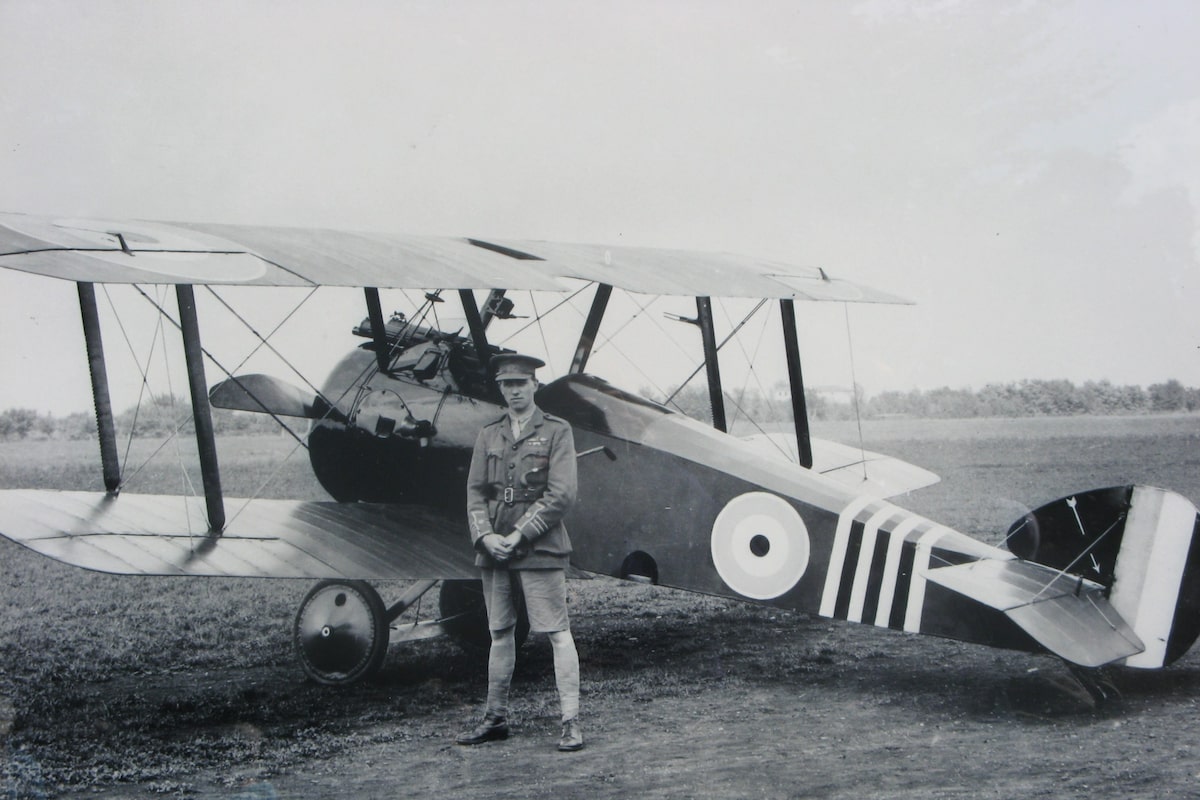
William Barker, a First World War flying ace, is the most-decorated service member in Canadian history.Pat Hewitt/The Canadian Press
No one in Toronto could remember a funeral as large or elaborate as William Barker’s.
Two thousand troops paraded city streets in front of 50,000 mourners. The guest list included the premier, the mayor, federal and provincial cabinet ministers, judges and much of the country’s military brass. A squadron of planes released a shower of rose petals.
The date was March 15, 1930. The country was lurching toward the Great Depression. Unemployment approached 15 per cent. The weary country longed for a hero. In Mr. Barker, they found one.
And then promptly lost him.
Mr. Barker’s wartime heroics were once the stuff of movies, comic books, an Ernest Hemingway short story: 50 enemy aircraft destroyed, 12 gallantry awards, one legendary dogfight with upwards of 15 German Fokkers.
But his memory began to fade from public consciousness in the years after his death, until few but his family and military history buffs could distinguish Mr. Barker from the more renowned ace Billy Bishop.
On Wednesday, admirers and family members of Mr. Barker will gather to unveil a statue of the pilot in midtown Toronto, part of a broader effort to resurrect appreciation for him and the fighting forces he represented.
“If he was an American, you can damn-well bet there’d be a movie about him,” said Capt. Cal Bricker, special adviser to the Commander of the Royal Canadian Navy. “This kid from Dauphin ends up as a national hero and then has a tragic end.”
From the archives: Canada’s most-decorated war hero finally gets his due
The script starts in rural Manitoba. Born in a log cabin to farmer parents, he was a quintessential prairie boy, as skilled on a horse as he was with a rifle.
He left for war in 1914 at age 20, enlisting as a trooper in the 1st Canadian Mounted Rifles Regiment. After several months machine-gunning in the foul trenches of Belgium, he decided he’d rather wage war in the skies and volunteered for the Royal Flying Corps as a gunner.
By February 1917, he’d completed pilot training in England. He flew a Sopwith Camel in France, and then Italy, where he earned the “ace” designation given to any aviator who shot down five or more enemy aircraft.
The kills would come in bunches – 22 by April 1918 – but he would also specialize in low-altitude ground assaults, for which one character in Hemingway’s The Snows of Kilimanjaro called him “a bloody murderous bastard.”
His final mission came on the morning of Oct. 27. He shot down a German reconnaissance plane stirring a swarm of enemy aircraft. Fifteen broke off to pursue Mr. Barker, their rounds striking the Canadian in both thighs and the left arm. He fainted, but regained consciousness long enough to crash-land his bullet-riddled plane behind Allied lines.
He survived, adding the Victoria Cross, the British Empire’s highest award for military bravery, to a collection of honours that made him Canada’s most-decorated service member – a designation that remains to this day.
His postwar life was nearly as eventful. A full-on Canadian celebrity, he founded one of the country’s first commercial airlines with his close friend and fellow ace Billy Bishop before becoming the first president of the Toronto Maple Leafs.
In the early 1930s, he became vice-president of Fairchild Aviation Limited of Canada, but died crashing a company biplane into the frozen Ottawa River near the Rockcliffe airfield.
The massive funeral and subsequent naming of Barker Field, an airfield in North York, kept his memory alive. But the field would close in 1953, and his name gradually faded.
“People would think they recognized the name but it would turn out they were thinking of Billy Bishop,” said Ian Mackenzie, Mr. Barker’s grandson.
All that changed in 2009, when veteran pollster John Wright bought a book about Toronto’s Mount Pleasant Cemetery. He intended to keep it in the bathroom. But the entry on Mr. Barker caught his attention. He lives near the cemetery and walked over to have a look at the Barker grave. It proved elusive, lying within a crypt marked with his wife’s maiden name, Smith.
He could hardly believe that the country’s most-decorated service member had no public marker and, with the family’s permission, began a 17-year campaign to cure the national amnesia.
He enlisted a long list of people and organizations to help establish major Barker monuments at Mount Pleasant and Rockcliffe.
On Wednesday, he’ll be on hand to unveil a Barker statue by sculptor Armando Barbon.
At 2:30 p.m., a ceremonial parade will head along Yonge Street – the same street Mr. Barker’s funeral procession followed 96 years ago – ending at Mount Pleasant Cemetery, where more than 400 veterans’ graves will be illuminated.
“This is not just about Barker,” said Mr. Wright. “It’s about all of them, all the veterans, and this provides a convening place where we can all go and remember who they were in the past and who they are today.”