
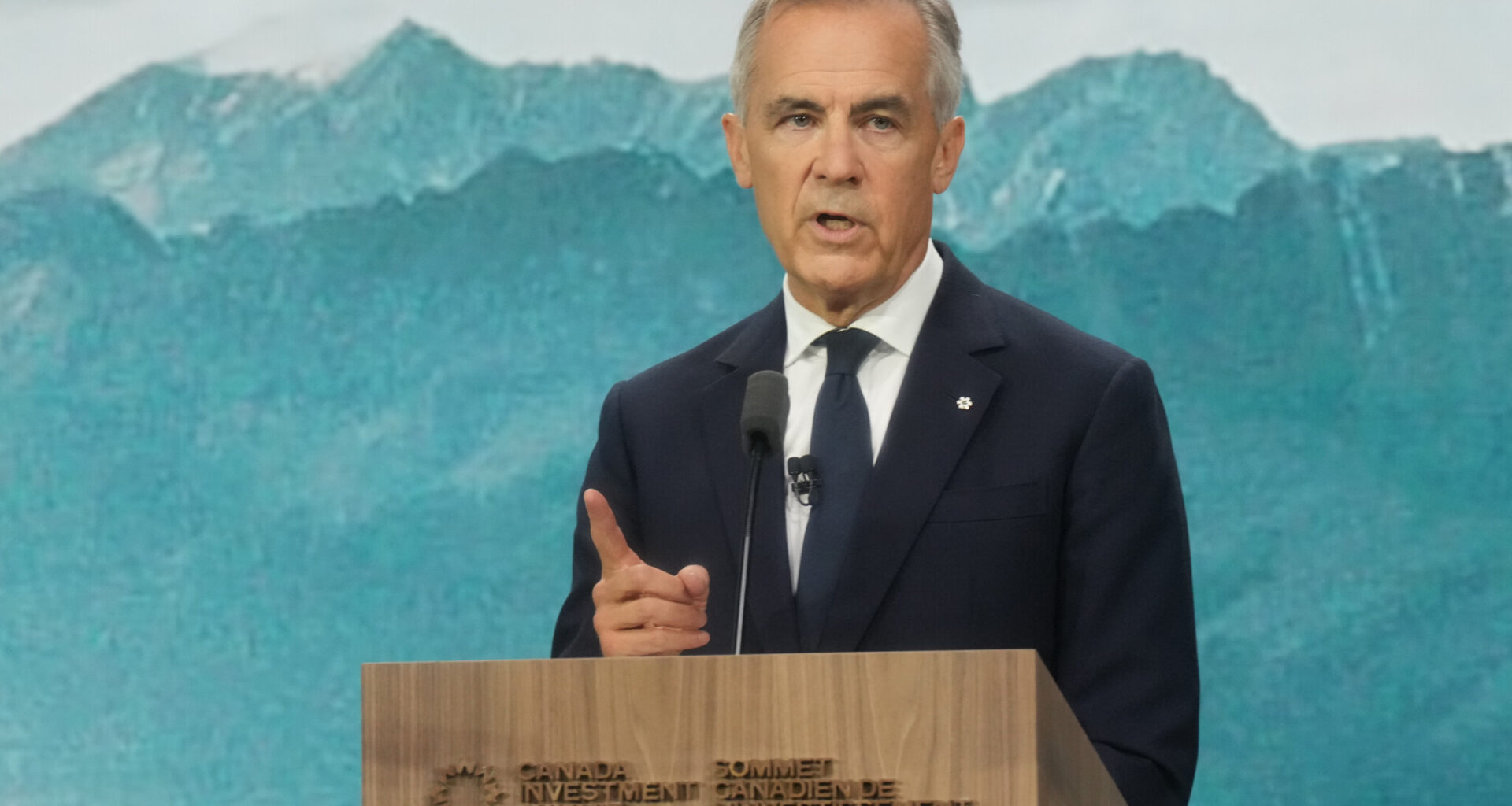
Prime Minister Mark Carney’s much-anticipated second budget, titled “Masters of Our Destiny,” falls well short of expectations.
Ottawa received a windfall and spent nearly all of it. And while it continues to use a made-up accounting system that flatters the books, interest on debt rises much higher than the spring update projected.
Where the windfall went
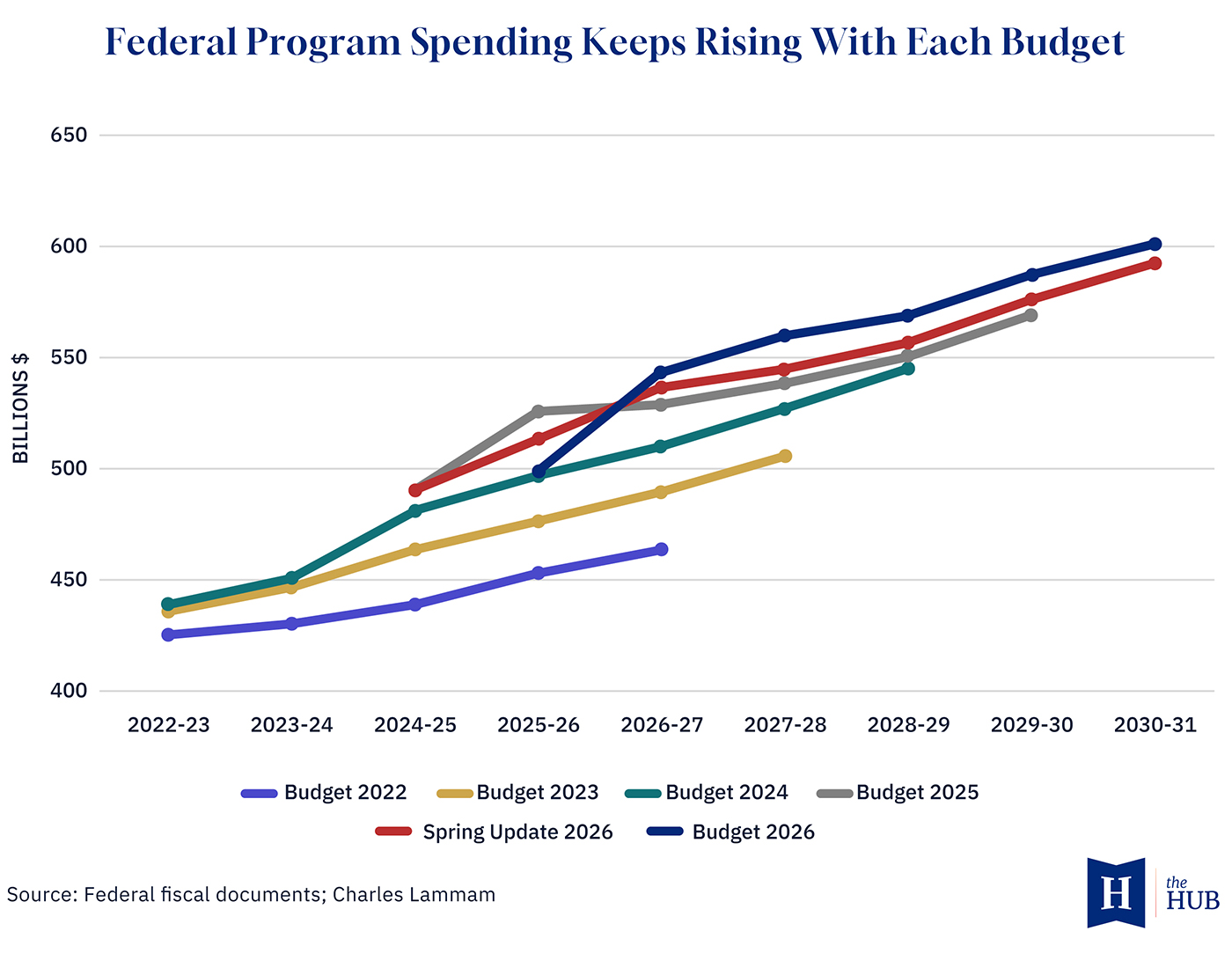
Over the next five years, the federal government expects $158 billion more than it did in the spring, mostly from stronger revenues and a lower baseline for existing programs. The budget then uses $152 billion of it on new spending and tax measures, or 96 cents of every extra dollar. The new spending more than offsets the lower baseline, so program spending still ends up above the spring update in every year after 2025–26. Deficits end up only $7 billion smaller than in the spring update, a trim of about 2 percent on a five-year total of almost $290 billion.
Had Ottawa simply banked the improvement, the five-year deficits would add up to about $137 billion instead of $289 billion, less than half of what the plan now shows. In 2028–29, the new measures almost exactly offset $32.8 billion of a $32.9 billion improvement.
The spending forecast shows little restraint, even though the budget’s cover letter says growth in spending has slowed to under 2 percent a year since this government took office. That figure covers only direct program spending and is measured after a 10.7 percent jump in 2026–27, while total program spending rises 8.9 percent that year and 3.8 percent a year on average through 2030–31 and sits above the spring update in every year except 2025–26.
Graphic credit: Janice Nelson
Since the spring update, the money has gone to a long list of priorities, including $36.1 billion over five years for the “productivity mega deduction,” $26.6 billion to advance reconciliation with Indigenous Peoples, $11.3 billion to support workers and businesses hit by tariffs, $11.2 billion toward a 10-year goal of “ending homelessness,” $8.7 billion for electricity, $5.4 billion over two years for child care, and $4.7 billion for the enhanced grocery benefit, including a one-time cheque worth $4.1 billion in early 2027.
A stable debt ratio and a rising interest bill
Defenders of the plan will point to the debt ratio, since federal debt, the accumulated total of past deficits, stays near 40 percent of the economy through 2030–31. The dollar amounts tell a different story, with federal debt rising from $1.37 trillion this year to $1.59 trillion in 2030–31 and net debt, the amount Ottawa owes after subtracting its financial assets, climbing from $1.54 trillion to $1.92 trillion. The ratio holds because the government’s ships, aircraft, vehicles, computer systems, and other physical assets nearly double on its books and because the forecast has the economy growing at close to 2 percent a year after 2027.
The cost of carrying that debt keeps rising, with public debt charges growing from $53.5 billion last year to $85.5 billion in 2030–31, or almost 14 cents of every dollar of revenue, up from about 10 cents. That is higher than both the spring update and the forecast of the Parliamentary Budget Officer, by about $13 billion and $10 billion over five years.
Read for free
Prime Minister Mark Carney’s second budget has disappointed expectations despite a significant windfall of $158 billion. The government plans to spend nearly all of this on new initiatives, resulting in only a modest reduction in projected deficits. While the debt-to-GDP ratio remains stable, the actual debt is set to rise significantly, leading to increased interest payments. The budget employs creative accounting and fails to address long-term fiscal sustainability, leaving Canadians with ongoing deficits and a growing interest burden.