
Get the best of Vancouver in your inbox, every Tuesday and Thursday. Sign up for our free newsletter.
As PISS is a project very much rooted in personal trauma, one of the strange things is how a past horror has led to countless positives. On the front of things to be grateful for, there are many.
The members of the Vancouver quartet—singer Taylor Zantingh, guitarist Tyler Paterson, bassist Gavin Moya, and drummer Garreth Roberts—are living the kind of hurricane dream most bands never get to experience, especially those that fall under the umbrella of unapologetically extreme. Two and a half years ago PISS played its first ever show, taking an unsuspecting audience by surprise at Vancouver’s Red Gate Arts Society. Looking back to that time, Zantingh recalls the band having a goal.
“We were like, ‘Can you imagine if we got to play in Toronto one day?’ ” the singer says with a laugh in a video interview with the Straight. “That was literally one of the early conversations that we had.”
Everything that’s happened since that night suggests PISS was aiming a little low. As 2026 enters its dying days, the band has just unleashed its debut album, with you made me / skin on linen hitting global record stores on Sub Pop, the Seattle label responsible for more than one pop-culture palace coup, starting with Nirvana.
Recent weeks have seen a spread in England’s standard-bearing The Guardian, and a New York Times video feature titled “We Still Need Riot Grrrl”. The U.K.’s venerable New Music Express tapped PISS for its flagship digital feature The Cover, which spotlights emerging bands from around the world.
Backing up to before the hype, PISS quickly built a reputation in Vancouver for live shows that mixed flamethrowing noisecore with sampled recordings and shock-therapy spoken word.
Because the band’s songs deal with subjects including personal trauma, sexual violence, and systemic misogyny, performances start with trigger warnings, with support available on site. As one might expect from that, shows played out like personal exorcisms, with Zantingh seemingly intent on purging the demons inside. The singer is, magnetically, the centre of the onstage storm, often dropping to her knees, screaming, with her trademark long braided locks flying.
To see PISS is to witness art at its most raw, visceral, and cathartic, the band’s sets short and brutal, audience members often reduced to literal tears.
Sometimes music truly matters.
“After we played a few shows,” Zantingh says, “it became pretty clear to me that, if we can be put in a room with people—the people we are supposed to reach—we will reach them.”
Rather than be content playing the Vancouver underground circuit, PISS began touring, often exhaustively, building a following organically. Conventional thinking is that a band releases a record before loading into the tour van. With PISS the only warning the world got was a handful of demos on Bandcamp and a couple of guerrilla-style live videos on YouTube. That was enough. The live shows did the rest, establishing PISS as a must-see act in the global underground.
“It took me by surprise that we’d be able to tour as much as we have,” Paterson admits. “We’ve honestly been lucky.”
Video of PISS – time loop at hot slit (Official Music Video)
Flash forward to today and PISS continues to be a rarity: a Vancouver underground band that’s blown up beyond Vancouver. Seattle’s mega-influential KEXP radio station recorded the band live in-studio, with the performance racking up over 190,000 YouTube views in the two weeks since its release. (Sample comment: “This is literally the first time in my 45 years a song has made me cry when I’m sober.”)
Positives? Too many to count.
“It kind of feels like riding a roller coaster,” Paterson says. “At no point did any of us expect to get to this point. It’s been very surreal, but I’ve just tried to stay as grounded as possible, and be grateful for the opportunities that we’ve had.”
But even as PISS has become one of the most important bands to ever come from this rain-soaked city, it’s not lost on Zantingh that there is a cost. Imagine not only tapping into your worst traumas on a daily basis, but doing it night after night in front of people who are, for the most part, complete strangers.
PISS is a lot. And sometimes that’s draining.
“The resistance you’d expect—trying to get people to come to your shows, trying to get people to invest in your project, trying to get people to talk about your project—it felt like we didn’t face any of that,” she says of the ascension of PISS. “But it’s almost like we’ve traded the usual grind and slow slog that bands have to do for the physical toll that the project takes on me—the emotional vulnerability. Like I traded for something intangible. That the more I suffer, and the more that I push myself, the more that I sacrifice, the more that I give, the easier that it has been for us. So, for me, it’s constantly trying to find where that line is for myself so it’s sustainable. And so I can protect myself a little bit.”
Grace Gignon
AT THE RISK of understating things, you made me / skin on linen (released on Paper Bag Records in Canada) isn’t the kind of record found in the easy listening section of your favourite record store. (For the in-joke there, see PISS’s Bandcamp page, where the “file-under” tag suggests the band has more in common with Michael Bublé than Converge or the Blood Brothers).
At first listen you made me / skin on linen sounds like a red-alert emotional meltdown in real time, Zantingh howling and panting, seeming to grasp for words while her bandmates traffic in full-bore no-wave chaos. At just 42-seconds, “a little girl’s horse craze betrays her” is warp-speed hardcore at its most condensed and brutal, while “time loop at hot slit” serves apocalypse-now punk with a lethal dose of blind range.
But get beyond the album’s doomsday bass and drums and scratch-acid guitar violence, and it’s clear that PISS is also shooting for something more than nonstop aural terrorism. Check out the way “i wanted to be a singer” swings from grey-skies postrock to nail-bomb metal, and then back again.
There are moments of painful reflective beauty: see both “blocking a scene you can’t remember” and “i keep trying to change the ending”, each astonishing in different ways.
But mostly you made me / skin on linen is a record that’s uncompromising, unrelenting, and entirely impossible to ignore.
Quite understandably, Zantingh tends to get much of the attention with PISS. That’s going to continue with the release of you made me / skin on linen. To ingest her lyrics is to have it driven home that the project has been an outlet for working through some things. Start with the record’s second track, “i wanted to be a singer”, which has her screaming “I don’t know if writing about violence is helping me/Am I helping you?”.
What follows on you made me / skin on linen is often harrowing, from “I was 10 years old and learning blow jobs on a glue stick” in “time loop at hot slit”, to “Do you ever get flashbacks of the bed springs squeaking?/Do you respect the power of liquor and Oxycontin?” in “how can you act opposite to this emotion?”.
Zantingh, quite fairly, won’t discuss the specifics of her lyrics, noting that past events are now even walled off to those in her personal life. Listen to the songs, pay attention to the audio samples, and then feel free to bring your own experiences to the table.
“It’s very easy for me to make the art and share the art because I have all the control over it,” she allows. “I have crafted things down to the syllable. But I also choose not to share details about things, only because I’ve never really found it to be helpful to do so. I’ve never gotten positives by sharing details—it’s only ever made me feel more alone. Words spoken in conversation cannot accurately describe the weight of what happened. That’s why I make art.”
Grace Gignon
She does feel it’s necessary, however, to make it clear who the lyrics aren’t about.
“I want it to be clear and on the record that I didn’t write any of these songs about my parents,” she says.
As is the case for many of us, it would seem not everything was perfect.
“It’s tricky to talk about, and I think if it’s something that I was to talk about, then I would talk about it in art in some way, because these things are so complicated,” Zantingh offers.
Perhaps a way to frame things is that, no matter how much our parents try—and by that, we’re talking about every procreator on the planet—they aren’t going to be perfect. No human being is.
Reflecting that reality, Zantingh says, “I struggle to talk about my parents because I know that they did the very best that they could. I love them and have so many great memories from my childhood. I just don’t know to talk about it all.”
She acknowledges that, as is the case for many of us, she’s been shaped by the people who raised her.
“I learned a lot of really beautiful and important things from my family members,” Zantingh shares. “My dad is a super-articulate and passionate person who definitely never has any problem speaking his mind, whereas my mom is a very soft-spoken person who can empathize with literally anybody. I think that contrast definitely informs how I move through the world.”
Indeed, the person we see onstage with PISS isn’t the same person in an interview situation. Like Paterson, Zantingh is thoughtful but easygoing and chill, laughing often.
Those same traits would prove important when PISS got down to thinking who they wanted to work with for their debut. you made me / skin on linen was produced by Victoria-based Colin Stewart, a much-respected veteran who normally works with less abrasive acts like the New Pornographers, Dan Mangan, Yukon Blonde, Brasstronaut, and Veda Hille.
“One of the main reasons why we worked with Colin is we had an incredible meeting with him even before we actually went over to his studio,” Paterson says. “He really put all of our minds at ease.”
Video of PISS – blocking a scene you can’t remember (Official Music Video)
The recording took place over five days just after Christmas in 2024.
“We did the majority of the album live off the floor,” Paterson says. “That was always the approach we wanted to have going into it—to capture the rawness and live energy as best we could.”
Stewart understood what PISS was after sonically, the main goal being to capture the spontaneous energy of the band’s live show in the studio.
“All the vocals are one consistent take,” Zantingh says. “There was no punching in to fix mistakes, because it’s very important to me that my breath is an instrument on the record. If it sounds sometimes like I can’t get the words out, then I can’t get the words out. That’s the way I wrote things—it’s supposed to be a struggle, and sound like a struggle.”
The songs that would become you made me / skin on linen weren’t new to PISS. The band had been playing them live—both in Vancouver and during constant touring—for the better part of a year when it entered the studio. But as much as PISS left a trail of newfound disciples every time it loaded into the tour van or hit Green Auto, there’s sometimes a difference between being told you’re doing something great and actually believing it.
“It’s strange to look back on the mindset going in to record,” Zantingh reflects. “It really was a transformative experience for me. I remember early on, writing PISS songs with Ty, and being nervous to tell him my ideas when it was just the two of us. I was really anxious. And so I had really bad imposter syndrome being in the studio—having all these ideas while we were working, but being really afraid to voice things, and going, ‘Maybe that will be stupid.’
“But by the end of the five days,” she continues, “I really got to feel this sense of, ‘Okay, I’m a musician now, and I’m allowed to be here. And I am here because I’ve proven myself—and I don’t need to feel so insecure all the time.’ ”
On that level alone, you made me / skin on linen represents a triumph. She acknowledges that, over the years, she’s had her share of dark days filled with doubt and self-loathing.
“I graduated high school and then spent a lot of years doing nothing with my life except being severely depressed, working at Home Depot and living in a basement apartment,” Zantingh shares. “When I was in high school, I wanted to, like, be a perpetual student, because I love reading and studying and learning. But then, you know, trauma and depression do crazy things.”
At one point, she decided she wanted to leave Home Depot behind. Her sense of self-worth got in the way.
“I can remember thinking that I should apply to be a waitress, but then not doing it because I thought I wasn’t pretty enough,” she recalls. “Never mind the fact that you do not have to be a model to be a waitress.”
The blackness didn’t stop with the self-talk.
“I definitely was in a very, very, very destructive—really self-destructive—time for like five to seven years, I would say, of my life,” Zantingh says. “I always feel like my life has been like literally crawling on my hands and knees out of a hole that I was pushed into. And sometimes it has felt, I guess, nihilistic, where it feels like, ‘Okay, this is never gonna get better.'”
Eventually things did. She enrolled in Sheridan College in Ontario, earning honours in the Bachelor of Creative Writing and Publishing program. That, along with time at Durham College and internships at literary journals, would open up a whole new world of thinking.
“I was like, ‘Oh, wait, I can actually do all this stuff,’ ” she says. “It was suddenly all about having corrective experiences, which has been my passport ever since. Whenever I feel like I can’t do something, I’ll seek a corrective experience. And by that I mean if I have a belief that I can’t do something, I find a way to get an experience where I prove to myself that I can, and then those types of things become easier after that.”
Like, for example, making you made me / skin on linen.
“I feel like I’m definitely not in that place anymore,” Zantingh says. “But sometimes when I think about the things like the way that I used to treat myself, and also treat people around me, I feel very sorry for myself and my past self. And grateful that I’ve come as far as I have.
Grace Gignon
PRIOR TO PISS, both Zantingh and Paterson had been in bands. Zantingh was a member of the Ontario punk group Doctors Hate Her, where even though she sang and played guitar, she wasn’t involved in the writing of the songs.
“It’s not like I was consciously going ‘You’re not good enough to write a song,’” she says. “It’s more like I didn’t even try because it wasn’t a possibility to me that I could make music because of my skill set. I took writing very seriously—I was studying at university and writing poems—trying my best to write good poems and stories. But the textural and sonic elements that are part of music, that’s never been a language for me the way that it is for Ty.”
While country music and Top 40 were played around the house when she was growing up, Zantingh parents weren’t particularly musical. Paterson’s mother and father were, however, signing him and brother up for piano lessons as kids. When piano stopped being cool for them, a drum kit, guitar, and amp arrived one Christmas.
“When my parents realized how into music me and my brother were getting, I remember my dad took it upon himself to run out to HMV,” Paterson says. “It was like, ‘Now I need to school the kids on music’, and getting us a bunch of CD by the Buzzcocks, the Clash and old Black Sabbath.”
Paterson played in a long succession of Vancouver bands, often serving as the primary songwriter. Collaborations included playing wingman to Vancouver singer-songwriter Riun Garner; on the 2020 single “Wrote Myself Off”, the pair sound like disciples from the church of Sufjan Stevens.
PISS started with Zantingh and Paterson connecting at Vancouver house parties. Zantingh was living in Victoria, but thinking about abandoning the West Coast and returning to Ontario. Paterson was finishing up a degree in film at UBC.
Both drew up a playlist of artists they found inspirational, starting with CRASS, Swans, Coughs, and homegrown Vancouver agitators Mutators. If one thing binds those acts together, it’s that they sound like the terrifying end of times.
“I was finishing up four years of film school, and I had really been taken with the idea of sound design and recording as well,” Paterson says. “And I think that also informed a lot of the direction that we would go in.”
The inspiration for PISS didn’t stop with music.
“A big catalyst was going to a poetry reading that Tay did one night,” Paterson remembers. “It really blew me away. She’d only shown me slivers of her writing up to that point, so it was a really incredible experience getting to hear her recite her work live. It kind of rewired my brain as to what this project could be.”
When a roommate moved out to go back to Japan, Paterson suggested to Zantingh that she move in rather than going back to Ontario. The two began sketching out song ideas, committed to the idea that the only rules they would play by would be ones of their own making.
“Tay started sharing a doc with me—a kind of general outline of what PISS, and what a possible album, could be,” Paterson shares. “She didn’t have lyrics on it—they were more sort of vague concepts—like the duration of a song, or the general mood of a song. I really loved that—it was kind of a jumping-off point to go bury myself in my little bedroom studio and experiment with things. There was a lot of excitement and freedom.”
At first PISS was just Zantingh and Paterson, free to build songs around whatever they pleased, whether that be audio clips of feminist activist Andrea Dworkin or French philosopher Manon Garcia, or abstract sheets of guitar violence. Realizing they were onto something, they brought in Moya on bass and Roberts on drums to form an actual band.
“With bringing Gavin into the project, I’d known him for years,” Paterson says. “I knew that he would gel well in the project because he’s such an open and down-to-earth person. We had a few meetings with Gareth before we even went into the practice room. It was like small steps to see how well we all gelled as a group before we went the full mile. Very quickly, we all clicked and got along so well. The atmosphere was just comfortable.”
But there was also another factor at play.
“Something that goes along with making music about trauma is that you have a traumatized person that you’re in a relationship with, who has trauma symptoms sometimes,” Zantingh says. “There’s been a learning curve for all of them to sort of understand what it is like to live with mental illness and to have, sometimes, emotional regulation issues.”
Indeed, PISS is a safe place—one where Zantingh feels supported by people who care about her.
“From the beginning of the project, it’s been about making sure—even before we were playing shows—that there was a support system for Tay and that she’s always comfortable in what she’s doing,” Paterson says.
Video of PISS live under oak street bridge
AS YOU MIGHT have noted, the Paterson and Zantingh tend to describe PISS as a project with multiple components rather than a band. That’s in some ways tied into the idea of community—which in turn speaks to community being one of the most crucial support systems for anyone who’s gone through trauma.
“We always considered PISS as having three main branches,” Zantingh says. “There’s the music—and now the album—being music and poetry as the first part. And then there’s the art project, including the visual art for the record being the second part.”
The cover art for you made me / skin on linen is a reproduction of a quilt the singer worked on in real life, the centre panel being a dancer caught in mid-flight, shown from behind, arms flailing, with long blonde braids flying.
“The art project was a month-long process that definitely took years off my life,” Zantingh says with a laugh. “Essentially, I really wanted to explore the themes on the record in a visual medium. I’m not a visual artist personally, but I liked the idea of surrendering control for the visual aspect of the album.”
The process was indeed involved. For the centre image, Grace Gignon, a photographer friend of Zantingh who also shot PISS for this feature, took pictures of the singer dancing in a studio. The photo was then given to an artist, Emma White, to interpret and abstract.
“We have the record and we gave her the photo,” Zantingh shares. “She made a drawing of the body with some imagery from the record, and was asked to abstract the body in some way. So she kind of bent the arms a little bit, and made the dancer look broken—like someone slipping away.”
That drawing was given to a painter, who was given the record and the same instructions as above.
“She created a painted collage with different images laid on top of each other, and cut the body in half,” Zantingh says.
All these provided a template for the singer to get quilting by hand.
“I sourced fabric from thrift stores—different elements that reminded me of pieces through that whole project, and also themes on the record. So have wolves, although they are supposed to be dogs, and horses and clouds.”
In the end, what the quilt, and album, signifies, Zantingh suggests, is different communities coming together.
“I liked the idea of passing my body, through art, into the hands of different people, and having it change over time,” she says. “And then having to pick up these different pieces and make something out of them for our album cover. There were couple of of hiccups that I won’t got into detail about, but I’m very happy with how it turned out. There’s a lot of heart in it.”
The idea of community also factors into the third branch of the project that is PISS: the live shows where, in addition to trigger warnings, community an activist groups are invited to set up tables to provide information and support on issues important to the band.
“The last part is the performance, Zantingh says, “There’s the performance art element of it on stage, but it also includes the way that we take care of our audience and the environment at our shows.”
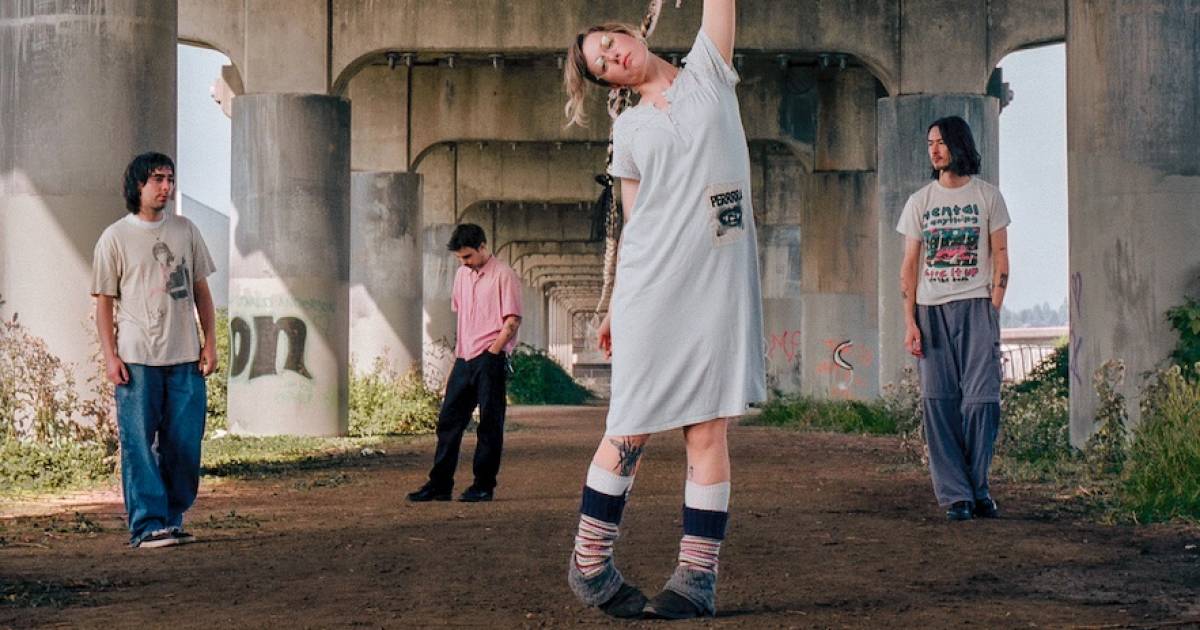
The people of PISS (left to right): Gavin Moya, Garreth Roberts, Tyler Paterson, and Taylor Zantingh. Grace Gignon
Zantingh says that navigating everything that’s happened over the past couple of years has been at times challenging.
“I think maybe that a lot of survivors of sexual violence will understand that sharing your story, even with people you know really intimately, is very often met with criticism and being picked apart and questioned,” she says. “I’ve noted a lot of parallels between me sincerely telling my story in a literal way to friends in my life, and also the experience of getting on a stage and sharing my story with strangers who you don’t know, and who you have no trust with.”
Finding time to write new material has been almost impossible thanks to PISS being constantly on the road.
“I’m a person who needs a lot of quiet and boredom in my life to create anything,” she says. “I need a lot of solitude, which I’m not getting at all because I’m either in a van with three people at all times, or I’m trying to catch up with people who I’ve been missing when I’m home. So I haven’t written anything in a serious way in over a year.”
Even though you made me / skin on linen was only released days ago, there is a very valid question of where PISS goes from here with its next record. The songs on the debut are, after all, ones they’ve been playing nightly, always in the same order at shows—the reason for that having everything to do with curating an experience.
On the music side of things, Paterson can see PISS evolving.
“When we’ve talked generally about what the next album would look like, it’s been about having a very different approach,” he says. “Something distinctly its own that’s in a new direction.”
Lyrically, Zantingh has ideas, but stresses that, at the moment, that’s all they are.
“I know the subject matter that’s interesting me right now, and it is in the same world, same book, and the same chapter,” she says.
For now, there are also positives—many of them. Some are quantifiable.
“I love being on tour—it’s something that I’ve always wanted to do,” Paterson says. “I’m very excited to be on the road, experiencing new places, meeting new bands, playing so many cool venues. But also having the time to pause and take a breath and really ground myself and be grateful for how far we’ve come.”
And then there’s what PISS has become, including a beacon for anyone who’s ever had an experience that’s left them scarred. A project that started out rooted in trauma has become one that’s about healing. And while that process is ongoing, at least there’s progress—something that should inspire us all.
“PISS has been the healthiest relationships that I’ve had with men, like in terms of friendships, in my entire life,” Zantingh says. “To have three men approach me with so much openness and respect for my artistry is huge, especially when we’re talking about this record. It’s the complete opposite of the types of relationships, or experiences, that I’ve had in the past. It’s been a corrective experience.”
In “i wanted to be a singer”, Zantingh howls, enraged, “I spent my life trying to turn my pain into something beautiful.” Mission accomplished. With the warning that she’s just getting started.