
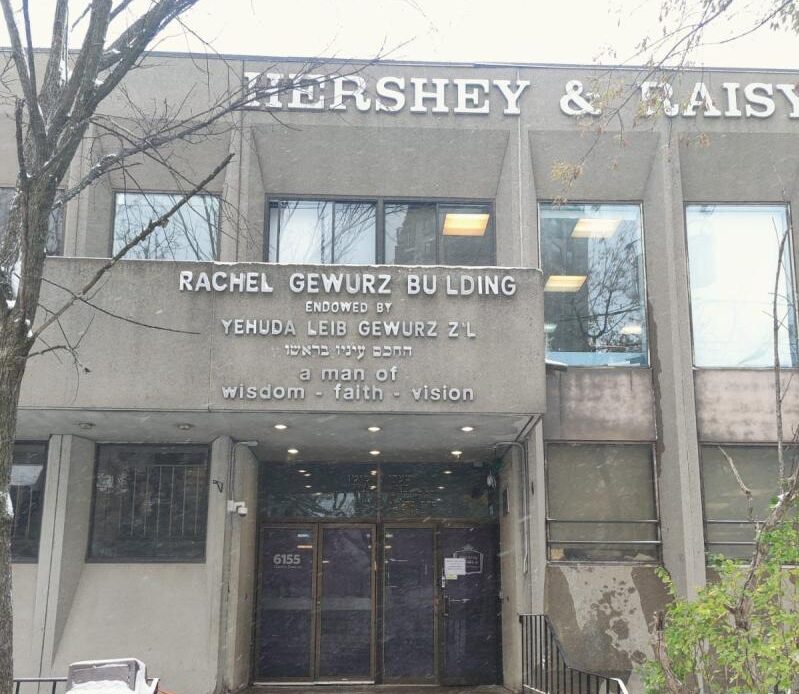
As it stands, the public will never know what exactly brought then-21-year-old Abdirazak Mahdi Ahmed, who had no criminal record, from his residence in a suburban subdivision just steps from the St. Lawrence River, to drive an hour in the middle of the night to the Côte des Neiges street where he fired bullets into the front door of Yeshiva Gedolah Merkaz, a school with some 350 students in the heart of an Orthodox Jewish neighbourhood. No one was injured in the shooting.
Mahdi Ahmed was slated to stand trial in Quebec Superior Court this month, facing four counts related to the Nov. 12, 2023, yeshiva shooting. Three of the charges he originally faced –mischief damage to property, auto theft and possession of stolen property – were dropped upon a plea agreement. Now 23, he pleaded guilty to a charge of recklessly discharging a firearm in September, his 25th court date since being arrested in May 2024.
He was sentenced to five-and-a-half years in federal prison, minus time served equal to 1,353 days, leaving a remaining 655-day term.
The gunfire on Nov. 12, 2023, was one of a number of attacks on Jewish institutions in the weeks following the October 7, 2023, terrorist attacks by Hamas and other armed groups on Israel and the start of the Gaza-Israel war. It was the second shooting targeting Yeshiva Gedolah in three days; the first on Nov. 9, along with Talmud Torah Elementary, adjacent to the Spanish and Portuguese Synagogue and neighbouring the Jewish community campus. In December, someone set fire to Congregation Beth Tikvah in Montreal’s west island. No suspect was identified in either of those cases.
Counsel for the defence and the Crown agreed on a sentence of 66 months with conditions, accepted by Judge Pierre Labelle who imposed it on Nov. 9, almost three years to the day since the crime. Labelle read out the statement of facts at the sentencing, the courtroom empty except for a journalist and a B’nai Brith representative. Appearing on video from the detention centre where he has spent the last 902 days, the shooter stood silent, hands by his sides. Since his arrest, Mahdi Ahmed has never addressed the court, nor spoken out other than in “yes” or “no” replies to queries throughout the process.
Highlighted number of shots fired
Labelle said the charge carries a maximum prison sentence of 14 years, but the usual sentencing range suggested by higher courts, is three to eight years. He noted that Mahdi Ahmed had no criminal record at the time of the crime, but highlighted “the number of shots fired” – police found three bullet holes in the school’s doorway – and the profound and serious repercussions for the Jewish community, specifically referring to, and quoting from, the impact statement delivered to the court by the Centre for Israel and Jewish Affairs’ vice-president (Quebec) Eta Yudin.
“This attack is part of an alarming trend; the school had, in fact, been the target of a similar incident previously” he read, “another school had also been targeted earlier in 2023. This attack has had a profound impact on the community, including parents, students and teachers… These attacks were directed at the community and its families, striking, above all, at their fundamental sense of security.” (When Yudin read the moving community impact statement on Oct. 9, a shackled Mahdi Ahmed sat in the prisoner box, showing no emotion, merely leaning forward and looking around the room before leaning back in his chair and watching Yudin speak as she delivered her statement in French.)
As such, said Labelle, a five-and-a-half-year sentence “is not unreasonable considering the nature of the offender’s actions, as well as the deep, lasting scars these acts have inflicted upon the community. Unfortunately, no sentence, however severe, can ever fully erase the consequences.” Labelle saved his own commentary in the judgement to one line, saying: “Those who commit this type of attack against schools are, in the view of the court, cowards. I have nothing more to add.”
Outside the courtroom, B’nai Brith Quebec regional director Paola Samuel was pleased with the verdict, which she called “another very strong message to the Jewish community that these things have been taken seriously.” This case is especially symbolic she said, because it was the first one after October 7, “the first big gut punch.” She told The CJN what is most disheartening now “is that these attacks are so normalized that we don’t react in the same way anymore.
“This verdict was very important because bullets were fired at a school, and the message it sends is so significant for the community. A few weeks after Oct. 7, most of us were still in shock, trying to process what was happening, and how the world, instead of standing with us, was rallying against us. Then we realized it’s right here in Montreal.” Samuel says while waiting for justice can be frustrating, “what’s more important is that judges and prosecutors get it, and what we’re hearing from Judge Labelle today is that he understands.”
Upon his expected release in August 2028, Mahdi Ahmed will begin three years of mandatory probation, which means he must keep the peace and is prohibited from possessing unrestricted firearms for 10 years and restricted firearms for life, including ammunition and explosive substances. He was also ordered to submit a DNA sample within the next few days to be entered into the Convicted Offenders Index in the RCMP’s National DNA data bank.
He is further prohibited from coming within 200 metres of the Yeshiva Gedolah and from communicating with or being in the presence of his accused accomplice, Joseph Feijhoo-Leito, 21, who returns to court next month to face charges of possession and theft of a vehicle used during the shooting. Feijhoo-Leito was arrested in February 2025.
Unanswered questions
Unanswered questions remain, and there are striking similarities to other recent cases, notably that of Montrealer Mohammed Ilyess Akodad, who was hired by an unidentified sponsor via an online platform to firebomb a synagogue and Jewish community centre. Akodad pleaded guilty in Quebec Superior Court in January to three arson-related offences and sentenced to 24 months, minus time served, for a remaining term of 127 days followed by three years of probation upon release next January.
On Nov. 10, an 18-year-old, who was a young offender at the time of the offence, was sentenced for shootings at two Toronto-area synagogues. Police have said the synagogue shootings appeared to fit a pattern involving youth recruited through encrypted messaging apps to carry out and film attacks for payment.
In a statement about the Toronto case Tuesday, CIJA noted that those who recruit, direct, and finance such attacks must face justice, not just those who carry them out. “The dangers posed by these criminal networks have already claimed the life of Constable Marc Pinizzotto, who was killed in the line of duty while executing a search warrant connected to the U.S. Consulate shooting and other linked attacks.
“We cannot ignore the potential role of hostile foreign actors in fuelling violence on Canadian soil. The use of criminals-for-hire raises serious concerns over the threat posed by Iran’s Islamic regime here in Canada. Canadian intelligence has warned of a ‘realistic possibility’ that the Islamic regime is directing local criminal elements to target Canadians.
“Recent U.S. Treasury sanctions against eight Canadian businesses linked to Iranian sanctions evasion, further underscores the reach of the regime’s networks in Canada… We must determine whether these networks played a role in the attacks on our community and hold those responsible to account.”
That there are youth who are willing to target Jewish Canadians only adds to the heightened state of fear of the Jewish community who have been struggling through a national crisis of antisemitism, B’nai Brith research director Richard Robertson told The CJN. “We are grateful for the charges that were laid and for the strong sentences that were handed down in connection with gun for hire cases in Toronto and Montreal, but now it is imperative that law enforcement determine who orchestrated these attacks. Until they are identified and brought to justice the threat remains.”
Links to international networks always a consideration
After the Crown presented its sentencing submission on Nov. 2 and asked whether investigators considered a link of the yeshiva shooting to a broader international network, prosecutor Jean-Christofe Ardeneus told The CJN “it is always a consideration for police investigators when they’re investigating such crimes.” Proving it in court he says, “is something different. In the era that we live, where anonymity behind the internet is a problem and criminal elements will use such tactics to try to evade law enforcement, it’s a difficulty that police officers have to be aware of,” he said. “In this case, we were not able to determine beyond reasonable doubt the origin of the motivation.”
Despite investigators placing an undercover officer in Mahdi Ahmed’s cell where he made statements that led investigators to conclude he was involved in firing the gun on Nov. 12, 2023, police and prosecutors couldn’t determine motive. Still, he said, “the consideration was there. It’s always there.”
As for antisemitism as a motivating factor, Ardeneus had earlier explained that intent to commit a hate crime is an aggravating factor that must be proven beyond a reasonable doubt, and “the evidence didn’t suggest it… this element could not be raised in court as an aggravating factor. We know nothing about the motive.”
In her statement, Yudin reminded the court that although Jews make up only 1 per cent of the Canadian population, they have been the victims of 71 per cent of all religion-based hate crimes, according to the latest available data from Statistics Canada, something Labelle repeated in his judgement. Also, data provided by the SPVM indicates in 2023, the community was the target of 103 out of 139 religion-related hate crimes – 74 per cent of the total – and 27 per cent of all hate crimes across all categories, figures that have remained high throughout 2024 and 2025.
When she read her statement, Yudin told the court “for several years, we had been watching with concern the situation unfolding in Europe, particularly in France, where the safety of the Jewish community is frequently and gravely threatened… Then, in November 2023, our fears that similar phenomena might reach Montreal became a reality.”
Joel has spent his entire adult life scribbling. For two decades, he freelanced for more than a dozen North American and European trade publications, writing on home decor, HR, agriculture, defense technologies and more. Having lived at 14 addresses in and around Greater Montreal, for 17 years he worked as reporter for a local community newspaper, covering the education, political and municipal beats in seven cities and boroughs. He loves to bike, swim, watch NBA and kvetch about politics.