
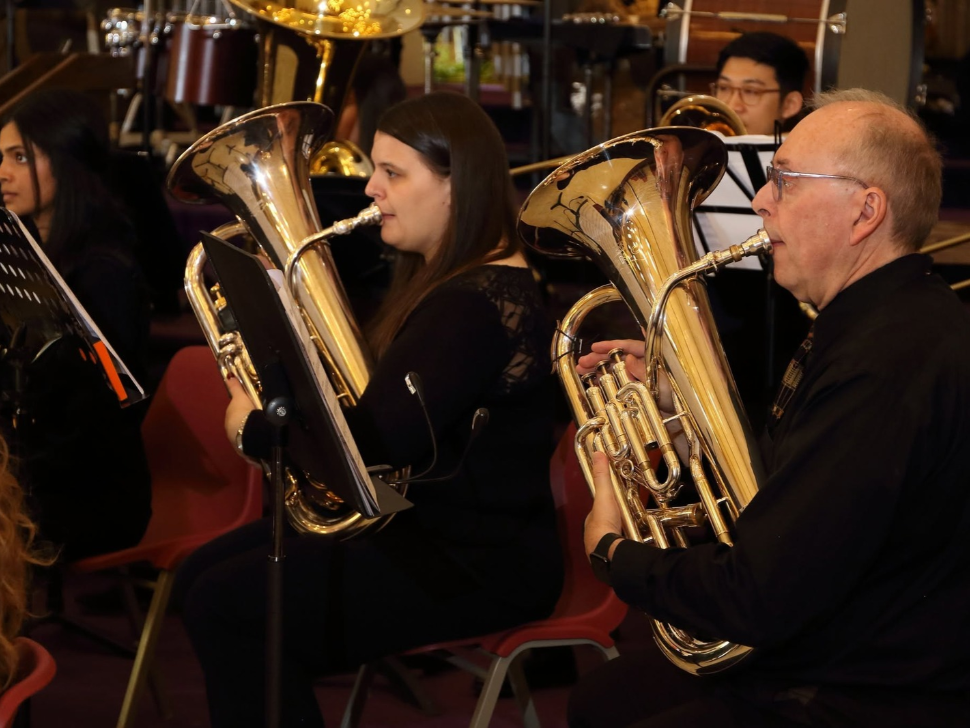
The passage of time takes many forms. It can be measured in the steady ticking of a clock, celebrated through the changing hours of a day, or reflected upon through memories, loss and the legacy we leave behind. Those ideas provide the inspiration for The Hours, the Winnipeg Wind Ensemble’s first concert of its 2026–27 season, taking place Sunday, November 22, at 3 p.m. at St. George’s Anglican Church, located at the corner of Wilton and Grosvenor.
Under the direction of Virginia [Ginny] Helmer, the ensemble has assembled a program featuring music by Camille Saint-Saëns, Franz von Suppé, David Maslanka and Winnipeg composer Pete Meechan. The afternoon will also feature a special appearance by the Dakota Collegiate Wind Ensemble, directed by Darren Ritchie.
Although the concert’s theme developed through several different musical discoveries, the idea of time ultimately provides a fascinating thread connecting the works. For Helmer, the program also reflects a personal interest in the subject, particularly as she considers the changing perspective that comes with retirement.
Finding inspiration in the passage of time
The original inspiration for the concert actually came from a desire to perform Saint-Saëns’ Symphony No. 3, commonly known as the Organ Symphony. With St. George’s Anglican Church offering an impressive pipe organ, the opportunity to feature the instrument seemed too good to pass up.
From there, other musical possibilities began to emerge, eventually developing into a program exploring different interpretations of time and the experiences associated with it.
The theme also has a personal connection for Helmer, who says she has been thinking about time differently since retiring a couple of years ago.
“Music is life. So, and I’ve been thinking a lot about time because I retired a couple of years ago. So, I think there’s definitely a strong connection there.”
One work in particular makes that connection especially clear: Pete Meechan’s Clock with No Hands, a composition that explores the relationship between musical time and the experience of dementia.
Pete Meechin’s Clock with No Hands: Remembering a music educator
Meechan’s Clock with No Hands was discovered while Helmer was searching for repertoire that would connect with the concert’s emerging theme. The title immediately caught her attention, but the story behind the composition ultimately made it an especially meaningful addition.
The piece is dedicated to Bill Wahl, a band director in Medicine Hat who died a couple of years ago after receiving a diagnosis of Alzheimer’s disease. Wahl had established the Medicine Hat concert band and directed the ensemble for 40 years, continuing until he was no longer able to do so.
The composition was commissioned by the band Wahl founded, with a consortium of bands from across Alberta contributing to the project. His daughter was particularly interested in ensuring that the music recognized both his accomplishments as an educator and his experience with dementia.
As Helmer explained, “So it’s great to have, recognition for somebody who was part of our profession, because many of us are band directors.”
The musical structure reflects the uncertainty associated with losing one’s sense of time. The work begins with a vibraphone pulse moving slightly faster than a conventional clock, a rhythmic idea that disappears and returns throughout the composition.
Meechan also manipulates the musical structure, shifting between different time signatures and changing the lengths of held chords. Helmer describes how the theme begins in four before moving into three, while chords that might normally last four beats sometimes last only two or extend to six.
These unexpected changes create an unsettled musical landscape, reflecting the disorientation that can accompany dementia.
From Vienna’s celebrations to the urgency of Maslanka
Not every musical interpretation of time is serious or reflective. The program also includes Franz von Suppé’s Morning, Noon and Night in Vienna Overture, in Henry Fillmore’s transcription for wind ensemble. The work offers a joyful musical celebration of the passing hours in Vienna during the mid-19th century.
For Helmer, conducting the piece is an opportunity to have some fun, particularly because of its connection to the classic Warner Brothers cartoon Baton Bunny, featuring Bugs Bunny conducting an orchestra while dealing with a troublesome fly.
When asked what she enjoys about conducting the work, Helmer offered a simple answer: “I can pretend that I’m Bugs Bunny.”
Beyond the cartoon connection, she says the music captures the pleasure of spending time in the magnificent city. The overture builds toward an increasingly energetic conclusion, with the tempo continually accelerating. As Helmer puts it, “It just goes faster and faster. Yeah. Lots of fun.”
A more contemplative perspective comes through David Maslanka’s Give Us This Day, a short symphony for wind ensemble inspired by the writing of Vietnamese Buddhist monk and peace activist Thich Nhat Hanh. His essay For a Future to Be Possible explores the importance of mindfulness, self-understanding and developing the ability to relate compassionately to others.
Helmer describes the opening movement as having a meditative quality, while the second movement takes a much more urgent direction. The work eventually returns to its central theme, but with a darker character.
For Helmer, that final section raises questions about the future and the responsibility each generation has toward those who follow.
She draws a connection to the Indigenous concept of seven generations, explaining the importance of acknowledging those who came before while planning for the generations yet to come. It is a particularly thought-provoking addition to a concert examining how we experience time and consider our place in the world.
Discovering the music of Lili Boulanger
Another discovery on the program came through Helmer’s search for music by female composers. That search led her to D’un matin de printemps (Of a Spring Morning) by French composer Lili Boulanger.
Although her older sister Nadia Boulanger became internationally recognized as a teacher who influenced generations of composers, Lili’s life and career were tragically short. She died at just 24 after struggling with illness throughout her life.
Helmer was immediately attracted to the work’s beautiful impressionistic sound and the story surrounding its creation.
She explains, “And it was fascinating because it’s not Nadia Boulanger who wrote this. It’s her sister who died at the age of 24 and was ill all of her life.”
Originally written for violin, cello and piano, the composition has since been arranged for various instrumental combinations. The wind ensemble version presents its own orchestration challenges, but Helmer considers it a beautiful addition to the afternoon.
The work offers another perspective on time, particularly when considering that Boulanger composed it near the end of her life. Despite her circumstances, the music is filled with beauty and imagination.
The Organ Symphony and an Opportunity for Young Musicians
The afternoon concludes with the grand finale of Saint-Saëns’ Symphony No. 3, the Organ Symphony. With the concert taking place in a church equipped with a pipe organ, Helmer felt it was the perfect opportunity to bring the work to the stage.
Interestingly, Helmer eventually found her own connection between the symphony and the concert’s theme through the 1995 film Babe. She recalls how Farmer Hoggett whistles and hums the melody from the Saint-Saëns symphony, eventually singing “If I had words to make a day for you” to encourage the depressed pig to start eating again.
The concert will also highlight the Winnipeg Wind Ensemble’s commitment to music education through the participation of the Dakota Collegiate Wind Ensemble under the direction of Darren Ritchie.
The students will perform several selections that complement the afternoon’s theme, including Robert Buckley‘s The Gathering of Eagles, written in collaboration with Bob Baker, an Indigenous musician from British Columbia.
For Helmer, sharing the stage with younger musicians is an important part of the ensemble’s mandate. It gives students the opportunity to perform for an audience beyond their families and experience a different concert venue, while also allowing them to hear and learn from professional musicians.
The Dakota Collegiate musicians are preparing for a trip to Japan in March to participate in a band festival, making additional performance opportunities particularly valuable.
A Magnificent Musical Conclusion
Ultimately, Helmer hopes audiences will leave The Hours having experienced an afternoon of music that is entertaining, thought-provoking and emotionally engaging. The program moves between celebration, reflection, remembrance and contemplation, offering several different ways of considering the passage of time.
While each composition brings its own character and story to the concert, Helmer is particularly excited about the conclusion.
“I think just really offering the audience something that I think they’re just going to love. Those last chords of the organ symphony where the whole room is ringing is just going to be magnificent. So I am really looking forward to it.”
The Winnipeg Wind Ensemble presents The Hours on Sunday, November 22, at 3 p.m. at St. George’s Anglican Church, located at the corner of Wilton Road and Grosvenor Avenue. The concert promises an engaging afternoon of wind ensemble music, with a special opportunity to hear the Dakota Collegiate Wind Ensemble sharing the stage with professional musicians.

Get the facts
Add Classic107 as a Preferred Source on Google to see more of our stories in your search.