

Research Design and Approach
This study employed a multi-step, mixed-method research approach that integrates:
Secondary research
Primary research
Data triangulation
Hybrid top-down and bottom-up modelling
Forecasting and scenario analysis
This approach ensures a balanced and validated understanding of both macro- and micro-level market factors
influencing the market.
Secondary Research
Secondary research for this study involved the collection, review, and analysis of publicly available and
paid data sources to build the initial fact base, understand historical market behaviour, identify data
gaps, and refine the hypotheses for primary research.
Sources Consulted
Secondary data for the market study was gathered from multiple credible sources, including:
Government databases, regulatory bodies, and public institutions
International organizations (WHO, OECD, IMF, World Bank, etc.)
Commercial and paid databases
Industry associations, trade publications, and technical journals
Company annual reports, investor presentations, press releases, and SEC filings
Academic research papers, patents, and scientific literature
Previous market research publications and syndicated reports
These sources were used to compile historical data, market volumes/prices, industry trends, technological
developments, and competitive insights.

Primary Research
Primary research was conducted to validate secondary data, understand real-time market dynamics, capture
price points and adoption trends, and verify the assumptions used in the market modelling.
Stakeholders Interviewed
Primary interviews for this study involved:
Manufacturers and suppliers in the market value chain
Distributors, channel partners, and integrators
End-users / customers (e.g., hospitals, labs, enterprises, consumers, etc., depending on the market)
Industry experts, technology specialists, consultants, and regulatory professionals
Senior executives (CEOs, CTOs, VPs, Directors) and product managers
Interview Process
Interviews were conducted via:
Structured and semi-structured questionnaires
Telephonic and video interactions
Email correspondences
Expert consultation sessions
Primary insights were incorporated into demand modelling, pricing analysis, technology evaluation, and
market share estimation.
Data Processing, Normalization, and Validation
All collected data were processed and normalized to ensure consistency and comparability across regions
and time frames.
The data validation process included:
Standardization of units (currency conversions, volume units, inflation adjustments)
Cross-verification of data points across multiple secondary sources
Normalization of inconsistent datasets
Identification and resolution of data gaps
Outlier detection and removal through algorithmic and manual checks
Plausibility and coherence checks across segments and geographies
This ensured that the dataset used for modelling was clean, robust, and reliable.
Market Size Estimation and Data Triangulation
Bottom-Up Approach
The bottom-up approach involved aggregating segment-level data, such as:
Company revenues
Product-level sales
Installed base/usage volumes
Adoption and penetration rates
Pricing analysis
This method was primarily used when detailed micro-level market data were available.
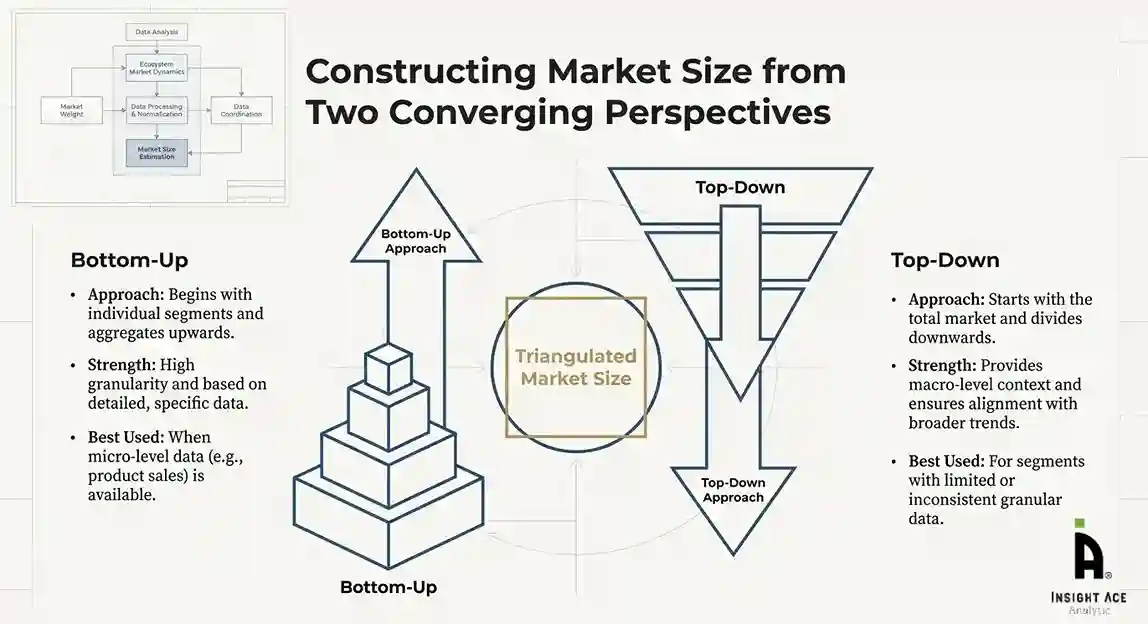
Top-Down Approach
The top-down approach used macro-level indicators:
Parent market benchmarks
Global/regional industry trends
Economic indicators (GDP, demographics, spending patterns)
Penetration and usage ratios
This approach was used for segments where granular data were limited or inconsistent.
Hybrid Triangulation Approach
To ensure accuracy, a triangulated hybrid model was used. This included:
Reconciling top-down and bottom-up estimates
Cross-checking revenues, volumes, and pricing assumptions
Incorporating expert insights to validate segment splits and adoption rates
This multi-angle validation yielded the final market size.
Forecasting Framework and Scenario Modelling
Market forecasts were developed using a combination of time-series modelling, adoption curve analysis,
and driver-based forecasting tools.
Forecasting Methods
Time-series modelling
S-curve and diffusion models (for emerging technologies)
Driver-based forecasting (GDP, disposable income, adoption rates, regulatory changes)
Price elasticity models
Market maturity and lifecycle-based projections
Scenario Analysis
Given inherent uncertainties, three scenarios were constructed:
Base-Case Scenario: Expected trajectory under current conditions
Optimistic Scenario: High adoption, favourable regulation, strong economic tailwinds
Conservative Scenario: Slow adoption, regulatory delays, economic constraints
Sensitivity testing was conducted on key variables, including pricing, demand elasticity, and regional adoption.