
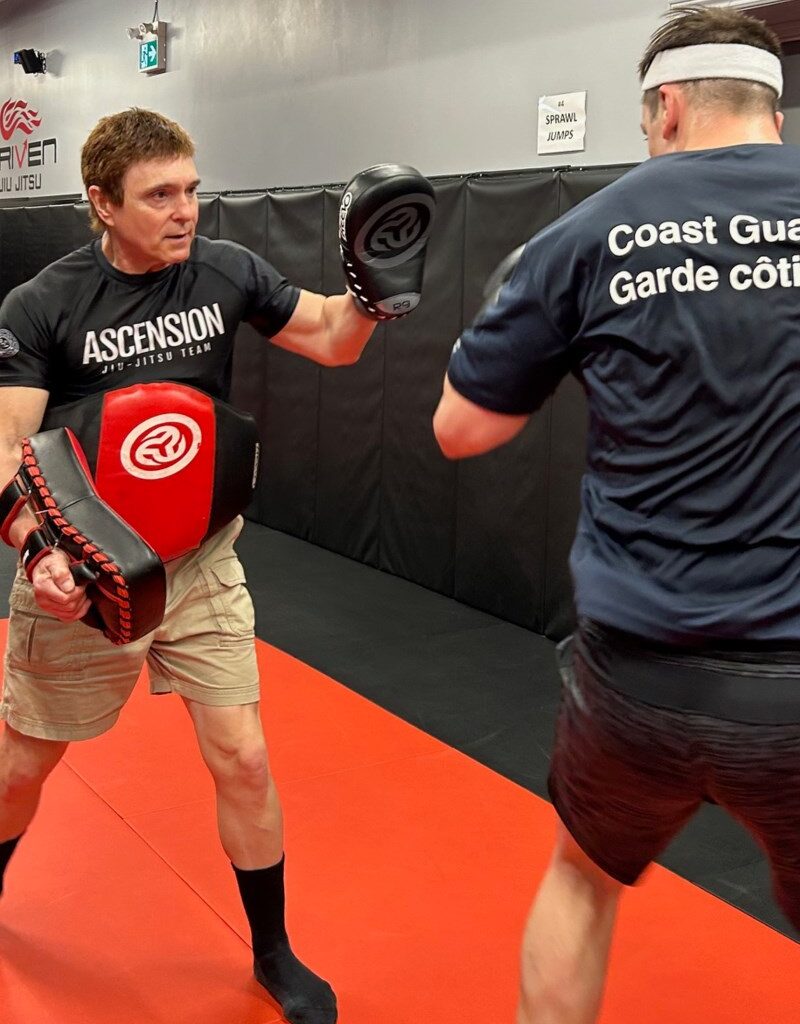
‘I’m always trying to optimize my conditioning, my technique, you know, different aspects,’ says David Goodman who is passing his boxing passion to next generation
David Goodman has been boxing since he was 15 years old; now at 68 and in excellent shape, he is a testament to what an active lifestyle can do for you.
“He’s pretty much an iron man,” says Jordan Stewart, 35, who met Goodman at the Midland YMCA where they both work out.
Inspired by the older man’s vigour, Stewart signed up for Godman’s coaching eight months ago.
Currently Goodman, who operates Sweet Science Boxing, has 15 students, ranging from 10 to 40 years old. He hopes to turn it into a full time job.
Although Stewart does not plan on boxing at a competitive level, he says he does plan to train with Goodman indefinitely.
“I feel like it’s a younger man’s sport, but you’re never too old to learn how to defend yourself,” he says.
Goodman keeps his classes small, training one-on-one or with two students at a time. Individuals require more attention, he says, due to the technicality and precision of the boxing style.
Developed by Cus D’Amato, the Peek-A-Boo defence style was made popular by Mike Tyson. It involves combinations of deliberate and explosive movements. Goodman has been practising it since his youth — long before Tyson popularized it
After reading the biography of 1950s boxer Floyd Patterson when he was a teenager, he found a heightened level of focus.
“It helped me follow a particular style,” he says.
Trained in traditional martial arts as well, Goodman was always more fond of boxing.
“Oriental martial arts are more structured, less realistic … There’s some effectiveness to them, but they’re more about concepts than just pure reality of fighting,” he says.
His enthusiasm is the driving force behind everything he’s learned.
“I’m always trying to optimize my conditioning, my technique, you know, different aspects,” he says.
Even in his senior years, Goodman makes it look easy. But the hours he dedicates to the sweet science indicates otherwise.
“An hour of cardio, 45 minutes of intense weight lifting, 45 minutes of light stuff, you know, to strengthen abs and forearms and little things that don’t require intensity. Then, usually like an hour and a half of boxing training … that’s about the amount of activity in a day,” he explains.
As a coach, he practises at a higher level than he expects from his students.
“That’s probably the majority of the motivation … like, if I’m going to offer somebody a service, I’m doing something that I love, I want to do the best job possible,” said Goodman who has a background in computer science and engineering.
“It really all comes down to Dave … he really guides you and it’s more than boxing because he wants to improve the person he’s training,” Stewart says, acknowledging his coach’s patience and ability to adjust the intensity for each student’s level.
A little psychology is also helpful when teaching. Goodman ensures his students are appropriately challenged by mixing 30 per cent reward with 70 per cent correction.
“That way they have enough incentive to feel like they’re doing OK and they’re moving forward, but at the same time they’re being moved in the correct direction … If it’s too easy you don’t learn anything,” he says.
Training novice boxers begins with balance, moving between static positions, and punching. Defensive skills are layered into the classes and details increase as the student improves.
Conditioning involves working with an individual’s genetic makeup to gain optimal speed and power.
“Hitting someone with power, cleanly, is really difficult when the other person’s not cooperating,” Goodman says, explaining that opponents avoid providing a target.
He describes the ease of teaching someone the movements, like a rear naked choke hold.
“That takes a few minutes … but to get somebody into a rear naked choke who isn’t cooperating is really tough,” he says.
Opponents with different body weights and fighting knowledge provide an array of obstacles. Another hindrance may come in the form of physical health and injury.
Now on what he says is his second life, Goodman overcame the challenge of recovering from a hip injury. For someone so athletic, it was gruelling to endure, both physically and mentally.
It’s all in the mind, he says.
“Developing a drive towards a goal, that’s the most important thing.”
Students discuss setting goals with him. Of the 15, two of Goodman’s students are driven to box competitively. Training for a fight in October is their priority.
Stewart’s goal was to improve his cardiovascular capabilities and overall fitness.
“He’s improved my fitness, he’s improved my cardio and he’s just made me a lot more confident of a person … That’s all thanks to Dave,” he says.
Sweet Science Boxing is open to all ages and levels. Goodman is proficient in precision training, conditioning, diet, motivation and life coaching as well as the Peek-A-Boo Defence and Dynamic KO style of boxing. He can be reached at [email protected]