

For David Paribello, the dream of moving back to Toronto has turned into a painful and frustrating dilemma.
Paribello and his wife left the GTA for California in 2019, planning to return “down the road” to be closer to family. But when they began looking at jobs and housing last year, he said the numbers just didn’t add up.
Together, the two earn close to US$300,000 a year in the San Francisco area. Paribello has been working in the medical technology sector for nearly 18 years and says he has been unable to find a comparable role amid Ontario’s tepid job market. He explains many of the roles he found across the GTA carry much lower salaries.
It’s a blunt reality that experts tell CTV Toronto underscore a widening affordability crisis: wages in Ontario aren’t keeping pace with housing costs, and new data shows more people are leaving the province than moving in, even as unemployment rises and middle-income households are squeezed out of the GTA.
“I’m the primary income earner and I’ve always known coming back to Canada, would be a hit on income,” Paribello said. “But some of these jobs that I’ve talked to… the salaries that they’re offering for someone with the level of experience that I have — is just abysmal.”
Paribello, 42, works 40-50 hours a week in sales and marketing. His wife, who is self-employed, works about 14-15 hours a week. Together they are raising four children under the age of eight in the Bay Area.
 Paribello family A photo of Paribello’s family provided on Friday September 5, 2025. (David Paribello photo).
In the U.S., he said, job prospects are plentiful for someone with his skillset.
“I was getting one or two meaningful interviews a week. In Canada, I could probably count the number of meaningful interviews on one hand,” Paribello said.
One Toronto job he interviewed for offered $80,000 to $90,000 annually.
That role, he said, was with an established multi-billion dollar company. He said most companies, in his experience, tend to offer higher salaries south of the border.
“Dollar for dollar, I need to (at least) be around the $200,000 mark,” he said. “I don’t know how we can live a comfortable lifestyle in the GTA on the salaries that they’re offering.”
Fewer opportunities, higher costs
The couple kept their Oakville home until 2021. They now own a five-bedroom home in California, bought for just over US$1 million.
 home The home David Paribello and his wife purchased in the Bay Area for just over US$1 million. (Photo provided by David Paribello).
“For a five-bedroom, two-and-a-half bathroom place in the Burlington, Oakville area you’re looking at probably a minimum of a million and a half or more,” Paribello said.
But it’s not just housing that concerns him.
“Why live in a city or an area where the pay is low? The traffic is some of the worst in the world. The job opportunities are not as abundant as they are in other countries,” he said.
He describes the inability to return home as more than a financial setback. “It’s a complete matter of shame to know you can’t go back to your home.”
A broader affordability crisis
His struggle comes at a time when affordability pressures are pushing many out of Ontario. According to Statistics Canada, the province lost 5,664 people to other provinces in the first quarter of 2025, its largest quarterly population drop since 1951.
Meanwhile, job losses are also mounting. This week, Statistics Canada reported more than 66,000 positions were lost nationwide in August, pushing the unemployment rate to 7.1 per cent. In July, 41,000 jobs were lost, bringing unemployment to 6.9 per cent.
It’s no secret Canadian wages in some sectors have trailed behind those in the U.S. In fact, a 2023 study by Toronto Metropolitan University found Canadian tech workers earn 46 per cent less than their American peers — about $83,700 annually compared with $122,600.
For housing, the gap is even starker. A new report from the Canadian Centre for Policy Alternatives says someone in Toronto would need to make nearly $38 an hour — around $78,000 a year — just to afford a one-bedroom apartment. The rental wage for vacant units is even higher, at $41.73 for a one-bedroom and $51.73 for a two-bedroom.
CivicAction, a non-profit group, warned earlier this year that middle-class households earning up to $125,000 are being squeezed out of the GTHA. The group noted the city’s price-to-income ratio now sits at 11.8 times the median household income, forcing average homebuyers to spend 76.9 per cent of their pay on mortgage payments.
What experts think
Economist Obeid Ur Rehman of Toronto Metropolitan University said Paribello’s frustration reflects a wider imbalance.
“I think it’s surprising, particularly for someone coming from the Bay Area,” he said, noting Toronto now rivals one of the most expensive housing markets in North America.
“Wage growth has not been as persistent and compared to the U.S. I think this is a common trend that a lot of people are finding — for similar types of jobs, wages are noticeably lower.”
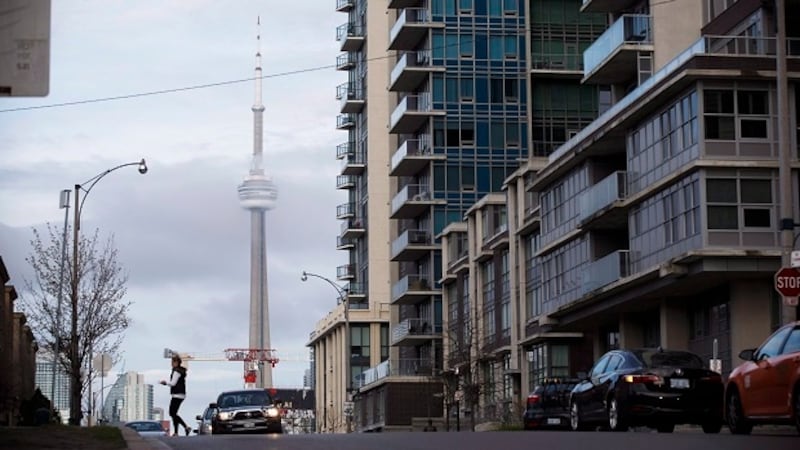 condo, Toronto, housing market, Liberty Village The CN Tower can be seen behind condo’s in Toronto’s Liberty Village community in Toronto, Ontario on Tuesday, April 25, 2017. (THE CANADIAN PRESS/Cole Burston)
Rehman said Canada’s affordability crisis is the result of “a combination of high housing costs, low wage growth, and limited supply of affordable housing.”
“Even if wages continue to grow… we would still be in an affordability crisis, because housing costs have just exploded,” he noted, referring to pre-pandemic levels.
For Paribello, the decision is personal but rooted in economics.
“At the end of the day, it’s always home, right? That’s where we call home. That’s where we grew up. It’s where our family is,” he said. “There’s always a plan to move back, it just has to make sense.”
For now, he says, it doesn’t.