
Breadcrumb Trail Links
Published Jul 16, 2025 • Last updated 5 hours ago • 3 minute read
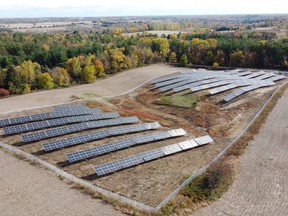 Compass Greenfield Development included this image of an Ontario solar farm in its presentation to Town of South Bruce Peninsula on Tuesday, July 15, 2025. The company is proposing to buiild a 60-acre solar installation near Allenford. ScreenshotArticle content
South Bruce Peninsula councillors unanimously supported a proposed 60-acre solar farm near the intersection of Bruce Road 14 and Pleasantview Road.
Advertisement 2
This advertisement has not loaded yet, but your article continues below.
Article content
Council received a delegation from Roberto Caputo on behalf of Compass Greenfield Development, where Caputo is the senior director of development, at a meeting Tuesday.
Article content
Recommended Videos
Article content
The company proposes to develop an approximately 11 MWac project, called Sauble River Agrivoltaics, and is seeking council support as part of the process for participating in the IESO’s long-term energy procurement scheduled for later this year.
MWac stands for megawatts of alternating current. Agrivoltaics is the practice of combining solar power generation with agricultural activities. In the case of Sauble River Agrivoltaics, the site would be used for sheep grazing and eventually hand-picked crops.
The Independent Electricity System Operator (IESO) has forecast a 75 per cent increase in electricity demand in the province between 2025 and 2050. The Sauble River Agrivoltaics Project will submit to the IESO request for proposals (long-term 2 procurement), which has a submission deadline of Oct.15.
Advertisement 3
This advertisement has not loaded yet, but your article continues below.
Article content
The project is on private land, but the company needs municipal support for its application to the IESO.
Compass Greenfield Development (CGD) began in 2011 as a sister company to Compass Renewable Energy Consulting Inc. and has been awarded 46 megawatts of battery energy storage by the IESO.
CGD has developed more than 100 renewable energy projects in Ontario, representing more than 100 megawatts in the last six years, and has supported the development of more than 2,000 megawatts for its clients, Caputo told councillors.
Caputo said Sauble River Agrivoltaics, and projects like it, optimize land-use, diversify income for local landowners and contribute to a stronger energy grid. The company is also committing to an annual community benefit agreement payment of $1,000 and will pay for any third-party costs related to permit reviews incurred by the municipality.
Advertisement 4
This advertisement has not loaded yet, but your article continues below.
Article content
The IESO procurement and Ministry of Agriculture guidelines restrict solar development on Prime Agricultural Areas, as defined in the Provincial Policy Statement. The Sauble River Agrivoltaics Project is situated on rural lands, as outlined in Bruce County’s official plan. The local Hydro One transmission station will support the project’s capacity.
Caputo said the project area will be fully fenced and secured with a plant buffer along the perimeter and set back a minimum of 15 metres from the property line.
When in operation, the site is controlled remotely and monitored 24/7. Operations and maintenance contractors are based in Ontario, and scheduled site visits occur four times a year.
Caputo said CGD will work with local farmers and is committed to encouraging sheep grazing at the solar site. The fenced area will provide protection for the flock, and the panels provide shade, while the sheep help maintain the vegetation.
Advertisement 5
This advertisement has not loaded yet, but your article continues below.
Article content
He said that as the field of agrivoltaics continues to advance, CGD is committed to establishing crop production at the site over the project’s lifespan.
Deputy-mayor Caleb Hull said he supports the project, but is concerned about its what happens when it reaches it’s end of life.
“My big concern is the decommissioning of it,” he said after the delegation, noting constituents have had issues before with companies leaving behind a mess.
Caputo said his company will present a formal decommissioning plan.
“We’ll make sure you’re happy with the plan,” he said.
Hull also wondered if CGD considered building solar plants in nearby spent quarries, rather than on rural land. Caputo responded that, at its current proposed site, there’s a willing landowner, as well as a Hydro One infrastructure nearby with capacity to tap into, making it a good fit.
Coun.Terry Bell wondered who foots the bill for any maintenance, for which Caputo said the company would be 100 per cent responsible.
Councillors supported the project unanimously in a recorded vote.
Next, CGD will undertake Indigenous and community engagement beginning with a session scheduled for July 31.
Article content
Share this article in your social network