
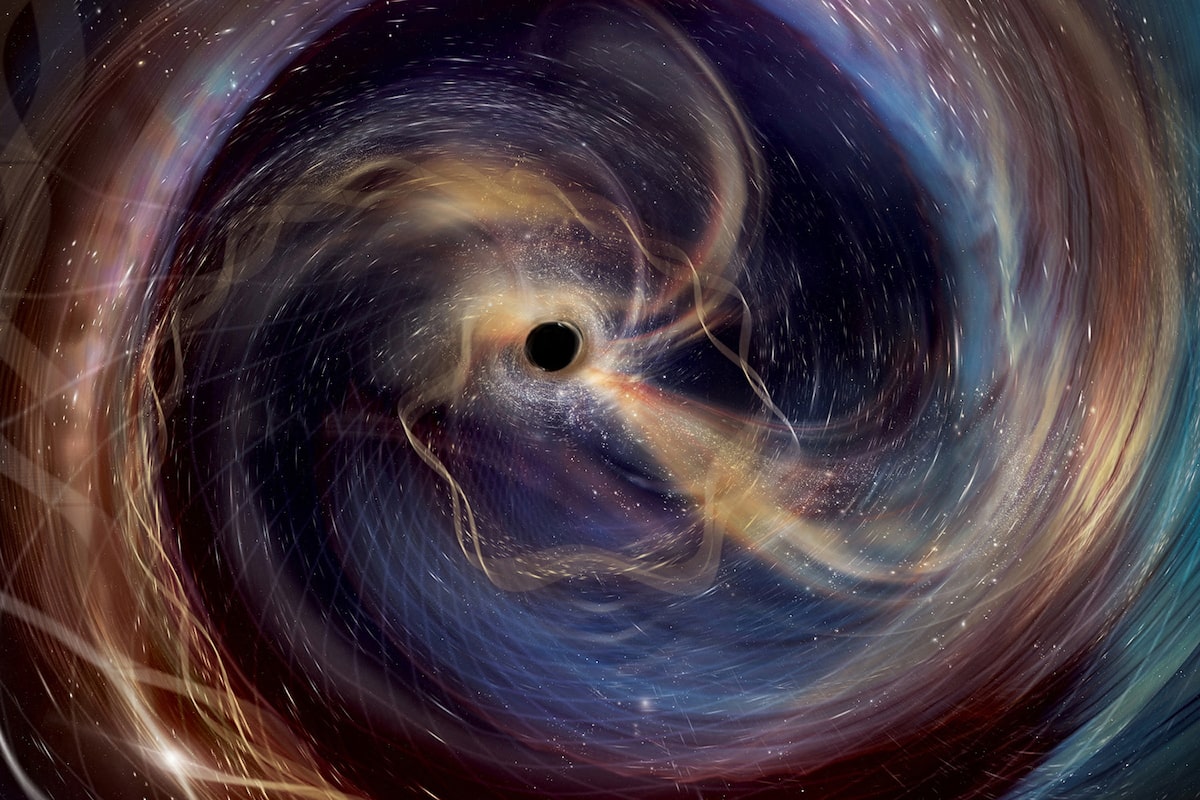
An artist’s conception shows the events immediately preceding a collision between two black holes, observed in gravitational waves by the U.S. National Science Foundation’s Laser Interferometer Gravitational-Wave Observatory. It depicts the view from one of the black holes as it spirals toward the other.Aurore Simonnet (SSU/EdEon)/LVK//Reuters
Jess McIver knows black holes are real. She can hear them dancing in the dark.
An astrophysicist and associate professor at the University of British Columbia, Dr. McIver spends her time reading the subtle vibrations in spacetime that rattle our planet when distant black holes spiral into each other and violently collide.
The detectors that make such observations feasible are part of the Laser Interferometer Gravitational-Wave Observatory, also known as LIGO.
On Wednesday, Dr. McIver and her colleagues revealed that LIGO has bagged its most unambiguous signal yet.
“This is actually a bit of a weird one,” she said. “It’s very interesting, mainly because it’s so boring.”
That’s no contradiction.
Detecting gravitational waves that have travelled across the vast reaches of intergalactic space – in this case 1.3 billion light-years – is no mean feat. Such signals are easily buried in the random noise that can affect the detector. To have such a clear indication rise above the noise, without additional complications that can make it hard to interpret, means it is ideal for probing the nature of black holes and for testing the theory that underpins our understanding of gravity.
The bottom line from this particular result: The theory of general relativity, which has been the ruling mathematical description of gravity ever since Albert Einstein developed it more than a century ago, remains spot-on.
The signal shows that two black holes, each 30 to 40 times more massive than our sun, collided and merged to form a larger black hole.
The event is remarkably similar to LIGO’s first positive detection, which occurred 10 years ago this week on Sept. 14, 2015. The biggest difference is how much the instrument has improved to make the detection so straightforward.
This week’s release, made during a meeting of LIGO researchers in Fort Collins, Col., is a celebration that underscores both the experiment’s growing success and its vulnerability in the current political climate.
For redundancy and to help establish the direction of incoming signals, LIGO consists of two giant detectors situated far apart in Hanford, Wash., and Livingston, La. In its 2026 budget proposal, the U.S. National Science Foundation has indicated it will shutter one of the two facilities as part of a 57-per-cent budget cut imposed by the Trump administration.
LIGO operates two detector sites, one near Hanford in eastern Washington, and this one near Livingston, La.Caltech/MIT/LIGO Lab/Supplied
From a science and technology perspective, the proposed shutdown would be “very bad,” said David Reitz, the executive director of the LIGO Laboratory at the California Institute of Technology.
“There’s no other way to put it,” Dr. Reitz said in an interview. “It would severely disrupt LIGO’s ability to continue with our groundbreaking scientific program.”
Ten years ago, scientists had only recently switched on the two detectors after a round of upgrades that they hoped would finally achieve the sensitivity needed to pick up gravitational waves from space. When the first signal came in, LIGO was on an engineering run – a final check intended to ferret out any technical issue with the operation of the experiment.
Instead, it achieved what had never been done before: It picked up the momentary jiggle of a distant astronomical event as it rippled through Earth’s gravitational field. It was a momentous discovery that would not be revealed to the public for another five months as researchers carefully reviewed the data to confirm what they had seen.
“That first event, which was bigger than anybody had reason to believe – that’s probably still my biggest surprise so far,” Dr. McIver said.
In addition to proving that gravitational waves exist – a prediction of Einstein’s theory – the detection marked the first time information from a source in the distant universe had been received directly through the medium of gravity. It meant LIGO had opened a new window onto the universe. The scientists who first devised the experiment, which was decades in the making, were duly awarded the Nobel Prize in Physics in 2017.
Dr. Jess McIver says the latest discovery from LIGO is ‘very interesting, mainly because it’s so boring.’Jimmy Jeong/The Globe and Mail
Each LIGO detector consists of a pair of laser beams that travel back and forth along identical four-kilometre-long tunnels built at right angles to each other. Normally the beams are synchronized so they cancel each other out. But if Earth is slightly stretched or squeezed by a ripple in the gravitational field we all inhabit, the beams will slip out of sync and register the passing wave.
Reed Essick, an associate professor at the Canadian Institute for Theoretical Astrophysics at the University of Toronto, was one of the first people on Earth to see that memorable first signal.
A graduate student at MIT at the time, his work involved quickly following up on anything spotted by LIGO’s twin detectors.
“People thought it must be some test that someone had put into the data, because that’s the thing that we do to make sure that everything is working,” Dr. Essick said. “But pretty quickly it was realized that, no, it was a real signal. So then we all sort of scrambled to figure out what to do, who we needed to tell.”
Since then LIGO has increased in sensitivity and is now joined by Virgo and KAGRA, two partner detectors located in Italy and Japan respectively. The experiment now spots a merger of black holes about every three days on average, with a catalogue of detections that now runs into the hundreds.
Scientists report cosmic hum that may come from clusters of massive black holes
Canada plays a role in handling the vast data stream from LIGO, and Canadian researchers, including Dr. McIver and Dr. Essick, work with the data from the experiment to glean new information about black holes and other massive objects that populate the universe and generate the strongest gravitational fields known. And, as always, the search is on for a divergence from Einstein’s equations that might yield a clue to a deeper theory about gravity, space and time at the most fundamental level.
Meanwhile, LIGO has blazed a trail for a future detector called LISA that would fly into space and measure gravitational waves at longer wavelengths as a way to explore the characteristics of giant black holes whose mergers were part of the building of the galaxies that populate the universe.
“I think with LIGO, the thing that you’re constantly reminded of is just how much it’s the tip of the iceberg,” said Daryl Haggard, a McGill University astrophysicist and Canadian spokesperson for LISA. “We just are barely starting to understand how to use this probe of our universe, and that’s just so exciting. Every single discovery is still rich with potential.”