
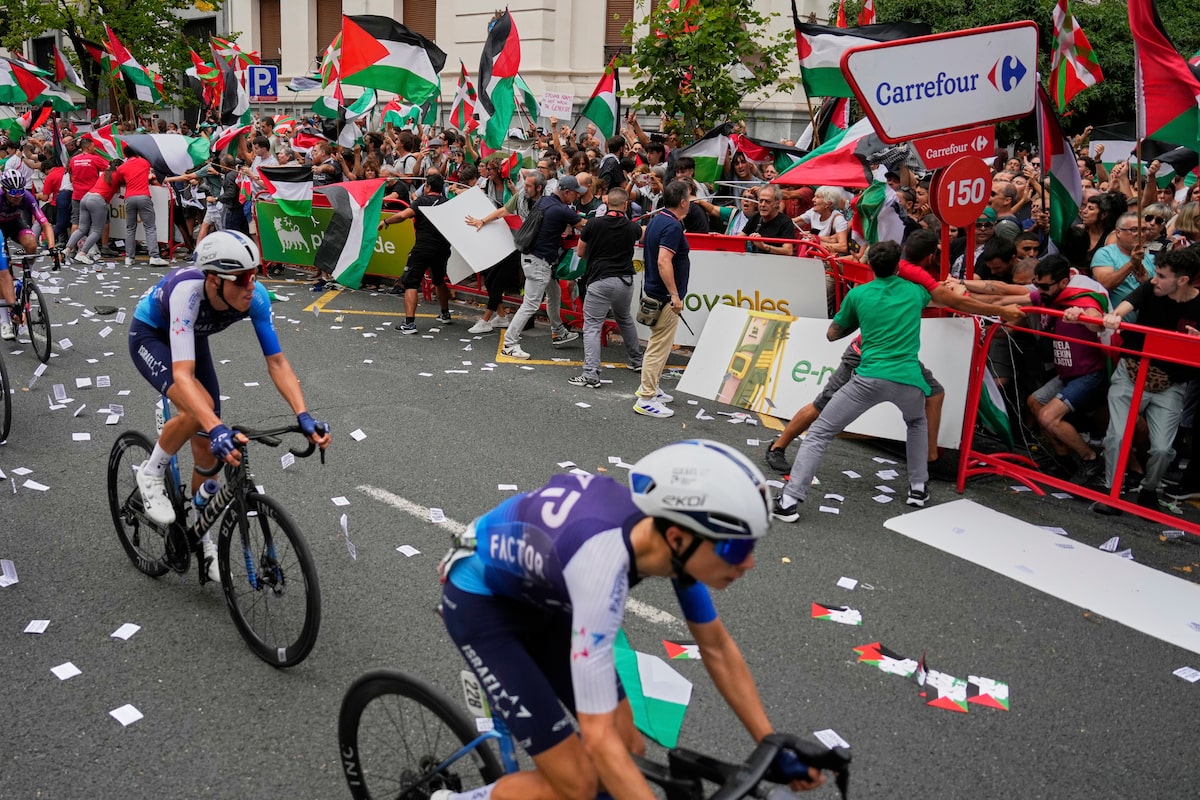
Protestors wave Palestinian flags as members of the Israel-Premier Tech team ride by during the 11th stage of the Vuelta a España in Bilbao, Spain, last week.Miguel Oses/The Associated Press
Some of the world’s best cyclists are in Quebec this week for two of the most exciting, and excruciating, races the sport has to offer. Les Grands Prix Cyclistes de Montréal et Québec will see 161 riders race through the streets of the province’s two biggest cities. Thousands of fans are expected to line the routes.
Friday’s race, a 216-kilometre course through Old Quebec City that culminates on the Plains of Abraham, is tough enough. Sunday’s race in Montreal is even tougher. The punishing 209-kilometre course requires riders to climb Mount Royal no fewer than 17 times. With a cumulative ascent of more than 4,500 metres, the Montreal race is comparable to the hardest Tour de France stages through the Alps or Pyrenees.
The star attraction in Montreal will be Tadej Pogacar, the 26-year-old four-time Tour de France winner from Slovenia who rides for UAE-Team Emirates. Mr. Pogacar sat out this month’s Vuelta a España – the last of pro cycling’s Big Three stage races, after the Giro d’Italia and the Tour de France – specifically to train for the Montreal Grand Prix, which he won in 2022 and 2024.
Mr. Pogacar’s reported salary of more than €8.3-million ($13.5-million) is by far the highest in professional cycling. But he is a priceless brand ambassador for the United Arab Emirates, whose initials are splashed across the front of Mr. Pogacar’s jerseys and seen by millions of cycling fans across the world during the marquee three-week-long Tour de France.
Indeed, perhaps no country has engaged as unabashedly in “sportswashing” as the UAE, a Persian Gulf petrostate and haven for Russian oligarchs that’s also known for the over-the-top skyscrapers of Dubai and Abi Dhabi and, oh yes, its human rights abuses.
Spanish Vuelta stage cut short as pro-Palestinian protesters disrupt race
The UAE is the main arms supplier to Sudan’s Rapid Support Forces, which the U.S. State Department has accused of committing genocide in that country’s civil war, a conflict that has left at least 150,000 dead and left millions more facing severe hunger or famine.
Yet this week, Quebec’s massive public pension-fund manager, Caisse de dépôt et placement du Québec, announced a joint venture with DP World, the Dubai-based, state-owned logistics giant, to run the Port of Montreal’s new container terminal in Contrecoeur, Que. The relationship between the Caisse and DP World, which first announced a $5-billion global partnership in 2016, has faced little scrutiny by federal or provincial politicians.
No one appears to have batted an eye about the participation of UAE-Team Emirates in the Grand Prix Cyclistes, either. Yet, pro-Palestinian activist groups have demanded that another team – Israel-Premier Tech – be barred from the races over Israel’s relentless war in Gaza.
This situation underscores the double standard that pro-Palestinian activists have consistently applied in the nearly two years since Hamas terrorists killed about 1,200 Israelis and took another 250 hostages in Gaza. If Israel’s conduct in Gaza is worthy of condemnation – and it is – then so too is the UAE’s role in the Sudanese civil war, in which atrocities are committed daily.
Pro-Palestinian protesters have disrupted several stages of the Vuelta a España. Members of Israel-Premier Tech participating in the Vuelta last week began riding without their team name on their jerseys to avoid being singled out for verbal abuse or violence. As if cycling were not already dangerous enough.
Organizers of the Grand Prix Cyclistes fear the races in Quebec City and Montreal could be marred by similar protests. Tennis Canada cited “escalating safety concerns” in barring spectators from this week’s Canada-versus-Israel Davis World Cup indoor event in Halifax, saying it had been warned by national security agencies of “a risk of significant disruption” by pro-Palestinian activists. But blocking the entire Grand Prix race routes is not possible.
Nor would it be desirable. There is a debate to be had about whether professional sports teams should be sponsored by non-democratic states seeking to burnish their global images. But that debate should be carried out before the Union cycliste internationale, professional cycling’s governing body, which decides which teams can compete in UCI-sanctioned races, such as the Tour de France and the Grand Prix Cyclistes.
Israel-Premier Tech is a privately owned team, and not one officially sponsored by the Israeli government. Its owner, Canadian-Israeli real estate heir Sylvan Adams, is, however, an unapologetic defender of the State of Israel. He bought the team a few years back with the stated aim of “showing to a worldwide audience the true face of Israel, which is that of normal, diverse, tolerant and, importantly, safe democracy.”
Mr. Adams has done wonders for cycling in this country, sponsoring several of Canada’s top riders. But for the sake of cycling and the respect of fans, neither he nor the UAE should be able to get away with sportswashing.