
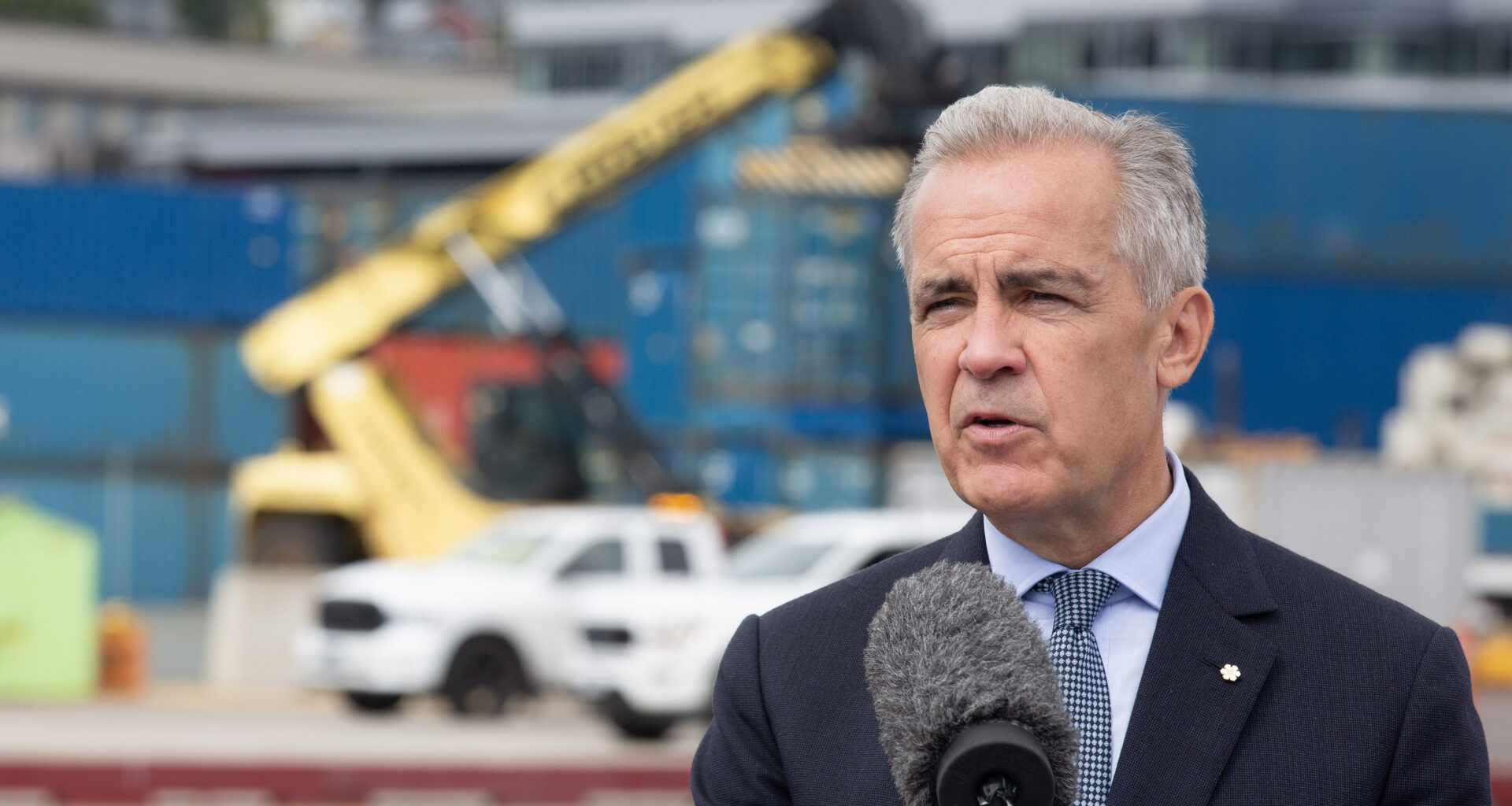
Another day, another major climate policy watered down. On Friday, Prime Minister Mark Carney announced that he is pausing the EV mandate created by his predecessor as part of a broader review aimed at creating a “carbon competitiveness” strategy. Given the Trump administration’s open war on renewable energy and climate policy and the Carney government’s determination to make life easier for the business community, it’s fair to wonder if that strategy will include more strategic retreats — and if any of Canada’s signature climate policies will survive the next few years as a result.
It’s also fair to point out that Carney is operating in a fundamentally different political and economic environment than former prime minister Justin Trudeau ever was. Where climate policy under Trudeau’s government was mostly about establishing moral and political leadership, Carney is facing a much more existential menu of choices. You might even call it a hinge point — and Carney almost certainly would, given that he was in the process of writing a whole book about them. While China races ahead in the development and application of key low-carbon technologies, from wind and solar power to batteries and electric vehicles, the United States has effectively abandoned that race in order to advance the interests of fossil fuels.
Case in point: despite claiming that America is in the midst of an “energy crisis,” the Trump administration cancelled a nearly completed $6.2-billion wind project off the coast of Rhode Island. It would have delivered power at 9.8 cents per kilowatt-hour, which is already cheaper than the average cost of electricity in New England, and locked that price in for two decades. They cancelled it, supposedly, because it was permitted too quickly — despite the Trump administration’s enthusiasm for permitting new oil and gas projects as quickly as possible.
The real reason, I’d suggest, is because it threatens the political and economic hegemony of the oil and gas industry. That’s something US Secretary of Energy Chris Wright and the rest of his administration won’t tolerate. His official social media account routinely posts false or misleading information about renewable energy and fossil fuels, all in an obvious attempt to boost the latter at the expense of the former. On Monday, for example, he wrote that “the U.S. is rapidly becoming THE powerhouse of the fastest growing energy source on the planet: natural gas.” In reality, a place the Trump administration inhabits with ever-declining frequency, solar actually grew 10 times faster — 10 times — than natural gas did in 2024. The United States, meanwhile, has been the world’s biggest gas producer since 2011.
All the lies in the world won’t change the ever-improving economics of renewable energy, much less what they say about the long-term demand for fossil fuels like oil and gas. But they do underscore the geopolitical realignment being driven by clean technology, one that increasingly pits a so-called “axis of petrostates” led by Saudi Arabia, Russia and the United States against China and its allies. As historian Nils Gilman wrote in a recent piece for Foreign Policy, “as the green transition gathers momentum, underpinned by Chinese technological prowess, a reactionary counter-bloc has already begun to coalesce — not around a commitment to liberal democracy or human rights, but to the continued extraction and political centrality of hydrocarbons.”
The alternative to that bloc isn’t much better. Yes, China has made remarkable progress recently on the development of clean technology, and it could continue to deepen its economic and diplomatic relationship with Europe. But it remains a fundamentally illiberal state with little regard for freedom of speech, expression and numerous other rights Canadians take for granted. It’s not hard to imagine Canada’s Conservatives, and especially the ones in Alberta, eagerly siding with America’s petro-nationalism over China’s green authoritarianism.
But maybe Canada doesn’t have to choose between these two unpalatable orthodoxies. Maybe, if Carney plays our cards right, Canada can emerge as a kind of third way on climate, a country that’s able to develop both conventional and renewable energy for as long as either are required. We don’t have to engage in the same sort of ideological self-sabotage that America is consumed by right now, nor do we have to subsume our hard-won freedoms to the economic and political imperatives of the state, as tends to be the case in China. We can, and should, let the facts tell us where to go.
Climate policy is no longer merely about reducing emissions or averting a crisis in the future. It’s now a key part of the ongoing geopolitical conflict between China and the United States — one that presents a clear risk to Canada’s interests.
That means continuing to develop our oil and gas assets while preparing for a world in which they’re not needed nearly as much. It means embracing the economic and environmental opportunities associated with wind and solar energy. And it means finding a way to skate to where the puck is inevitably going (I know, I know) without getting cross-checked by reality along the way.
In that environment, a federal climate competitiveness strategy is more important than it might sound. This is no longer about whether we want to voluntarily reduce our emissions and to what degree, although those reductions do still have strategic value. Instead, it’s about how we want to position ourselves in the deepening geopolitical conflict between China and the United States — and how to maximize our chances of surviving the fallout.