
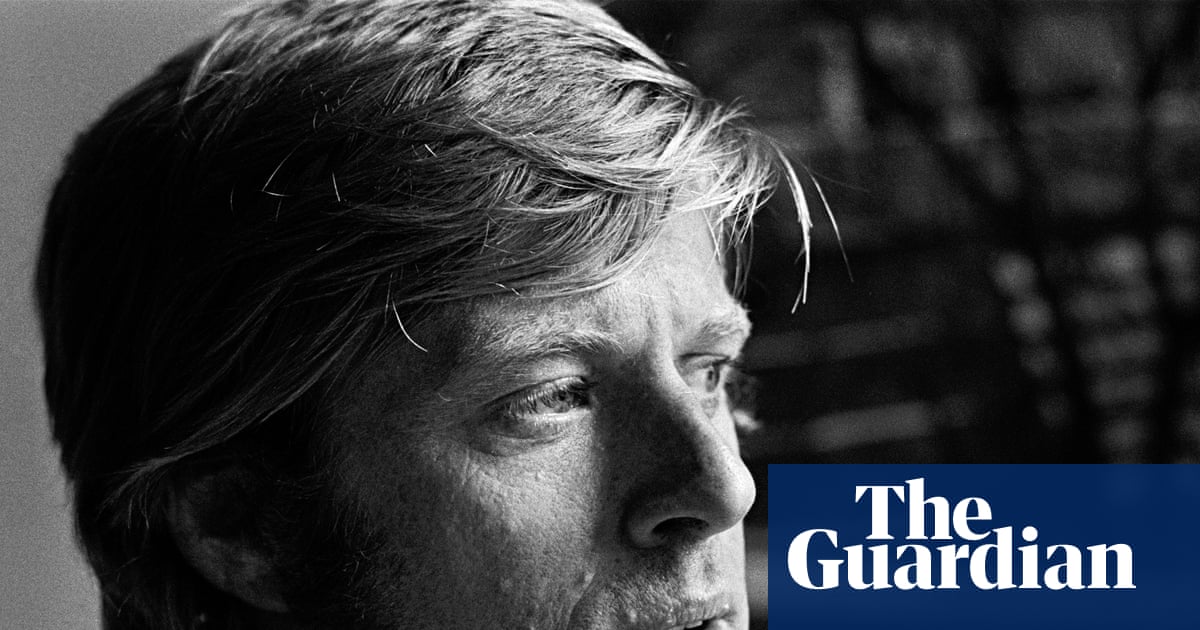
When Butch Cassidy and the Sundance Kid first went the rounds, the credits read Paul Newman, Katharine Ross, Robert Redford. Now they read Paul Newman, Robert Redford, Katharine Ross. Redford, the Sundance Kid, is probably the hottest new box office property in the male category since the emergence of Steve McQueen and Dustin Hoffman. The strange thing is that, though passably grateful, he couldn’t really care less.
“I am not,” he says determinedly, “a Hollywood man. Do you remember that guy who walks in and out of William Saroyan’s The Time of Your Life, saying ‘There’s no foundation, no foundation – all down the line’? Well, that’s what I feel about Hollywood. You can’t run an art form like a business any more, and they’re still trying to. Films to them are just like vacuum cleaners or refrigerators. The approach sickens me.”
We have, of course, heard all this before from aspiring film men. But Redford, who talks very quietly – and honestly doesn’t seem to know why anyone should want to interview him anyway – sounds as if he means it. One of the main reasons, one fancies, is that he put almost two years of his life into a film called Downhill Racer and found that fighting the system was an even harder job than making a difficult movie.
The film, which hasn’t yet been shown here, in spite of the fact that sneak previews were being given well before Christmas, has been released in America and has received reviews which suggest that it is considerably more than a skiing spectacular. “In fact,” says Redford, “it is about sport and sportsmen. And the reason I went to open it in London is because this is not a skiing country. There is more chance of it surviving here as a study of a certain kind of person rather than a certain kind of sport.”
“They wanted to open it in Austria, showing it to all the experts. But, really … here is a movie which shows an American getting a gold medal in downhill racing. Isn’t that going to wow them? Oh, boy, just as long as I’m not there. I’d be torn to pieces”
“Why downhill racing? Because it seems to me the perfect blend of poetry and danger, the perfect vehicle through which to show what sport sometimes does to men. You have to be a kind of kamikaze pilot to do it at all. And once you’ve done it, you are never quite the game again.”
“I’d like you to see all those downhill veterans hanging about around the boys doing it now. They are pathetic. They can’t keep still for a moment. Their hands move restlessly the whole time. They are all shot up. Sport can be very cruel, both to the sophisticated and the unsophisticated. Frequently it fits you only for the wrong things, even breaks you utterly.”
Redford should know what he is talking about. He was once a first-class American football and baseball player, and could well have made a name for himself as a tennis player too. “Christ, I really hated to lose,” he says, “but in the end I got so that I just couldn’t go on, winning or losing. I used to look at the guy over the net to me and think – goodness, his left sock is coming down. His shoe is going to murder that bare ankle by the end of the set, and he is so worried about the game that he won’t even feel it. Then I’d notice some spectator or other, and think: ‘What the hell is he thinking about just now? Am I really just an extension of him, fighting his fantasy? By which time it was 0–40!’”
His other love, perhaps secretly his main one, is painting. He bummed around Europe for over a year in the late fifties, mixing with artists, students and intellectuals, pseudo and otherwise. He ran out of money in Florence, but met a teacher who arranged an exhibition of his work which paid for his transportation back home. When he got back, his restlessness again got the better of him. He ended up an actor, first on Broadway, then television, and finally in films.
Inside Daisy Clover, Barefoot In the Park (one of the biggest box office grossers of 1967), Polonski’s Tell Them Willie Boy is Here, Cassidy, and Downhill Racer followed in quick succession. Next is Sidney Furie’s Little Fauss, Big Halsey, a film about motorcycle racing with Michael J Pollard. After that, possibly a movie on latter-day rodeo riding. Sport looks like dogging him for some time to come.
And what about painting? Redford looks a little uneasy. “Well.” he says, “I haven’t done it for two years. That’s why I’d like to take a rest from filming and start again. But can you really start again? I doubt it. It’s not for fun, is it? It’s got to be the whole of life. Mind you, my first visit to London has stunned me in this respect. It’s made me itch to paint.”
“Look at the light in this place. It’s absolutely fabulous. Each morning I’ve been here I’ve got up early and wandered round with my mouth open. I’ve never seen anything like it. I must come back again soon. Perhaps when Downhill Racer finally opens – if it ever does.”
“Wish I was as shrewd a cookie as Paul Newman. He’d have seen to it that the film wasn’t messed around like this. What about Rachel, Rachel? “Yes, of course. Even he can’t always buck the bloody system.”