
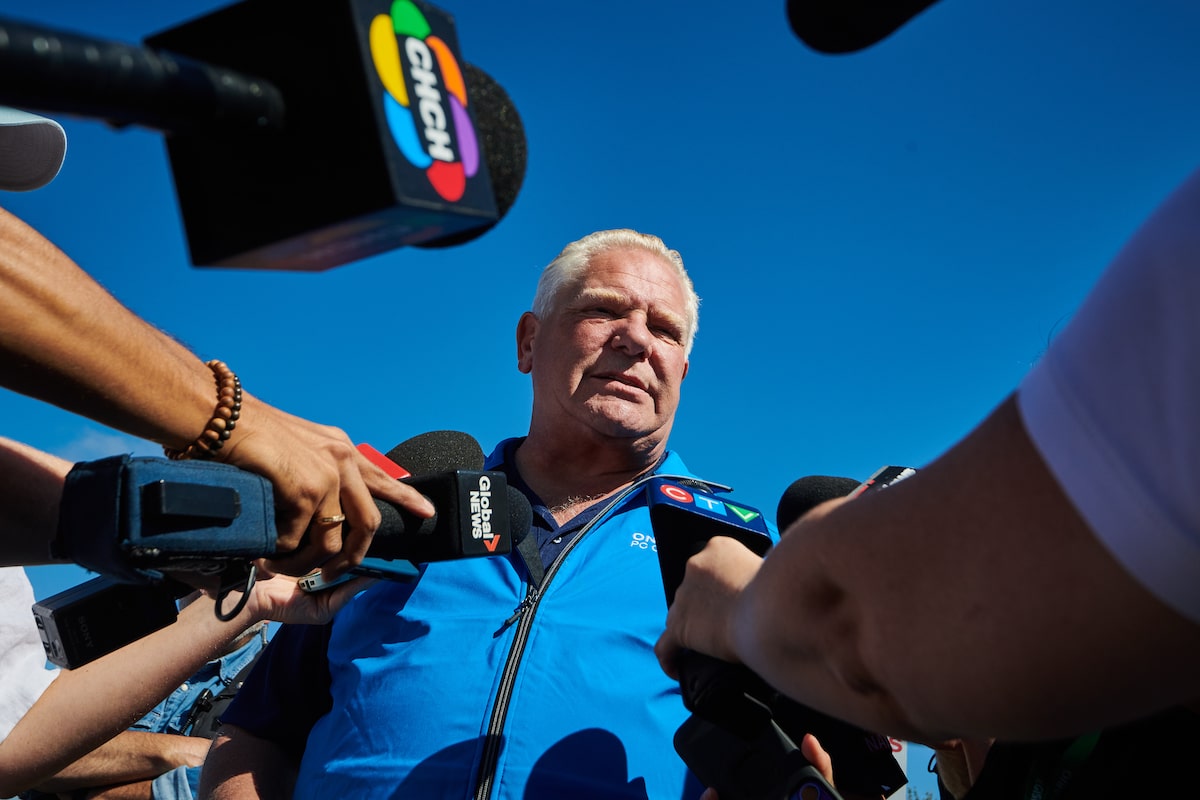
Ontario Premier Doug Ford believes Mark Carney will include the Highway 401 tunnel among the major projects the federal government intends to fast-track.Sammy Kogan/The Canadian Press
Ontario Premier Doug Ford says he believes Prime Minister Mark Carney will support his plan to build a tunnel under Highway 401 through Toronto and will include it among the major projects the federal government intends to fast-track.
Mr. Ford has spoken out about his plan to build a new driver and transit tunnel expressway under Highway 401 and included it on the list provided to Ottawa of five projects the province believes are in the national interest to build.
When asked if he thinks Mr. Carney will back the tunnel as a major project, the Premier said: “I believe he will.”
Pressed on whether the Prime Minister has spoken to him about the tunnel, Mr. Ford repeated: “I just believe he will.”
“Considering it’s the busiest highway in North America, and 50 per cent of the GDP comes through Toronto, and it’s costing us $58-billion of lost productivity, I think it’s pretty national,” Mr. Ford said.
He was speaking at the International Plowing Match in Grassie, Ont., a rural showcase attended by provincial politicians of all stripes.
Editorial: Doug Ford’s detour around accountability
Opinion: Will Mark Carney’s choice of ‘major projects’ be powered by politics or economics?
The Prime Minister’s Office did not specifically address Mr. Ford’s comments about the tunnel. But PMO spokesperson Audrey Champoux pointed to Mr. Carney’s comments last week, in which he said he expects to announce the next tranche of projects to be considered for fast-track approval before the Grey Cup football game, which happens in mid-November.
Mr. Ford’s government has launched a feasibility study of the tunnel, which experts say could cost upward of $60-billion or more and take decades to build. The Premier this summer also unveiled his vision for the expressway, saying his plan is to have a 19.5-metre-wide, three-level tunnel, with one level going eastbound, one for westbound traffic and a bottom level for transit.
But he has declined to release any estimated cost for what could be the world’s longest traffic tunnel, at up to 60 kilometres long, dug underneath one of the busiest stretches of highway on the planet.
Last week, Mr. Carney announced the first projects that will be reviewed for fast-track approval under Ottawa’s Building Canada Act and said he’s working with Alberta on a carbon capture and storage project that could ultimately lead to a new oil pipeline.
The five projects being referred to the new Major Projects Office include LNG Canada Phase 2, which would expand the liquefied natural gas export facility at Kitimat, B.C. Also on the list are modular reactors at Ontario’s existing Darlington Nuclear Generating Station; an expansion by the Port of Montreal in Contrecoeur, Que.; Saskatchewan’s Foran McIlvenna Bay copper mine project; and the Red Chris Copper and Gold Mine expansion in British Columbia.
After The Globe and Mail reported earlier this month on a draft list of 32 projects the federal government was considering, Mr. Ford said it was not good enough for his province and that he discussed the issue directly with Mr. Carney.
Only three potential major projects were exclusively in Ontario: a nickel mine near Timmins, an access road to mining claims in the remote northern Ring of Fire region, and the plan to build new small modular reactors at Darlington.
Mr. Ford said Tuesday he also expects the federal government will select critical-minerals mining projects and infrastructure for Ontario’s Ring of Fire region in the next group of chosen projects.
“It’s all right. I talked to him. It’s going to be on the next tranche,” Mr. Ford said.
The federal government has said that a priority for the Major Projects Office will be to get more critical-minerals projects to final investment decisions, “with a focus on sustainability and regulatory certainty.” Ottawa says this will enable critical-mineral proponents working with Indigenous and local communities, investors, and provinces and territories to develop projects in regions such as the Ring of Fire in Ontario.
Plans to fast-track major infrastructure projects at both the federal and provincial levels have received pushback from First Nations who accuse the governments of overriding their rights and abandoning the duty to consult with Indigenous people. Several First Nations – including one that once supported road access to the Ring of Fire – have launched legal challenges to both Ontario and Ottawa’s bills that speed up resource development.
Ontario Energy and Mines Minister Stephen Lecce called the Darlington nuclear project “just the beginning” and said the federal government also needs to invest in energy and critical-minerals projects, as well as modify the regulatory process to remove duplication.
“Yes, it’s money, but it’s also the red tape. We can make Canada a strong energy superpower, if we got out of the way,” he told reporters on Tuesday.
With a report from Jeff Gray in Toronto