
Unlock the Editor’s Digest for free
Roula Khalaf, Editor of the FT, selects her favourite stories in this weekly newsletter.
This article is part of FT Globetrotter’s guide to New York
This year, visitors have been flocking to the Guggenheim Museum in New York to see its hanging jungle. Crane your neck up the main rotunda’s cavity, and you will find a much-photographed and –reviewed suspended garden of living plants. Full palm trees, monsteras and cacti dangle from the rafters.
The work, “Sanguine”, is by artist Rashid Johnson. It is part of his immense solo exhibition, A Poem for Deep Thinkers, which has been up since April and is on view until January 18. It displays 90 works across the artist’s nearly 30-year career.
 Plants are suspended from the Guggenheim’s ceiling as part of ‘Sanguine’ . . . © David Heald © Solomon R Guggenheim Foundation, New York
 . . . a site-specific work in Johnson’s Guggenheim show © Photographs: David Heald © Solomon R Guggenheim Foundation, New York
But before “Sanguine”, an equally imposing purpose-built work is on display on the museum’s entrance wall, just beyond the ticket desk as you enter the building.
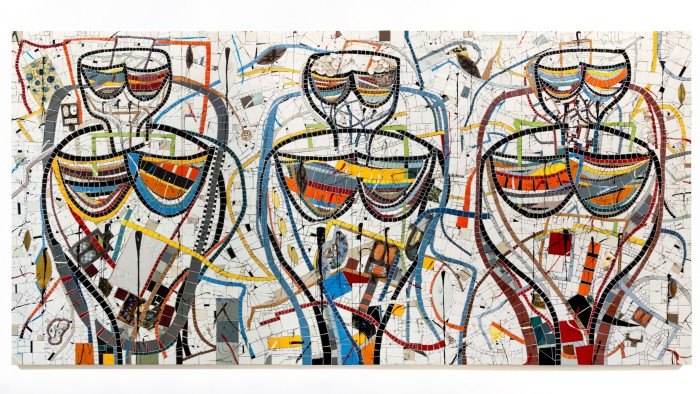
“Three Broken Souls” reflects the artistic evolution of Johnson, who has diversified his use of media over the years from photography and painting to video, audio, performance, mosaic and sculpture, much of it exploring Black identity and culture.
Sometimes described as a producer of conceptual post-Black art, Johnson himself spurns such labels and is enigmatic in descriptions of his work. But as he told one interviewer: “For my generation, having grown up in the age of hip-hop and Black Entertainment Television, there’s less of a need to define the Black experience so aggressively to a white audience. I think it gives us a different type of opportunity to have a more complex conversation around race and identity.”
 Rashid Johnson in his studio © Josh Woods
He invites visitors to come to the show “with an open mind and an open heart . . . and ready to bear witness”, to reflect and then think about what they’re observing rather than simply act as “just lookers”.
Completed in 2025, Johnson made “Three Broken Souls” for this Guggenheim exhibition. The colourful mosaic weighs more than half a ton and spans 20 feet. Get close and you’ll see it’s made of tiles, mirrors, oyster shells and other materials sourced or made by Johnson, held together with glue and grout, and then overlaid with black soap and wax.
We asked Naomi Beckwith, a deputy director of the Guggenheim and the show’s main curator, to select a work from A Poem for Deep Thinkers that could help us explore Johnson’s work. She chose “Three Broken Souls”. The artist designed it to help frame the museum’s large entrance hall, and as a powerful backdrop to the musical events, talks and performances they have been hosting there through the exhibition’s duration.
 Another detail from ‘Sanguine’. Johnson has diversified his use of media to include video, audio, performance, mosaic and sculpture © Photo: David Heald © Solomon R.Guggenheim Foundation, New York
Beckwith says that the work builds on several of the mosaics that Johnson has produced since 2015. They explore fatherhood, vulnerability and the lived experience of Black Americans, including “Anxious Men”, “The Broken Nine”, “Untitled (Broken Crowd)” and “The Broken Five” (the latter a possible reference to the Central Park Five, who were convicted and eventually pardoned).
Johnson told the New York Times of those earlier mosaics: “My work has always had concerns around race, struggle, grief and grievance, but also joy and excitement around the tradition and opportunities of Blackness. [ . . . ] I’m trying to illustrate tons of different people and at the same time they’re probably all me.”
Beckworth stood with me in front of the work to share her interpretation of its symbols, materials and hidden references, based on her knowledge of the show and of Johnson’s work (they are long-standing friends). Here’s a summary of what she sees:
Rashid Johnson: A Poem for Deep Thinkers is at the Guggenheim New York until January 18 2026
What do you see in this piece? Have you seen it in person? Share your impressions in the comments below.
We’re on Instagram at @ftglobetrotter
Cities with the FT
FT Globetrotter, our insider guides to some of the world’s greatest cities, offers expert advice on eating and drinking, exercise, art and culture — and much more
Find us in New York, Los Angeles, London, Tokyo, Paris, Lagos, Rome, Frankfurt, Singapore, Hong Kong, Miami, Toronto, Madrid, Melbourne, Copenhagen, Zürich, Milan, Vancouver, Edinburgh and Venice