
SELECTING traits that can make an economic difference in a herd should be the foremost consideration for beef producers.
Economic advantages can be gained in several key ways. The increases that are achievable for any breeding enterprise through an increase in weaning weight, gained either from heavier weaners or from more calves surviving to weaning is perhaps the greatest opportunity for most herds.
There are of course other economic improvements, such as increased compliance with market specifications. This can be achieved by adjusting maturity pattern, growth rates or from other decisions on farm.
 There is another provenly effective way for all producers to markedly improve the value of their sale progeny. This is through selection for improved muscle volume. For producers actively assessing bulls, where bulls have equal genetic merit and structural suitability for a program, bulls with better muscle scores offer a better option for herd improvement.
Despite some commentary suggesting that “the discipline of muscle scoring has long been challenged in certain areas – some suggesting it is a poor representation of actual meat yield – let alone meat quality” this doesn’t reflect research conducted over 25 years in NSW, as well as reflecting current market responses to cattle with increased muscling. In fact, both the NSW science and market data confirm that muscle scoring remains one of the most valuable, repeatable, and financially rewarding tools in beef production, especially when used alongside other selection traits.
Research into the value of selection for muscling commenced in the 1990s with the late NSW DPI researcher Bill McKiernan selecting cattle based on muscle score. British bred cattle (initially Hereford and then Angus) with high muscle scores (A and B) were joined to high muscled bulls and low muscled (C or below) cows to low muscled bulls. This process was repeated over subsequent generations.
This long-run running project demonstrated that:
Muscle score is highly heritable (56–63pc)
It has a strong genetic correlation with eye muscle area (EMA: 0.53–0.56)
There is no negative relationship with fertility, fatness, or liveweight
High-muscled cows performed equally well on conception, calving, and condition
In short, the research demonstrated that selecting for muscling does not compromise doing-ability or productivity. In addition to these outcomes, earlier research published in 1993 by NSW’s Bill McKiernan and Dianah Perry demonstrated that, when fat depth is held constant, every one-score increase in muscle resulted in:
+1.7pc in dressing percentage
+1.5–2pc in lean meat yield
The NSW research clearly demonstrated that when experienced assessors are properly trained, muscle scoring is highly consistent.
In scientific terms, the repeatability between trained assessors is 0.87 on a scale from 0 to 1, where 1.0 indicates perfect agreement. This means that in nearly 9 out of 10 cases, different assessors will assign the same or very similar muscle score to the same animal. That level of consistency is considered high for a visual assessment and is comparable to repeatability figures seen in some objective traits.
This high level of agreement also aligns well with ultrasound measurements of Eye Muscle Area (EMA), further validating its accuracy. In practice, it means that when producers or assessors use the correct reference materials and standard methods, muscle scoring becomes a robust and reliable tool. The evidence shows muscle scoring is repeatable, predictive of yield, and practical for both breeding and commercial decisions.
Commercially there is a clear incentive in selection for muscle volume and on choosing cattle with higher muscle scores. While breed certainly influences price and perception, the evidence shows that muscle score, regardless of breed, is a key driver of value.
Analysis of 1,649,658 cattle transactions, collected by the NLRS and reported from 2000 to 2025 across the major saleyards of NSW, Queensland and Victoria, reinforces the value of increased muscle.
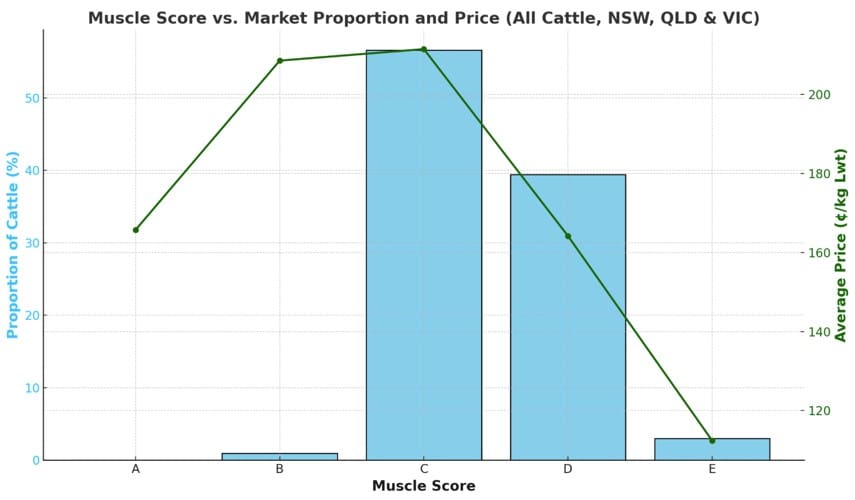
Across all livestock classes and breeds, Muscle Score C dominated, accounting for 56.6pc of all cattle sold. Although Muscle Score B cattle achieve the highest average price at $2.08/kg, these cattle represented less than 1pc of all sales, highlighting their scarcity. Below Score C, there was a clear price reduction, dropping by $0.47/kg from C to D, and by a further $0.52/kg from D to E. Notably, Muscle Score D cattle still make up 39.4pc of sales, and E scores account for 3pc, despite their consistent discounts.
As beef producers approach sales this season, it is worth keeping both the market signals and research findings in mind. The high heritability of muscle score means that with selection it is possible to lift a herd’s muscle volume significantly in a few generations, without compromising fertility of cow performance.
Including muscle score as a visual selection tool is an effective, repeatable and low-cost strategy that can have a significant improvement on the economic performance of a herd.

Alastair Rayner
Alastair Rayner is Principal of RaynerAg and an Extension & Engagement Consultant with the Agricultural Business Research Institute (ABRI). He has over 28 years’ experience advising beef producers and graziers across Australia. Alastair can be contacted here or through his website: www.raynerag.com.au