
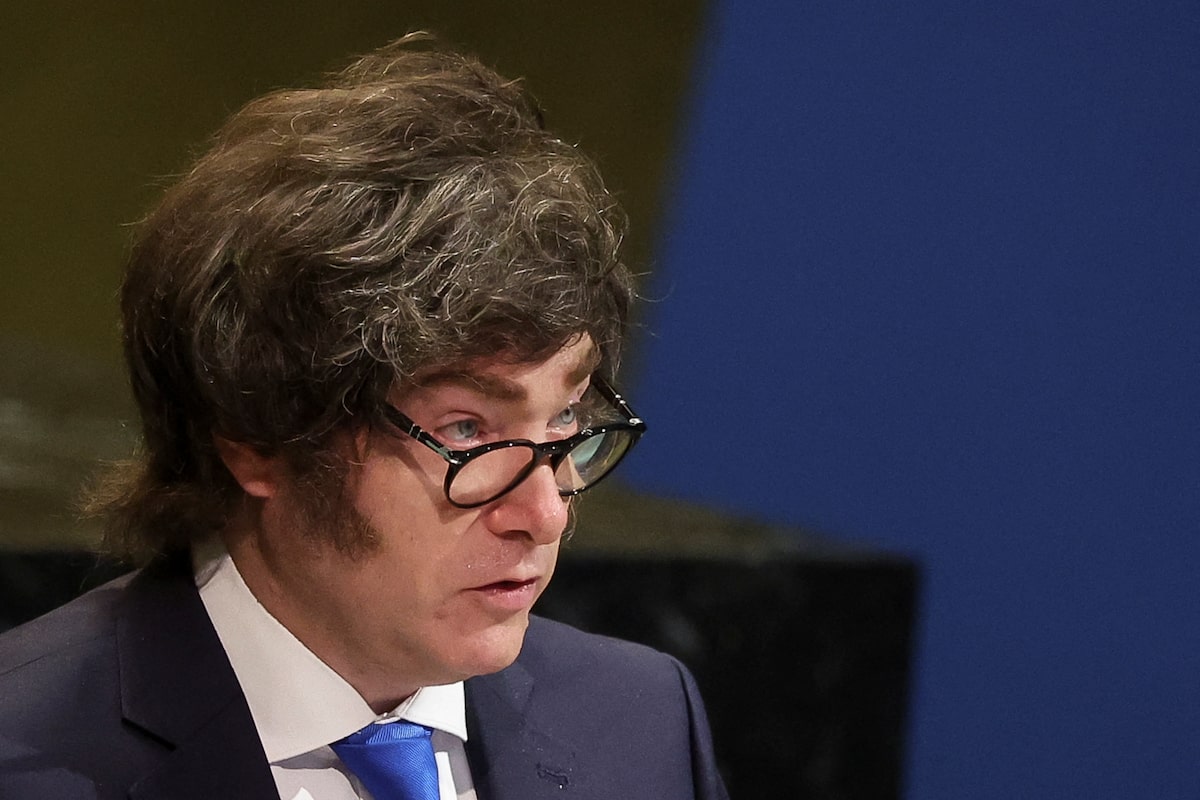
The IMF lent Javier Milei’s government money earlier this year to support its reform program, but the money is now being used to bolster the peso.Shannon Stapleton/Reuters
John Rapley is a contributing columnist for The Globe and Mail. He is an author and academic whose books include Why Empires Fall and Twilight of the Money Gods.
Early this week, Argentine President Javier Milei’s bold experiment in free-market economics looked to be in jeopardy. Investors, losing faith in Mr. Milei, had begun dumping shares and selling pesos. Mr. Milei wanted to wait until after next month’s legislative elections to devalue the currency, but that was forcing the central bank to sell its dollar reserves to defend the peso. Then after a shock result in a provincial election early this month launched a panic, the peso started plunging and Mr. Milei’s days looked to be numbered.
Cue a rescue from Washington. On Monday, the U.S. Treasury Secretary said the White House would explore “all options” to support Argentina, the peso rallied and Mr. Milei’s presidency got a reprieve. Washington’s US$20-billion line of credit will now allow Mr. Milei breathing space to try to win support on the campaign trail. But it’s a big gamble for the White House.
After his resounding victory in Argentina’s presidential election two years ago, Mr. Milei became a hero of the populist right everywhere. Side-burned, leather-jacketed, chainsaw-wielding, “The Madman,” as his compatriots call him, won a mandate to slash the Argentine state.
Tony Keller: Is Donald Trump an isolationist? No, he’s an anti-liberal imperialist
Boom-bust cycles are a regular feature of life in Latin America’s fourth most-populous country. The country has periodically experienced bouts of hyperinflation, followed by severe downturns that bring inflation back under control but at the expense of worsening social conditions. The latest iteration saw inflation reach 300 per cent on the eve of the 2023 election.
Although Argentines were deeply divided, enough of them were exhausted by the country’s latest battle with inflation to support Mr. Milei’s radical proposals to cut the Argentine state to size.
Mr. Milei was proposing little short of radical surgery, but had limited room for political manoeuvre. Although he won a resounding mandate, with 55 per cent of the vote, his new party won just a few seats in the legislative assembly. Meanwhile, being a federal system, not all of Argentina’s provinces were signed up to his program.
Nevertheless, by moving fast and forging alliances with centrist parties, Mr. Milei was able to implement a bold program: cutting government spending by the equivalent of 5 per cent of GDP by capping civil-service pay, eliminating a range of subsidies on gas, water, electricity and transportation, and rolling back many of the regulations that impede business formation. The results came fast, and inflation fell back down to around 36 per cent today. Then, following a recession last year, the economy began to rebound strongly this year.
Lawrence Martin: When it comes to repression, Trump now rivals Hungary’s Orban
Yet while his early successes garnered approval from his supporters – at one point, his ratings touched on 50 per cent – the road ahead remained perilous. One element of his program, a sharp devaluation of the peso, was put on hold. Mr. Milei was understandably worried that allowing the peso to find its true level would cause it to collapse, the result being a resurgence of inflation. So instead, he opted for a gradual devaluation, allowing the peso to trade in a narrow band. If it moved below the band, the central bank would dip into its reserves to sell dollars, driving the value back up.
The problem is, this suited Argentines all too well. With the peso strong, the middle class could continue vacationing abroad and imports surged. So even though Argentine exports are rising again, imports are rising much faster, running down the country’s dollar reserves.
The IMF lent the Milei government money early this year to support its reform program, but the funds are now being used to bolster the peso. Argentina’s creditors, worried that this could be throwing good money after bad and that the government might go broke, have been dumping their bonds, driving up interest rates.
Mr. Milei shakes hands with U.S. President Donald Trump during the 80th United Nations General Assembly in New York on Tuesday.Alexander Drago/Reuters
Mr. Milei is trying to hold out until next month’s legislative elections, when he hopes his party wins enough seats that he can overcome legislative objections to his program. The dollars were running out so fast, though, that it looked like he might not make it. So, the Trump administration’s pledge to do whatever is needed to keep Argentina afloat came just in the nick of time: the peso stabilized, the stock market stopped plunging, the dollar reserves stopped draining.
Donald Trump bought Mr. Milei time, but the next few weeks will be anxious for both men. The White House has clearly decided that Argentina can’t be seen to fail, for fear the most important Trump ally in Latin America is toppled. But provincial elections in Buenos Aires earlier this month delivered Mr. Milei’s party a stinging rebuke. If it’s an omen of what’s coming next month, Mr. Milei may not get the mandate he needs to proceed with his reform agenda, and the peso may yet collapse.
And if the U.S. government is then out of pocket a few billion dollars, at a time when it’s cutting its spending at home, it may not go down well in Peoria.