
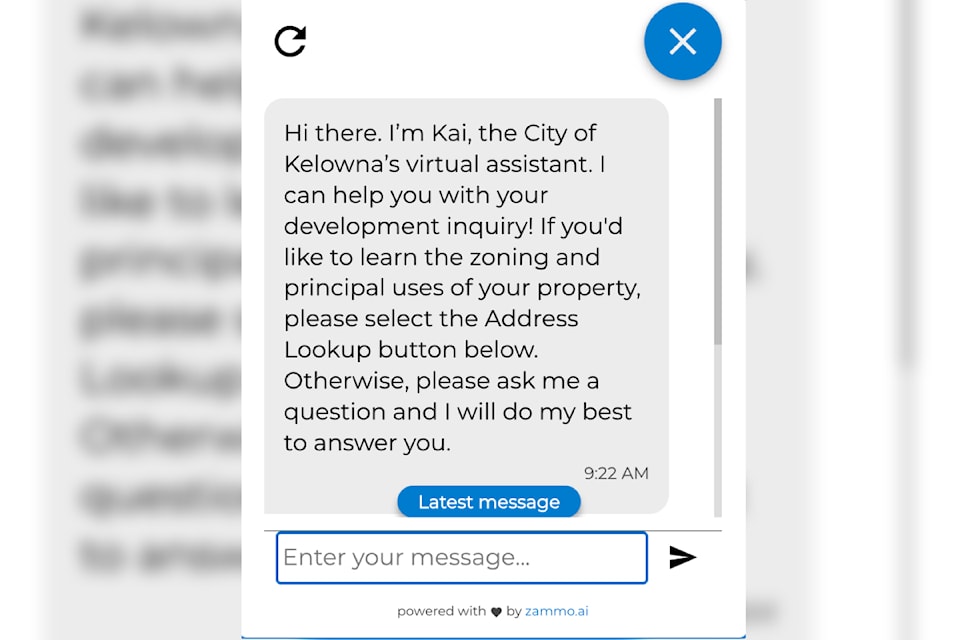
Kelowna’s KAI chatbot is just one type of AI tool among many that municipalities are experimenting with
To find out, say, what height of fence is allowed on their property, a Kelowna homeowner used to have to flip through 400 pages of bylaws.
Now, people with zoning and permitting questions can ask KAI — the city’s own AI chatbot — and have it guide them through the application process.
“It is really the future when it comes to housing and permitting processes in a lot of fast-growing cities,” said Ryan Smith, Kelowna’s planning director.
In 2021, more than a year before ChatGPT was released to the public, the City of Kelowna began working with Microsoft to develop the KAI chatbot and other tools that help streamline operations and aid the effort to build more infill housing.
Smith said the idea of a city creating its own chatbot was “a little bit wild” at the time. But with the support of a major developer, Kelowna plowed ahead. The city put up $350,000, which Smith said Microsoft matched “like five times over.”
One of its commitments was to share what it learned in the process.
Smith, alongside officials from Vancouver, made good on that at the Union of B.C. Municipalities’ (UBCM) annual conference in late September. They shared what they learned and also discussed some of the security and privacy issues that came up along the way.
The accounting firm KPMG released a survey of Canadian government workers in mid-September. It found 48 per cent of respondents used AI tools in their work, with 50 per cent of those using publicly available tools. The firm argues this creates risks for data security and concerns about potential exposure to biased or inaccurate information.
Kelowna opted for a ground-up approach heavy on experimentation, while Vancouver worked from the top down, carefully selecting where to apply AI tools through committee meetings and impact assessments.
Learning on the fly
At first, Smith was frustrated. He didn’t quite understand that AI systems couldn’t just come up with answers, but needed to be taught.
“You needed people behind the scenes helping it,” he said.
Without this training, and without consistent upkeep and use, the AI chatbots get “dumber,” Smith found.
KAI needs to be asked a lot of questions so municipal employees can sift through to determine what it knows and what it does not know. There have been some “hallucinations” along the way, but for the most part, Smith said that when KAI doesn’t know something, it tells the user to contact a city employee for the answer.
The team also reviews the answer logs to ensure KAI is giving correct answers. If they don’t do this, the chatbot can veer off course.
“If you’re not reviewing those logs, those answers aren’t going to get any better, and if they’re not being reinforced, it may start to add or change that answer,” Smith said.
Smith and his team have it dialed at this point so the chatbots can answer basic planning questions and guide people through the application process. This saves time for homeowners, developers and the city.
Those are just the outward-facing tools. Smith is also using AI to develop mapping programs that can, for example, estimate the redevelopment potential of properties in an area and help predict future growth.
This is all a work in progress, and the city has abandoned some ideas — especially those that don’t get much use, therefore don’t provide enough teaching opportunities.
“Some things work great, some things work really poorly,” Smith said.
Then there is the question of how and when to address security and privacy. Smith acknowledged that Kelowna did things “out of order” in this regard, creating the tools, then figuring out how to protect data.
“We were doing it before we were doing privacy impact assessments,” he said.
But Kelowna had spent 18 months developing the chatbots before their unveiling, and walled them off from the open internet. Unlike ChatGPT, KAI learns only from the things that Smith’s team want it to learn from.
While Kelowna takes a ground-up approach to AI development, Vancouver is taking the opposite tack.
Aman Sidhu, Vancouver’s director of enterprise data, analytics and AI, has the view that “AI for the sake of AI is pointless,” so she approaches new tools by first deciding on specific objectives to figure out how to offer better services and better decisions.
This can be automating municipal processes or figuring out how to be more efficient in something as basic as garbage collection.
Vancouver’s approach began with the privacy implications. The city even held a hackathon to explore vulnerabilities.
“We used privacy impact assessments (PIA) from the get-go,” she said. “We did not do any AI without a PIA.”
Since that initial testing of the waters, Sidhu said the city has built an internal innovation cycle to develop new uses for AI. One of the major projects underway is a situational awareness engine to use during the FIFA World Cup games next summer. This can help officials understand how people are moving during the games in real time to address risk levels.
Another project is a flood mapping program that the city is developing with the federal government. In total, Vancouver has 21 AI products in use or development.
This does not mean the city can apply AI to anything. The Tsleil-Waututh, Musqueam and Squamish nations asked the city not to use their data in AI applications.
While Vancouver and other large municipalities make major AI investments, many of those at the UBCM conference come from much smaller communities. They want to start using AI, but have limited staff and funds. They also need to figure out how to do this safely and securely.
Whistler Coun. Jeff Murl put it bluntly, asking, “How do we get some of what you’ve got going on?”
Murl said it was great to see two cities collaborate with the private sector to develop these innovations, but his community does not have the same resources.
“I’d love to have even just a piece of that in my community,” he said.
A solution to this could be to find those within an organization who have at least some level of AI competence and knowledge, and then build upon those skills, says Prof. Terri Griffith, the Keith Beedie Chair in Innovation and Entrepreneurship at Simon Fraser University.
Griffith studies organizations’ use of AI and advocates for a bottom-up approach that teaches basic levels of competence to everyone in the organization.
Because the technology is so new, and is being adopted by the public so much faster than previous technologies, such as personal computers, organizations can usually find people within who are already interested or experienced in using AI tools.
While local governments are trying to determine how and when to utilize new AI technology, technological change is outpacing regulation. The B.C. government, meanwhile, is not taking responsibility. A statement from the Ministry of Jobs and Economic Growth says the province has no oversight of local government AI usage.
Rick Glumac is the newly christened minister of state for AI and New Technology — tasked with promoting AI development in the province. But an interview request for this story was refused, as was a request to discuss the issue with Diana Gibson, minister of Citizens’ Services, who oversees much of the province’s internal AI usage.
Griffith promotes a balance somewhere between Kelowna and Vancouver’s approach — organizations need to maintain security, but shouldn’t stifle innovation.
And they need to be realistic about things like privacy impact assessments. Even if an organization has its computer systems locked down, employees will gravitate toward easier ways of doing things and faster ways of looking things up.
“They’ll never be able to do that assessment for every single thing that is happening in their organization, as much as they might want to,” Griffith said.
The key for Griffith is to make sure all workers have a basic understanding of AI.
This could help prevent what could become a leaky information system. People have long made security mistakes and sent out things they should not — an errant email, perhaps — but Griffith said it is now easier than ever to make mistakes.
“We can go back through the decades with the different ways that information can leak,” she said. “AI just makes it even easier.”