
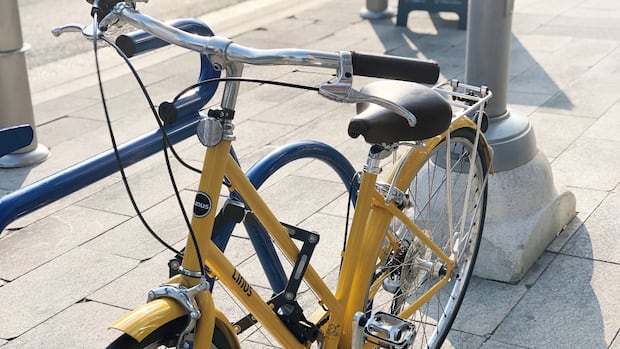
Guelph police are turning their focus to two-wheeled traffic this month by launching a dedicated initiative to promote bicycle safety, but some advocates say more education is needed for drivers, not cyclists.
“With the return of students, it’s appropriate for the month of October as we have a large number of cyclists currently traveling on our roads and that kind of by extension will be e-bikes, e-scooters and scooters,” said Guelph Police Insp. Micheal Davis.
In a media release, police said they are increasing “proactive engagement, education and enforcement” around cycling rules throughout October. Officers are encouraged to stop and speak with cyclists to make sure they understand the rules of the road.
The rules police are focusing on are:
Cyclists must obey all bicycle-specific and general traffic signals. Riding through pedestrian crosswalks or crossovers is prohibited. Cyclists must dismount and walk when going through a crosswalk or crossover. Cyclists are legally required to stop and identify themselves if a police officer suspects an offence has occurred. Proper front and rear lights are mandatory from 30 minutes before sunset to 30 minutes after sunrise, or during low visibility.
The campaign will also go beyond in-person interactions, Davis said.
“The initiative will have a social media component and we’ll be posting some legislation and rules related to cycling on our social media sites,” he said.
Enforcement concerns
The campaign has drawn some criticism from Guelph’s Bike Mayor Andrea Bidgood.
“It seems a little vague at the moment, so it is a little worrisome on how it’s going to be implemented,” she said.
Bidgood’s job as Guelph’s first-ever bicycle mayor is, among other things, “helping vulnerable road users be seen, heard, and protected in the spaces they navigate,” according to her website.
David Shellnut, a Toronto-based lawyer who specializes in advocacy for cyclists, weighed in on the campaign on social media.
Shellnut wrote on Instagram that the campaign “lacks compassion and empathy” in the wake of two fatal collisions in Guelph recently — one which saw the driver of a garbage truck driver charged after a cyclist was hit, and another that prompted a petition after a family of three was struck by a pickup truck, ultimately killing the 38-year-old mother.
“This is a police service demonstrating a failure to adequately respond to road safety issues. It lacks compassion and empathy for the two people (and their families) who were killed by dangerous and careless drivers,” he wrote.
“The [Guelph Police] Service should be reviewed and it’s priorities dictated to it by Guelph city council as [police] appear unable/unwilling to address the true dangers on our roadways.”
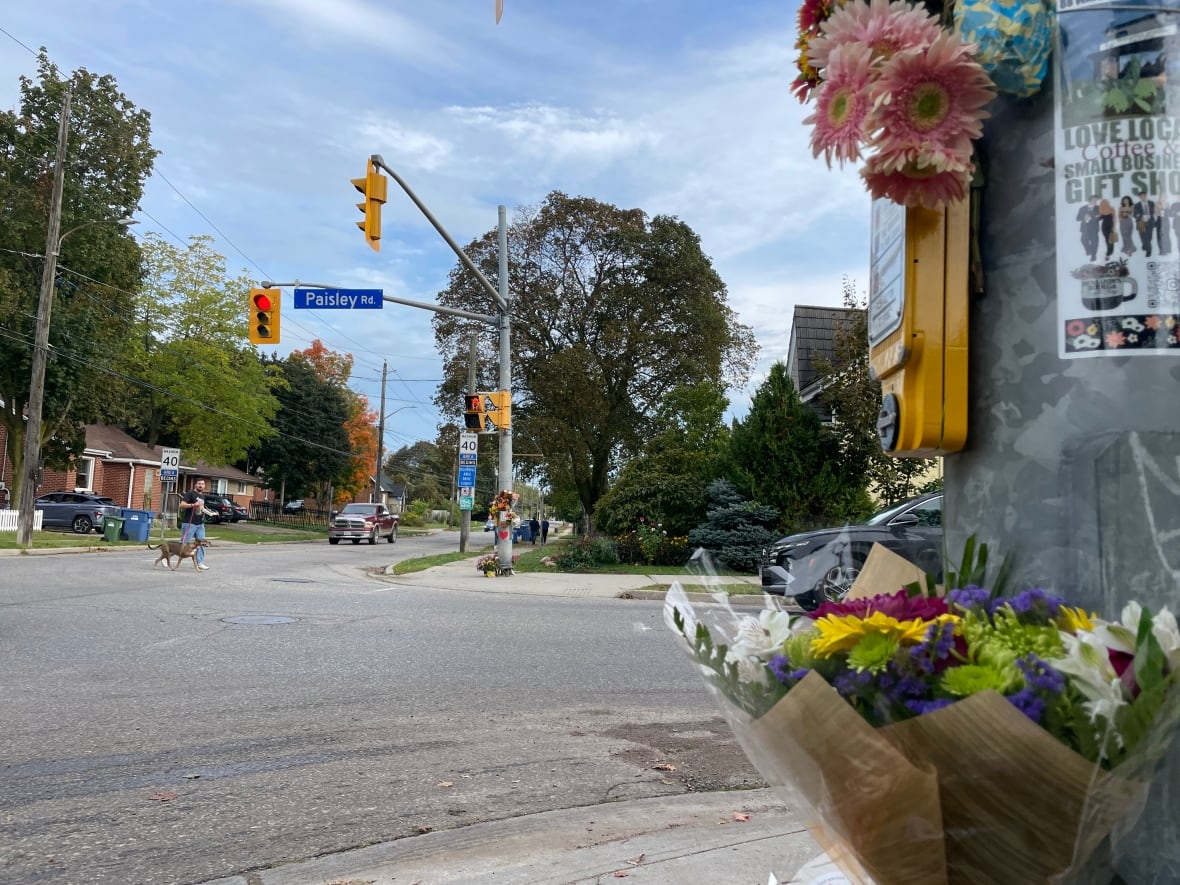 A memorial with flowers is located next to the crosswalk where the woman was struck and killed by a pickup truck driver in Guelph. (Kate Bueckert/CBC)
Insp. Davis said there will be increased enforcement against cyclists but says that is not the campaign’s aim.
“I think the overall goal of any of our road safety campaigns is education,” he said.
Davis says the two most common violations police encounter with cyclists are failure to obey traffic signals and failure to dismount at crosswalks.
“These two situations put them in direct conflict with other road users,” Davis said.
When it comes to how enforcement and education will be balanced during the campaign, Davis says this will be at the discretion of officers.
“I would suggest that there would be education for maybe equipment offences,” he said “Where there are moving offences such as disobeying signals, they’ll be dealt with in a way that’s similar to how a motorist would be dealt with.”
More bicycle infrastructure needed
Bidgood worries that the campaign unnecessarily targets cyclists rather than focusing on the root causes of safety issues, and points to the two recent deaths as well.
“We all have our responsibilities to follow and comply with the rules that are in place,” she said. “But what are they trying to achieve with what seems like just signaling out individual cyclists?”
Bidgood was named Guelph’s bike mayor in July. It is a position given by BYCS, a Netherlands-based NGO focused on improving bike infrastructure through community engagement. BYCS has a network of bike mayors across the globe that push for better bike infrastructure in their communities.
Infrastructure is at the heart of Bidgood’s criticism. She says that while education and enforcement have their place, there needs to be greater attention paid to improving bike infrastructure in Guelph.
“The reality is our safety networks are still incomplete,” she said.
Bidgood says areas with infrastructure not ideal for biking can lead cyclists to make decisions that don’t fall within the road rules.
“For a cyclist who is not complying, we might not know the reason why. Maybe it’s because they’re not feeling safe within the infrastructure, maybe there is no infrastructure,” she said.
One area Bidgood points to as an issue is the Woolwich-Gordon corridor. She says some sections have painted bike lanes while others have full separation from motorists. On Thursday, the City of Guelph added more street parking and the city’s first parking-protected bike lane to Woolwich Street, but Bidgood says there is still a lot of inconsistency in the city’s bike infrastructure.
“It is not the same level of safety the entire way even though it is the same corridor,” she said.
A ‘holistic’ approach to road safety
Davis agrees that road and infrastructure design plays an important role in keeping roads safe, but he says Guelph police are just one part of the city’s approach to road safety.
“We fit into that holistic approach with education and enforcement, that’s our priority,” he said. “The rules that we apply are in effect throughout the year. So we’re not picking on anyone.”
While Bidgood acknowledges the importance of complying with the road rules, she says cyclists are often forced to make critical decisions with very little warning or time.
“Ultimately sometimes it comes down to a survival decision,” she said. “If it’s a choice between ending up in a collision versus perhaps popping out of the way onto the sidewalk where you’re not supposed to be for a moment. It’s down to what feels safest.”
Bidgood hopes that police will take this into account as the campaign goes on.
“I really hope when it comes to enforcement there is a little bit of discretion and nuance as to why this person had to make a decision at that time,” she said.