
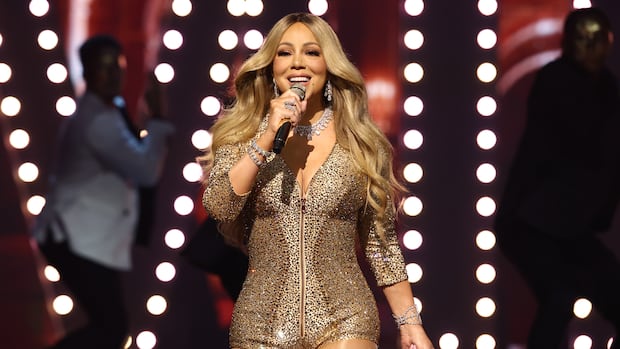
After seven long years, Mariah Carey has dropped a new full album, Here for It All. The new record, which was released on Sept. 26, comes on the heels of the 20th anniversary of her magnum opus, The Emancipation of Mimi.
Carey shaped the sound of the ’90s, having a hit every year of the decade, but she still had to fight with the music industry for her autonomy and her creativity. The We Belong Together singer-songwriter came out winning, bringing her whistle notes and mixture of pop and hip-hop into the 2000s, when she slowed production but continued to break records.
Today on Commotion, host Elamin Abdelmahmoud celebrates Carey’s iconic career with Juno-nominated singer-songwriter Tanika Charles and cultures critics Pablo The Don and Michael Blackmon.
We’ve included some highlights below, edited for length and clarity. For the full discussion, listen and follow Commotion with Elamin Abdelmahmoud on your favourite podcast player.
WATCH | Today’s episode on YouTube:
Elamin: Michael, obviously, we can’t talk about Mariah without talking about her place as one of the last pop divas standing…. How does Mariah fit into the mold of divas that came before her?
Michael: You have to look at — what I would consider to be — her progeny, which are people like Christina Aguilera to Ariana Grande, and even folks like Leona Lewis. These folks have been molded in Mariah’s shadow, but no one really comes close to having her impact. I think about these singers [who] have started as people who have these very pristine images and then they transition to having these more scantily clad images, and [are] more sexual, and able to be more free. And I think that Mariah is to credit for that. And they’ve even said it themselves in interviews, where they’re [saying] she is one of their inspirations.
I also think about the fact that, as a diva, she is someone who popularized the hip-hop collaboration, like with O.D.B. [on Fantasy]. There weren’t people doing those sorts of experimentations.
Elamin: It became an industry standard after she did it.
The most noteworthy moment in Mariah’s trajectory revolves around all of this tension that she has with her label and also her then-husband, Tommy Mottola, who was also the chairman and CEO of that label. Pablo, do you want to talk about what made that moment so significant? Because that is the turning point, I think, in Mariah’s career.
Pablo: That entire era was so incredibly wild because it was really Mariah fighting for her freedom, which is insane to say when you have a voice like that, like you have to fight to do what you want to do when you sound like that.
But at the time, she was signed to Columbia, which Tommy Mottola — her husband — ran, so the power dynamic there was kind of weird. It reminds you of Celine Dion and her husband, René, where he found her, and it felt like it was the repeat of that entire scenario. And [Mottola] had a lot of control over her image, making her come off as white-passing, despite Mariah always knowing she was Black, always accepting she was Black, putting it out there that she was Black. He really wanted her to stay in this racially ambiguous lane. And he wanted her to stay in that racially ambiguous lane in terms of music, as well. But Mariah felt so incredibly trapped. And she really wanted to start pushing her sound. She knew hip-hop — especially on the East Coast, being a girl from New Jersey — was on the rise and she wanted to infuse that into her music. So she really made that push.
Elamin: Tanika, it is worth noting that Mariah has always been open about wanting to incorporate R&B and hip-hop into her music…. What do you make of the hesitation that the music industry had to support her vision of what she wanted her career to sound like?
Tanika: Pablo absolutely nailed it. We have this artist who the label is trying to push as a pop artist. They want her to be palatable to a certain audience. So now you incorporate hip-hop, you incorporate R&B, maybe her reach wouldn’t be as global as maybe the pop scene might be. And perhaps the wrong audience would be attracted and maybe it would jeopardize sales. So I think, at the end of the day, it all boils down to money. The hesitation was like: are they going to see that this is actually a Black artist, when we’re trying to push her towards a different kind of audience?
Elamin: I think what’s worth talking about, Pablo, is with The Emancipation — but also just with her entire career — is that I don’t think she gets the credit for being a songwriter. I don’t think people see her as a songwriter because of the way they think about divas as a category. Divas sit atop a mountain, and then they are handed songs, and then they sing those songs. And we’re so lucky to get that.
But that’s not the case. She has a songwriting credit on almost every song on The Emancipation of Mimi. There’s something to her career as a singer-songwriter, as someone who’s had a hand in shaping so many of her hits, that gets a little bit overlooked and a little bit underwritten. Where does that place her in terms of all other pop acts?
Pablo: I think Mariah truly is in rarefied air. I don’t think there’s many people that also occupy that space. I think she has co-written, or a solo writer’s credit, on 18 of the 19 No. 1 hits she has. And also I think that is what real impact looks like.
It’s so rare to have someone who’s a hitmaker, but also is so ahead of the curve with music. She knew hip-hop and R&B wouldn’t just be a fad, she knew to latch herself to that. She knew that Jermaine Dupri was a really good producer that maybe, in the ’90s, didn’t get all the credit he deserved. So [she] brought him back for The Emancipation of Mimi, and they made the album of quite literally the decade, in my opinion. They do that together.
I think Mariah quite literally is in an air of her own with this. Most people are either focusing on being a vocalist or being a songwriter — rarely do we get both. And that right there is going to submit Mariah forever and ever. It’s rarefied air that she’s in.
You can listen to the full discussion from today’s show on CBC Listen or on our podcast, Commotion with Elamin Abdelmahmoud, available wherever you get your podcasts.
Panel produced by Ty Callender.