
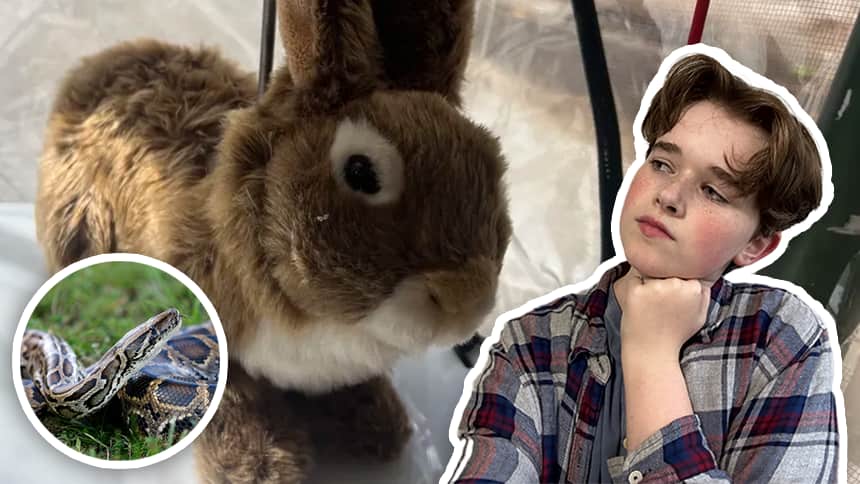
Burmese pythons are at the top of the food chain in Florida
⭐️HERE’S WHAT YOU NEED TO KNOW⭐️
Burmese pythons have become a big problem for local wildlife in the Florida Everglades.
Scientists developed a robot rabbit that’s used to lure the invasive snakes so they can be caught.
The robots look, smell and even have the same body temperature as real rabbits, which are common prey for pythons.
Keep reading to learn more about how robo-rabbits are helping protect the ecosystem. ⬇️ ⬇️ ⬇️
When you think of a robot, you’re probably not picturing a rabbit.
But that’s exactly the idea behind a new project in Florida that’s using robotic rabbits to help protect the ecosystem.
Unlike Wall-E or C-3PO, these robots aren’t so friendly.
They fool invasive Burmese pythons into thinking they’re real rabbits — typical prey for the giant snakes.
The robots look, smell and even have the same body temperature as real rabbits.
Once a python emerges from its hiding spot to hunt down the false prey, the robot sends out a signal that alerts someone to come and safely remove the snake.
Burmese pythons are harming the local wildlife and experts say these robots can make a difference.
Watch this video to learn more about robot rabbits:
The python problem
Burmese pythons are not native to Florida. They’re originally from Southeast Asia.
A full-grown Burmese python can be three to five metres long.
People brought them over as pets in the 1970s and some made their way into the forests and swamps of the Florida Everglades. Now they’re a big problem.
“Invasive species have a negative impact on the local ecosystem or human health and safety,” said Melissa Miller.
She’s an expert in invasive ecology at the University of Florida and she works with Burmese pythons every day.
Their ability to reproduce and hunt down prey — like birds, rabbits and raccoons — has put them at the top of the food chain.
Which also robs the local wildlife — like panthers, bobcats and alligators — of their food sources.
It’s hard to estimate exactly how many Burmese pythons there are in southern Florida, Miller said.
Florida wildlife officials say more than 16,000 pythons have been removed from the Everglades since 2017.
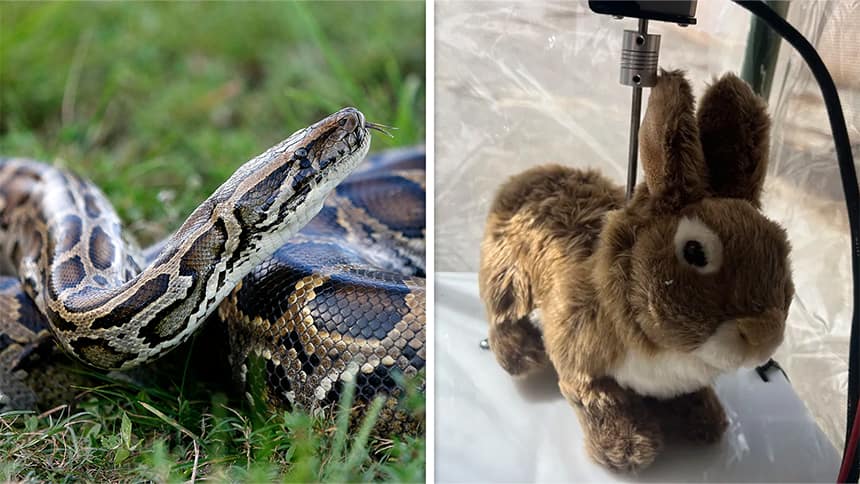
Left, a Burmese python. These pythons are three to five metres long when fully grown. Right, a close-up view of a robot rabbit. (Image credit: Rhona Wise/The Associated Press, Bob McCleary/University of Florida)
How pythons are usually caught
To get rid of the Burmese pythons, Florida officials pay local contractors to safely remove the snakes.
The longer the snake, the more they get paid. They also get an extra $200 if they spot a python nest.
Florida even hosts a yearly python-catching challenge that attracts thousands of competitors. The person who catches the most snakes wins $10,000.
This year, the winner caught 60 snakes.
Officials need all the help they can get because Burmese pythons are difficult to catch, Miller said.
“Even though they’re really big, they’re very hard to find,” she said. “The pattern of their skin blends in really well with the environment.”
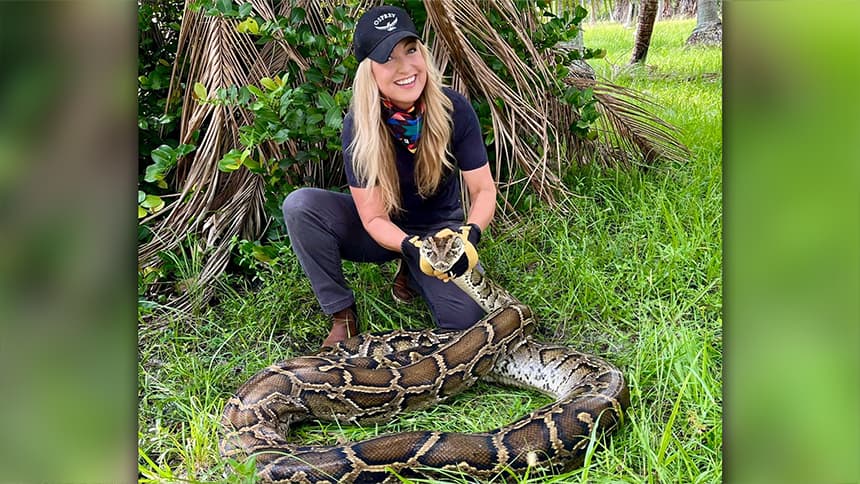
Melissa Miller poses alongside a Burmese python. She tracks pythons and researches their breeding habits and the pathogens they might spread. (Image submitted by Melissa Miller)
Looking to robots for help
This year, scientists from the University of Florida teamed up with state officials to find a better solution to the python problem.
At first, they used real rabbits to lure the snakes. But that became too expensive and time consuming.
So they invented the robot rabbit that looks, moves and smells like a real rabbit.
It has the same body temperature as a real rabbit and it’s solar powered.
This summer, 120 robot rabbits were deployed throughout the region.
It’s too early to say whether the experiment has been a success, but state officials say that every invasive python removed makes a difference.
What happens to the snakes once they’re caught?
In Florida, it’s legal to kill invasive snakes.
There are rules on how the snakes can be humanely killed.
Some snakes are tagged and released back into the wild to be studied by researchers like Miller.
However, most snakes are euthanized because there is no space for them and they are not allowed to be kept as pets.
“Unfortunately, it’s no fault of their own,” Miller said.
“They suffer the consequences of what happens when folks take an animal from one place and irresponsibly release it where it’s not supposed to be.”
Have more questions? Want to tell us how we’re doing? Use the “send us feedback” link below. ⬇️⬇️⬇️
With files from The Canadian Press
TOP IMAGE CREDIT: Joe Raedle/Getty Images