
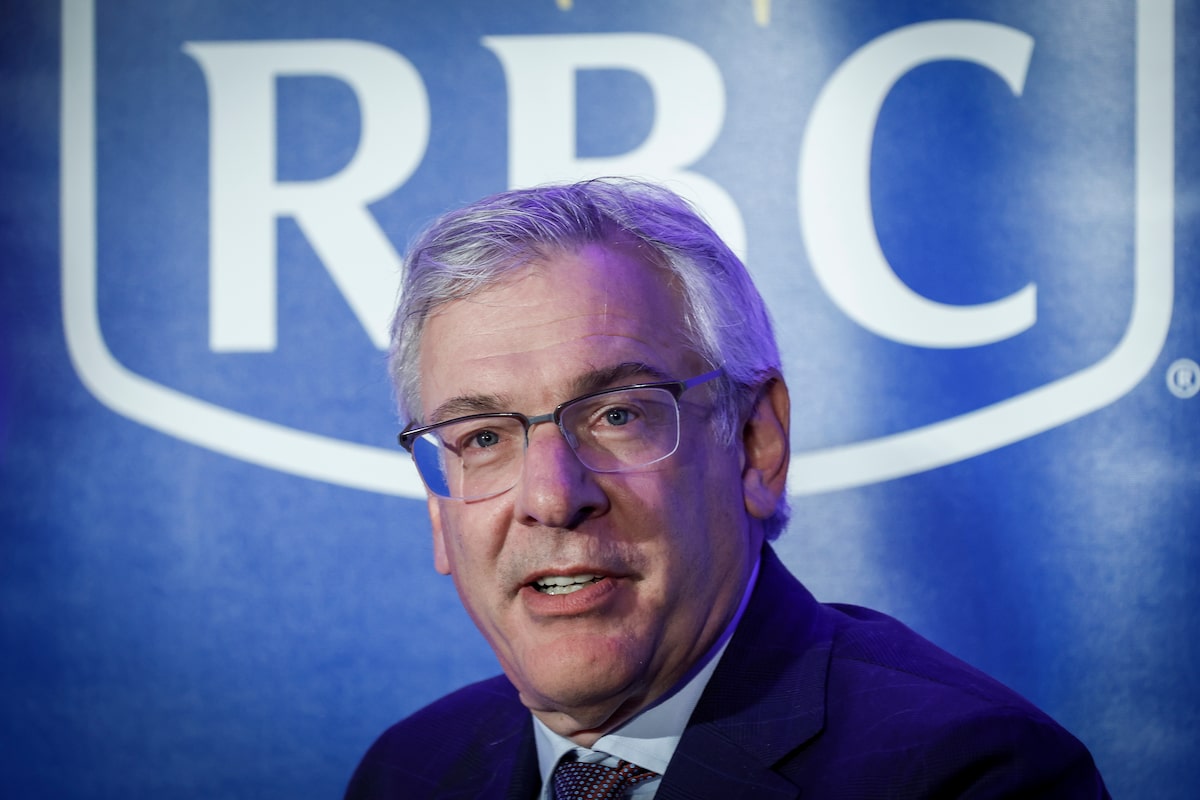
RBC CEO Dave McKay says Canada needs to get out of its own way to secure trade deals.Jeff McIntosh/The Canadian Press
Canada needs to stop cocooning its economy in bubble wrap and leverage its significant natural resources to create “grand-bargain” trade deals with other countries, the head of Royal Bank of Canada RY-T says.
Speaking at a Calgary Chamber of Commerce luncheon Wednesday, chief executive officer Dave McKay said that with more countries chasing Canadian fossil fuels to secure their energy supplies – including Germany, South Korea and Japan – Canada must move quickly to nail down deals.
“Their people want that product and want it delivered, but they’re not going to wait forever – and they’ve been tired of waiting for a while now. So, we actually have to start looking at pace and speed,” he said.
Canada’s inherent fear of making a mistake means it has largely failed to take advantage of its assets, he said. But the current trade climate – including tariffs slapped on a swath of Canadian goods by the U.S., and the very real possibility that market will remain somewhat estranged even after free-trade agreements are renegotiated – means Canada needs to “get out of our own way,” Mr. McKay said.
Doug Saunders: Carney’s better off without a big Trump trade deal. Just ask the Europeans
“The royalties that will come from leveraging these deals are significant. What are we afraid of? We’re afraid of making a mistake. Therefore, how do we minimize that risk? We’ll have to accept some risks to do that, to create options for the next generation.”
The volume of trade opportunities for its natural resources and agricultural products means Canada “can get to a grand-bargain agreement” with many markets, he said, but it will have to push hard and show political courage.
“These are situations where your success will be defined by your legacy and what you did for Canada, versus what the polls may say in the short term,” he said.
“We bubble wrap our economy, and we’re waiting for someone else to solve it. We have to solve it ourselves.”
Approval delays and false starts of major projects have worn down companies to the point where they no longer want to invest time, money and energy in Canada, he said. Instead, they head to the U.S., where they can “push shovels in the ground” and get return on their capital much more quickly.
“That capital tells you very clearly, ‘I’ve got other options.’ And even in this room, in the energy industry, those options often seem more attractive in the United States to build out energy infrastructure,” he said.
Mr. McKay is buoyed by what he’s seeing so far in terms of the federal Major Projects Office and a vocal push by Ottawa and Prime Minister Mark Carney to get projects done, but said speed is of the essence.
That means industry, government, Indigenous partners and communities working together, he said, including on projects such as the pipeline that Alberta Premier Danielle Smith wants to see built to the B.C. coast.
Lawrence Martin: It’s humiliating to kowtow to Trump. But what choice does Carney have?
The Alberta government is taking the lead on the application for a major new oil pipeline in an attempt to break through several federal policies that Ms. Smith has blamed for scaring away private investors. The idea is to hammer out a proposal for a one-million-barrel-a-day bitumen pipeline. The proposal would be sent to the Major Projects Office by May, 2026.
Mr. McKay said opposition to the plan is simply “arguing over hypotheticals,” because there’s no concrete route, let alone a proponent at the table.
The current free-trade agreement between Canada, the United States and Mexico is scheduled to be renegotiated next year. Mr. McKay doesn’t expect Canada to emerge victorious from those discussions, and says it would be foolish to think that the U.S.’s current nationalistic stand will dissolve.
“Even if I’m wrong and everything goes back, why wouldn’t we want to grow our economy, diversify and increase? I don’t sit here at RBC saying, ‘Oh, thankfully, I make 90 per cent of my profit in Canada. I never have to look at another country.’ I’m constantly growing in new markets,” he said.