
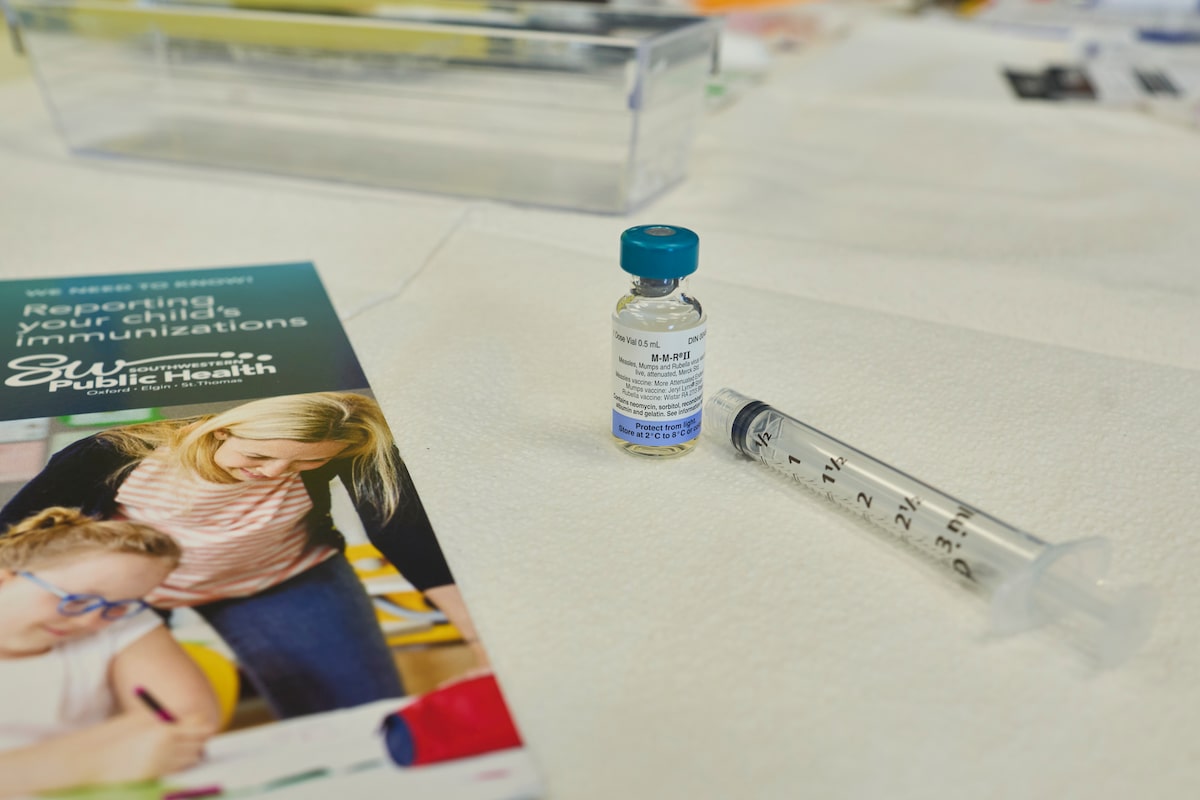
Over the course of Ontario’s measles outbreak, which began last October, the province’s health authority recorded 2,375 cases and one death.Geoff Robins/The Canadian Press
Ontario has declared its measles outbreak over after a nearly year-long battle, but other parts of the country are still managing new cases of the highly-infectious disease.
Public Health Ontario, in its weekly measles update posted on Thursday, announced that the provincial outbreak concluded on Oct. 6. National guidance states an outbreak is over when no new cases have been reported for 46 consecutive days, which is double the incubation period for measles.
The last person infected with measles in Ontario got the telltale red rash on Aug. 21, according to PHO. Over the course of the provincial outbreak, which began last October, the health authority recorded 2,375 cases and one death – a premature baby infected in utero.
Kieran Moore, Ontario’s Chief Medical Officer of Health, said in a statement on Thursday that the decision is based on careful monitoring and analysis by public-health experts.
Canada is close to losing its measles elimination status. What happens then?
“I want to sincerely thank Ontarians for staying up to date on their immunizations, as well as our public health units, health care providers, and community partners for their unwavering efforts throughout this outbreak,” Dr. Moore said.
“While this marks an important milestone, measles remains a serious and highly contagious disease.”
He urged people to stay up-to-date with their measles, mumps and rubella, or MMR, vaccinations. Two shots are required for full protection against the disease, which can lead to serious complications such as pneumonia, brain inflammation and death.
In its update, the Ontario health authority noted that measles is still circulating in Canada and across the globe, “so ongoing vigilance for measles case finding and public health follow-up will continue.”
Measles was declared eliminated in Canada nearly three decades ago, but has recently made a tremendous comeback. More than 5,000 cases have been recorded across the country since the first case was reported in New Brunswick last October.
Ontario and Alberta have been most affected by the disease. The Western province has seen the spread slow down in recent months but continues to record new, active cases. Another premature baby died in Alberta’s outbreak.
Canada will lose its elimination status if homegrown transmission isn’t stopped by Oct. 27, the one-year mark since the first locally acquired case was recorded. Infectious disease experts doubt that Canada will be able to cling on to its status barring a “miracle.”
Measles was once a common childhood illness but faded into the background because of high immunization coverage for the MMR vaccine. About 95 per cent of the population must be vaccinated to provide herd immunity.
Vaccination rates, however, have declined across Canada in recent years, opening the door to a measles revival. Data from the World Health Organization show only 79 per cent of Canadians had two doses of the MMR vaccine in 2024.
I’m fully vaccinated against measles, but I still became Ottawa’s fifth confirmed case this year
A recent investigation by The Globe and Mail tracked the source of Canada’s outbreak to the small town of Narathiwat in southern Thailand. A woman from there travelled to New Brunswick for a family wedding, where she unknowingly spread the virus to unvaccinated guests.
Many attendees then travelled back home to Ontario, igniting the provincial outbreak, which was concentrated in neighbouring public-health units, Grand Erie and Southwestern, where distrust in vaccines, media and public health helped fuel the crisis.
The majority of Ontario’s measles cases, roughly 73 per cent, were among those aged 19 or younger. Nearly all of the people in this age group were not vaccinated.
There were 165 people that were admitted to the hospital during Ontario’s outbreak, 12 of whom required intensive care.