
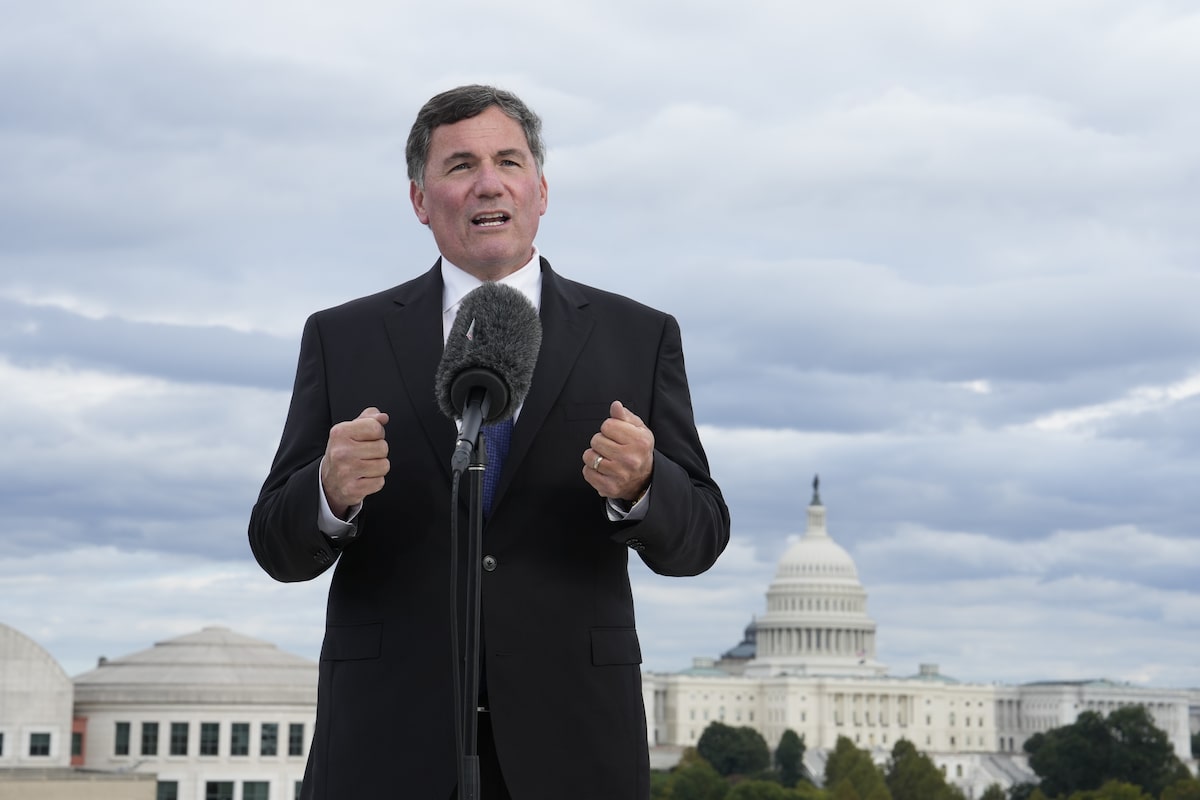
The office of Dominic LeBlanc, the minister in charge of U.S. trade, confirmed to The Globe that he is still in Washington.Adrian Wyld/The Canadian Press
Dominic LeBlanc, Canada’s minister in charge of U.S. trade, has remained in Washington in the days after Prime Minister Mark Carney’s Tuesday White House visit to pursue high-level negotiations aimed at lifting punishing tariffs on Canadian steel, aluminum, lumber and autos.
The talks have taken on an intensity that has led to some optimism on the Canadian side that substantial progress can be made on sector-specific trade irritants, three government sources say.
The sources say Mr. LeBlanc, Privy Council Clerk Michael Sabia and Canadian ambassador Kirsten Hillman, who is Ottawa’s chief negotiator, have been holding talks since Tuesday with U.S. Commerce Secretary Howard Lutnick and Trade Representative Jamieson Greer.
Mr. Sabia, the country’s top civil servant, who has extensive experience in negotiations after heading Quebec’s pension fund and Bell Canada Enterprises, returned to Ottawa Thursday afternoon.
Doug Saunders: Carney’s better off without a big Trump trade deal. Just ask the Europeans
Two of the sources say it’s possible that the LeBlanc talks could go into the Thanksgiving weekend. The Globe and Mail is not identifying any of the three sources because they were not authorized to discuss the sensitive U.S. talks.
Mr. Carney, who ran for prime minister on a promise to defend the Canadian economy against U.S. protectionism, has been under pressure to achieve relief from punitive U.S. tariffs, especially the sector-specific tariffs that Donald Trump’s administration has placed on imports of steel, aluminum, lumber and autos from Canada and other countries.
Trade talks faltered after no deal was reached by a Trump-imposed August deadline. But the relationship appeared to strengthen in the weeks leading up to Tuesday’s visit, Mr. Carney’s second as Prime Minister after a previous trip in May.
After the meeting this week, Mr. Carney and Mr. Trump had instructed their ministers to work quickly to try to iron out a deal on the sector-specific tariffs.
The negotiations have also involved the possible revival of the Keystone XL oil pipeline from Alberta to Texas and Canadian participation in a continental missile-defence system, which the U.S. refers to as Golden Dome. Keystone, which was approved in Mr. Trump’s first administration, was killed by former president Joe Biden.
Campbell Clark: A Keystone notion for Trump but still a mostly a pipeline dream
Mr. LeBlanc’s office confirmed to The Globe that the minister is still in Washington, but declined to say whether he would be staying through the Thanksgiving weekend.
“Minister LeBlanc has been in Washington to make progress on an agreement that will bring greater certainty to both countries,” press secretary Gabriel Brunet said in a statement. “Our objectives are clear: protect Canadian workers and their families, reinforce the competitiveness of Canadian businesses, and build the strongest economy in the G7.”
Ottawa has been focused on lifting the U.S. sectoral tariffs, which the President has justified under a national-security provision known as Section 232 in U.S. trade law.
Mr. Trump has imposed a 50-per-cent levy on steel and aluminum and 25-per-cent on autos, with a carve-out for the value of the vehicle made from U.S. parts. On Sept. 30, Mr. Trump imposed a new 10-per-cent tariff on Canadian softwood-lumber shipments, raising the total levy on softwood from Canada to more than 45 per cent.
Brian Clow, who was deputy chief of staff to former prime minister Justin Trudeau and key official overseeing U.S. relations, said it’s a positive sign that talks are continuing.
“Clearly the fact that they are still in Washington talking shows that something is happening, but it does not necessarily mean they are going to come to a conclusion,” he said in an interview.
“I recall in the renegotiation of NAFTA under prime minister Trudeau that many, many times we were down in Washington, extended our stay, thought we were getting close, only to reach an impasse.”
Mr. Carney told the BMO Eurasia US-Canada Summit in Toronto Wednesday that there will be bilateral deals with the U.S. alongside the continental free-trade agreement that comes up for renewal next year.
Opinion: Canadians are buying the Mark Carney brand, but can he deliver the product?
Canada is also thinking about where it is smart to remain integrated with the U.S. economy, he said, citing aerospace and defence.
Mr. Carney has taken sustained political heat from his opposition rivals over the fact that his trip to Washington yielded no new agreements with the U.S., specifically in industries such as steel and aluminum.
In the House of Commons Thursday, Conservative Leader Pierre Poilievre and Bloc Québécois Leader Yves-François Blanchet went after Mr. Carney for coming home empty-handed from Tuesday’s Oval Office meeting.
“He has failed to get tariffs lifted on our auto workers and our lumber workers, after thousands have lost their jobs and after he created the second-highest unemployment and the worst growth in the entire G7,” Mr. Poilievre said.
Mr. Carney replied: “We will only accept the best agreement for Canada and the private sector.”