
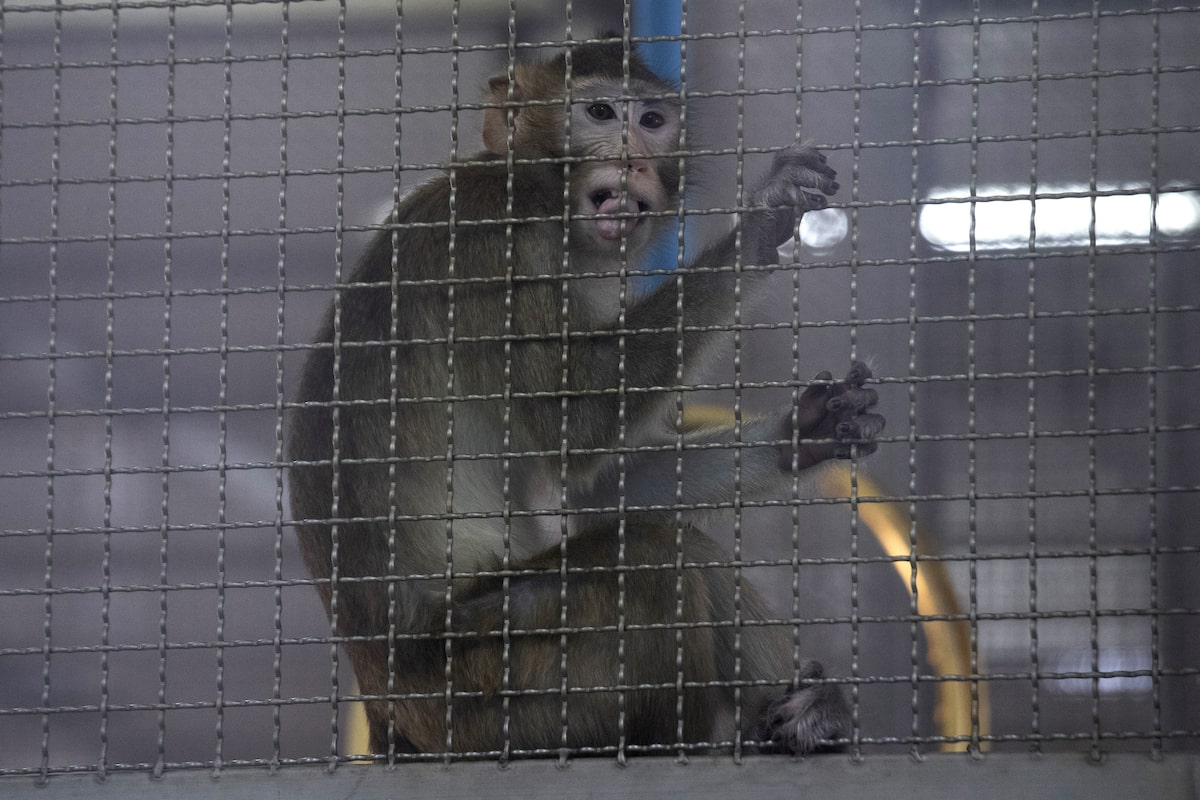
A long-tailed macaque kept for use in clinical research, at the National Primate Research Center in Bangkok, Thailand, in 2020. Nearly 1,800 wild-caught macaques from Mauritius and Cambodia were imported to Canada between 2021 and 2023.Sakchai Lalit/The Associated Press
Canada has imported nearly 1,800 endangered wild-caught monkeys from Mauritius and Cambodia for use in testing and research since 2021, prompting calls from animal welfare advocates to ban the practice.
The advocates say Canada is out of step with other countries, such as Britain, which have banned the import of primates caught from the wild for use in animal testing.
They say such imports cause suffering not just to the individual primates but their family groups, and raise concerns about the spread of zoonotic diseases.
According to the latest Convention on International Trade in Endangered Species, or CITES, trade figures, scrutinized by Canadian animal welfare group Humane World for Animals, 1,796 wild-caught macaques were imported to Canada between 2021 and 2023.
They included 1,772 endangered long-tailed macaques captured from the wild in Mauritius, and 24 wild macaques imported from Cambodia.
Between 2015 and 2020, no wild macaques were imported to Canada. But the sudden import of wild animals appears to have followed China’s decision to stop exporting macaques owing to the COVID-19 pandemic at the end of 2019.
Native to South East Asia, the long-tailed macaque has been listed as endangered by the International Union for Conservation of Nature since 2022. The intelligent primates typically live in family groups and are highly adaptable, living in forests, mangrove swamps and urban areas alongside humans.
It is the non-human primate most widely used in research and testing, which animal welfare experts say is threatening their numbers.
Opinion: Doug Ford is barking up the wrong tree with his ban on animal research
Sarah Kite, co-founder of British-based international advocacy group Action for Primates, said Britain and the EU have both banned the import of wild-caught primates for use in research and toxicity testing.
“The failure of Canada to follow their example is a major setback for animal welfare. By allowing the import of wild-caught long-tailed macaques from Cambodia and Mauritius, Canada is contributing substantially to the cruelty and inhumanity of trapping and the decimation of the species in the wild,” she said in an e-mail.
“The re-classification of the conservation status of the long-tailed macaque to Endangered by the IUCN Red List was based on the degree of their exploitation, which includes the global trade for research and testing.”
Shaarika Sarasija, director of research and regulatory science at Humane World for Animals Canada, said she was shocked to discover that Canada was importing macaques from the wild for commercial and medical use.
In 2021, 732 macaques trapped from the wild in Mauritius were imported for commercial testing and research. In 2022, 24 wild macaques caught in Cambodia were imported for medical research, and 645 wild-caught macaques from Mauritius were imported for commercial use. There were 395 wild macaques from Mauritius imported in 2023, according to the latest CITES trade figures.
The figures show they were exported from the United States. The U.S. still allows the import of wild-caught macaques. But for years the U.S. Fish and Wildlife Service has been denying permits for the import of Cambodian macaques after an investigation found evidence that thousands of monkeys caught in the wild have been smuggled to the U.S. from Cambodia, some with fraudulent documentation suggesting they were captive-bred.
Since the U.S. authorities took action, Canada has seen an exponential increase in imports of macaques. Animal welfare groups want Canada to stop importing Cambodian macaques for use in labs, while questions remain about whether the shipments could include illegally wild-caught animals.
Macaques can each sell for $15,000 or more.
Marineland’s belugas face euthanasia threat as Ottawa, Ontario point fingers
Rebecca Aldworth, executive director of Humane World for Animals Canada, said wild macaques have been witnessed being in great distress after being caught, and calling out from their traps.
She said shipping the wild animals in crates on a long journey from South East Asia to North America would be extremely distressing to the intelligent animals. Once here, the wild creatures would face a life of being tested and experimented on in confinement before being killed, she said.
She said Canada should ban the import of wild-caught primates and invest in earnest in alternatives to animal testing. She said Canada has the potential and expertise to become a leader in the use of AI modelling for research.
Keean Nembhard, spokesperson for Environment Minister Julie Dabrusin, said “Canada remains firmly committed to protecting global biodiversity and upholding the highest standards in the international trade of wildlife, and Environment and Climate Change Canada continues to verify that all imports of macaques into Canada comply with Canadian law and international obligations under CITES.”
“We are working to refine, reduce, and replace testing on animals by finding alternatives that keep chemical safety management world-class and humane,” he added.