
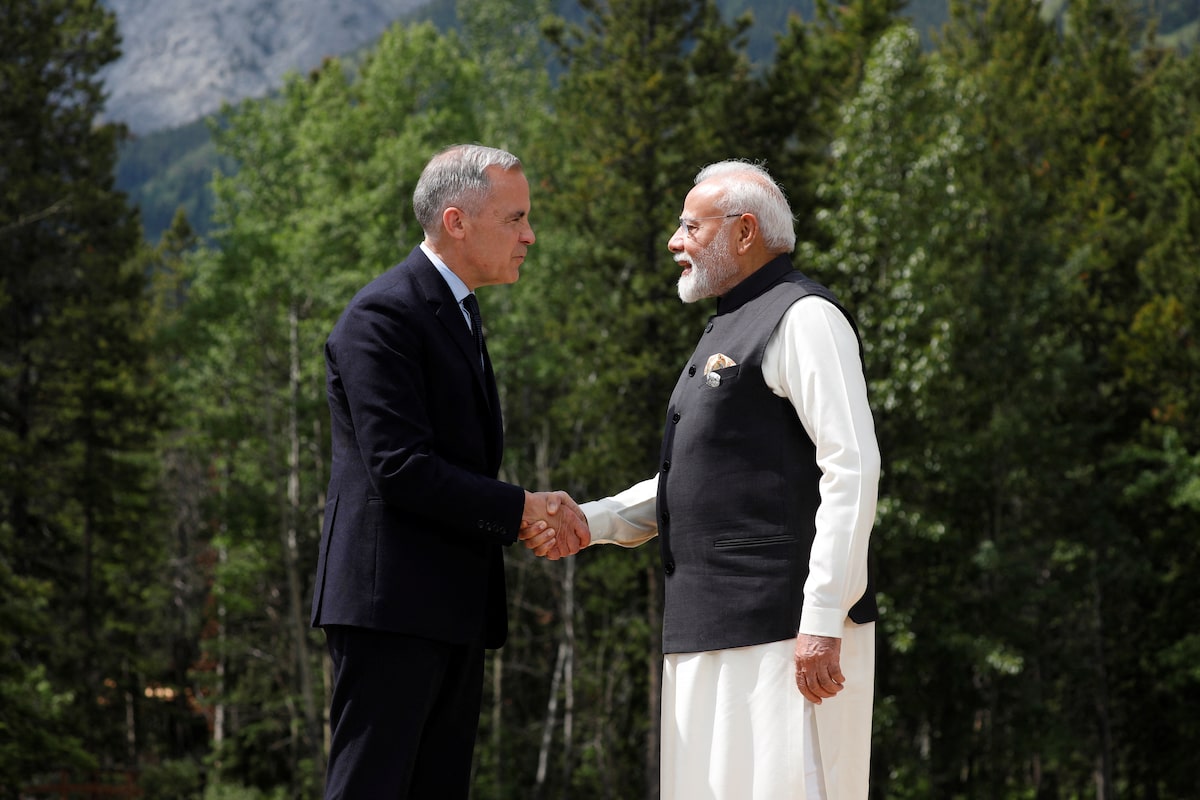
Prime Minister Mark Carney and India’s Prime Minister Narendra Modi shake hands during the G7 Leaders’ Summit in Kananaskis, Alberta in June.Amber Bracken/Reuters
Vina Nadjibulla is vice-president of research and strategy at the Asia Pacific Foundation of Canada
Last Thanksgiving, Ottawa was expelling Indian diplomats; this week, Foreign Affairs Minister Anita Anand is in New Delhi. The contrast captures how far relations have come – and how fragile the progress remains. Ms. Anand’s visit, Canada’s first ministerial-level trip to India in two years, also signals that the diplomatic reset launched by prime ministers Mark Carney and Narendra Modi in June is gathering momentum and that Ottawa and New Delhi have moved from crisis management to step-by-step re-engagement.
Canadians seem to support this, at least in principle. New polling by the Angus Reid Institute and the Asia Pacific Foundation of Canada finds that more than half of Canadians believe rapprochement with India was the right decision, while just one in five disagrees – a notable shift from the negativism of recent years. At the same time, a majority of Canadians also urge caution, and only about one-third say they know “at least something” about India – well below their self-reported knowledge of the United States, Japan or China. In short, Canadians support re-engagement but aren’t yet sure of the “why.”
For two years, the Canadian conversation about India has been dominated by headlines on foreign interference, diaspora tensions and student visas. Those issues are real and must be addressed through law enforcement co-operation and clear red lines. But when they become the whole story, we miss the bigger picture of what’s at stake for Canada’s prosperity and security.
The case for a careful, interests-driven re-engagement rests on three pillars.
The first is economic resilience. India – the world’s most populous country – is also one of the fastest-growing major economies and an increasingly important node in global technology and clean-energy supply chains. Canada–India merchandise trade grew 61 per cent between 2015 and 2024 to reach about $13.3-billion last year, while two-way services trade jumped from $2.6-billion in 2015 to $17.3-billion in 2023. Ottawa and New Delhi should resume and modernize trade talks focusing on early wins that deliver pragmatic benefits – on tariff-rate quotas, standards co-operation and investment protections – while scoping out what a fuller trade agreement would look like.
Canada and India set out ‘new roadmap’ for relations after Anand meets Modi
The restart of trade negotiations can also leverage India’s recent trade deals with Canada’s allies and partners. In July of this year, the U.K. and India announced a landmark trade deal, and in September, India signed a deal with the trading bloc of Iceland, Liechtenstein, Norway and Switzerland – evidence that it is prepared to move ahead on a kind of trade deal Canada would be seeking.
The second pillar is energy and critical minerals. India’s energy transition and manufacturing ambitions hinge on having secure access to inputs, from potash to uranium to battery metals. Canada offers trusted resources, world-class mining and ESG standards, and capital; India brings scale in processing, manufacturing and market demand. A Canada–India compact on energy and critical minerals would anchor the reset in tangible, job-creating projects on both sides.
The third is technology partnerships. Both countries see artificial intelligence, semi-conductors and digital infrastructure as strategic priorities. Canada’s research strengths and responsible AI leadership complement India’s scale in talent, compute power and digital public infrastructure. India will host the India AI Impact Summit in New Delhi in February, 2026 – a timely opportunity for Canadian leadership to engage, showcase its responsible-AI work, and launch joint projects in chips and compute power.
‘If there is no demand, we can’t operate’: Small landlords ponder future after foreign student cuts
None of this means lowering our guard on security concerns. On the contrary, a restored relationship should include law enforcement channels for addressing issues such as foreign interference or transnational repression with predictability, urgency and due process. Our goal should be to avoid a false choice between values and interests.
According to the same joint poll, Canadians are almost evenly split between prioritizing rule-of-law concerns and trade opportunities in our relationship with India. That tells us people want both – and they are right to think so: Effective statecraft is about advancing prosperity while defending principles, not choosing one at the expense of the other.
Finally, every step in this re-engagement with India should be clearly communicated to Canadians. The public deserves to know how these steps support not only Canadian jobs, trade diversification and national security, but also include a firm commitment that concerns about foreign interference will be addressed.
Rebuilding the Canada–India relationship will take patience, predictability and a broader public conversation than we’ve had so far. Ms. Anand’s trip is the right next step. The reset has begun; now it must deliver results Canadians can see – and understand.