
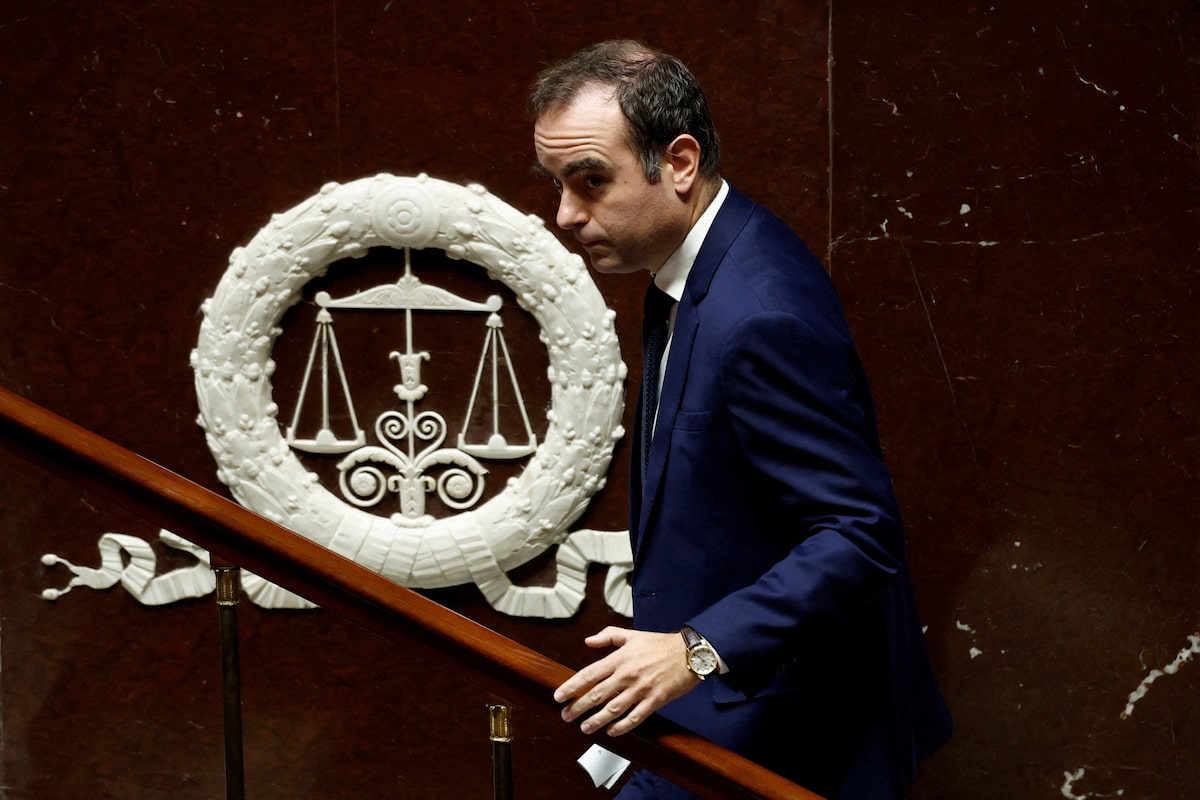
French Prime Minister Sébastien Lecornu survived two no-confidence motions Thursday at the National Assembly in Paris.Benoit Tessier/Reuters
French Prime Minister Sébastien Lecornu has narrowly survived two non-confidence motions in the National Assembly, offering the country some political stability after weeks of uncertainty. But his government is still far from stable, and is expected to face further challenges in the coming days when parliamentarians begin a debate on the budget.
The motions, known as censure, won 271 and 144 votes among MPs on Thursday, shy of the 289 needed to bring down the government.
However, several MPs cautioned that their support for Mr. Lecornu’s government might not last long and will depend on negotiations surrounding the budget.
“Our non-censorship today is obviously in no way a non-censorship pact,” Socialist MP Laurent Baumel told the National Assembly. “We are not committing ourselves to anything and especially not to voting for or allowing the recessionary and unfair budget that your ministers have presented to us to pass.”
Mr. Lecornu was reappointed Prime Minister by French President Emmanuel Macron last Friday, after abruptly resigning a few days earlier. He had served in the role for less than a month and resigned a day after naming his cabinet ministers, because of infighting among some of his appointees.
Mr. Lecornu is a close ally of Mr. Macron and said it was his duty to try once again to form a government and pass a budget. Days after returning to his post, he urged MPs to not bring down the government.
“This is obviously the moment of truth. Do we want republican order with debates taking place in the National Assembly or do we want disorder?” he asked the Assembly on Thursday.
In an effort to win over the Socialists, whose 69 MPs were the difference on Thursday, Mr. Lecornu made a number of concessions this week, namely announcing plans to suspend controversial pension reforms that were introduced in 2023 and backed by Mr. Macron. The reforms include gradually raising the retirement age from 62 to 64 by 2030, which has been widely unpopular.
The changes will be put on hold until after the presidential election in 2027, Mr. Lecornu said. He also promised to introduce some tax cuts and “exceptional tax increases” for certain large companies and the wealthy.
Macron reappoints Sébastien Lecornu as French prime minister days after he quit
But he added that delaying the pension reforms would cost €400-million ($655-million) in 2026, and €1.8-billion ($2.9-billion) in 2027, which would have to be offset by spending cuts to address France’s soaring debt level.
The country’s budgetary deficit is above 5 per cent of gross domestic product, nearly double the 3-per-cent-of-GDP target set by the European Union.
Mr. Lecornu has promised to bring the deficit down to 4.7 per cent of GDP in the 2026 budget, but has also said that he was open to compromise on that goal.
Nonetheless, it’s far from certain that he will win enough support in parliament for his fiscal plans. Two previous governments have collapsed this year over proposed budgets that included steep spending cuts.
Opinion: France barrels toward chaos as its public debt spirals out of control
The challenge confronting the French Prime Minister is the deep division in parliament that is split between three groups: a left-wing coalition led by France Unbowed, a centrist group that includes Mr. Macron’s party, and a far-right block led by Marine Le Pen’s National Rally.
Both France Unbowed and the National Rally have been pressing for an election and each vowed on Thursday to continue efforts to bring down Mr. Lecornu’s government.
“We will vote without hesitation to censure your government, because your budget is not a budget,” Ms. Le Pen told the Assembly. “This budget is a museum of horrors.”
Aurélie Trouvé, an MP for France Unbowed, said the reform proposal was only a distraction. “All of you who were elected to repeal the pension reform, are you really going to let yourselves be fooled by this deceptive handout?” she said during the debate. “A budgetary wrecking will take place if we do not censure.”
Many MPs have also turned on President Macron and demanded that he resign. Mr. Macron’s second term ends in 2027 and he cannot run for another. He has shown no interest in resigning early and has resisted dissolving the National Assembly for an election.
Mr. Lecornu expressed relief as he left the Assembly after Thursday’s vote. “The debates on the budget and other challenges needed to be able to start, and they will start now,” he told reporters.