
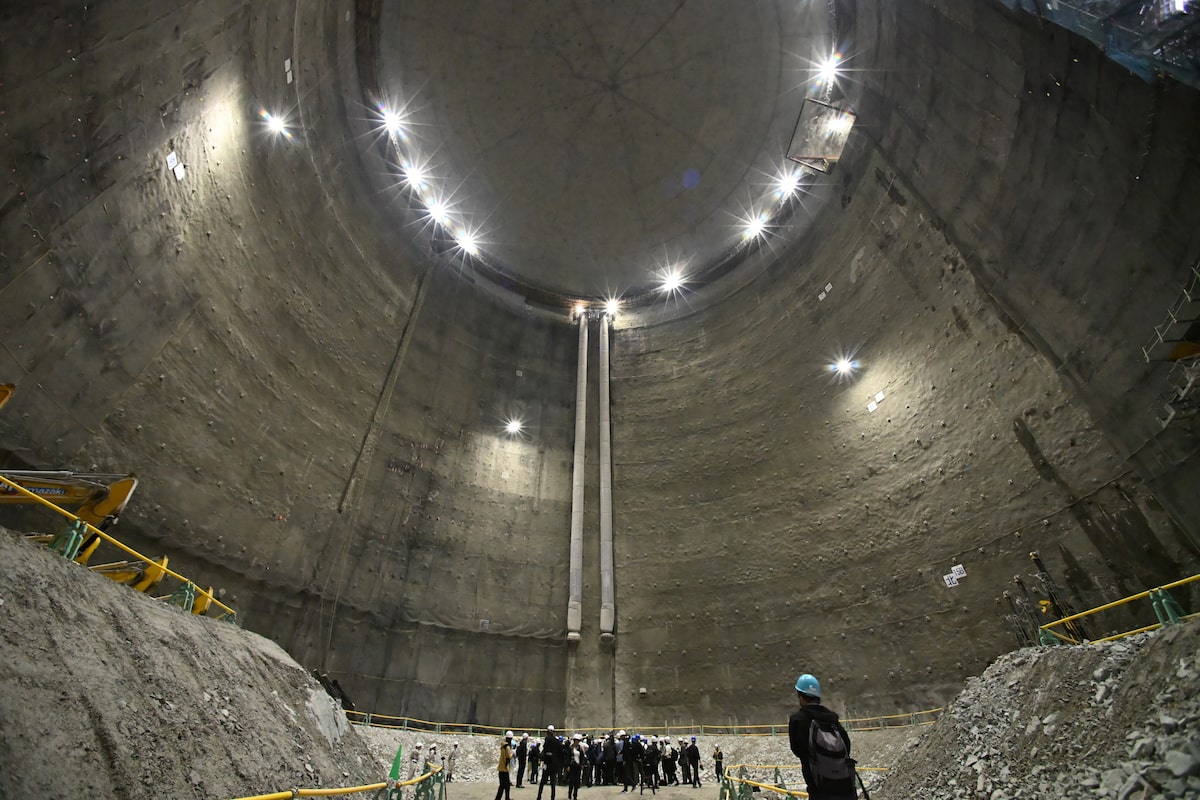
Hyper-Kamiokande, or HyperK, nears completion in Hida City, Japan, on June 28, 2025. The project aims to research the evolutionary history of the universe by looking at neutrinos.Satoshi Oga / The Yomiuri Shimbu/Reuters
Why is there something instead of nothing? Versions of that metaphysical chestnut have troubled philosophers and physicists for centuries.
Now, combined results from two research teams that study neutrinos – the most elusive particles known to science – have offered a possible clue as to why we live in a universe where matter exists.
The results, published Wednesday in the journal Nature, also suggest how future experiments, including one commencing in Canada next year, could further illuminate the question.
The new hunt for dark matter in Sudbury, Ont.
Neutrinos are the featherweights of the particle world. They come in three mass categories, the heaviest of which is estimated to be at least one million times lighter than the diminutive electron.
Indeed, the fact that neutrinos have any mass at all is one of the unsolved mysteries of physics. It was discovered not by weighing them directly but by showing that neutrinos are identity-shifters. As they travel through space, individual neutrinos behave as though they are in a continually changing mixture of the three mass categories. Mathematically, these bizarre oscillations require neutrinos to have a mass that is greater than zero at least part of the time.
In 2015, Queen’s University physicist Art McDonald shared the Nobel Prize in physics for his role in helping to prove that neutrino oscillations are real with an experiment located in a deep mine near Sudbury, Ont.
Since then, teams around the world have continued to probe neutrino oscillations to glean new information about the particles and the universe at large.
A picture of the Super-Kamiokande detector and an illustration describing the research field of Takaaki Kajita of Japan, who won the Nobel Prize in Physics in 2015 with Canada’s Arthur B. McDonald, are displayed on a screen on Oct. 6, 2015 at the Swedish Academy of Sciences in Stockholm.JONATHAN NACKSTRAND/Getty Images
Two such experiments are T2K in Japan and NOvA in the United States, which together have produced the new result. Each experiment generates a beam of neutrinos at a particle accelerator and then fires them through hundreds of kilometres of solid rock – which the neutrinos barely notice – before they are picked up in a detector located in a separate underground facility. In both experiments, scientists then switch their beams to create antineutrinos, the antimatter equivalent of the neutrino, and repeat the procedure.
As with the Canadian experiment, the reason for performing the sensitive measurements underground is to avoid cosmic rays, which continually rain down from space and would swamp any data gathered at surface level.
Both T2K and NOvA have operated for years with the aim of discerning how the three different neutrino masses relate to each other and to those of antineutrinos created under similar conditions. A key question is whether two of the three mass categories are relatively light and only the third one much heavier. Alternatively it could be the other way around, with one very low-mass neutrino (possibly zero mass) and two heavier neutrino masses.
In their latest effort, teams behind the two experiments have combined all their data to get at that question. The results do not provide a definitive answer, but they yield one interesting clue: If it were the case that there is only one light neutrino mass and two heavier ones, then the results indicate there must be some asymmetry between how neutrinos and antineutrinos behave.
“I don’t think we expected quite such a strong constraint there, so that was exciting,” said Patricia Vahle, a professor of physics at the College of William & Mary in Williamsburg, Va., and a member of the NOvA experiment.
This is interesting because such an asymmetry would shed light on how the universe came to be occupied by galaxies, stars and people all made of matter, even though the Big Bang is thought to have produced matter and antimatter in equal quantities when the universe began. If the situation remained that way, then the matter and antimatter would have annihilated each other, leaving nothing else but light. Whatever led to an excess of matter after the universe began is what ultimately made our existence possible.
Dr. McDonald, who attended a celebration at Queen’s last week marking the 10th anniversary of his Nobel Prize, said the condition that the two experiments have put on the neutrinos masses and their relationship to the matter-antimatter question is the most significant part of the combined results.
It means that if another experiment can determine how the three masses are ordered, “then we know whether neutrinos and antineutrinos have different oscillation patterns.”
One experiment that could contribute to the question is the re-tooled successor to Dr. McDonald’s original Nobel-winning experiment in Sudbury, dubbed SNO+. A new phase of that experiment is set to begin next year.
Meanwhile, plans for more powerful versions of T2K and NOvA, called HyperK and DUNE, are also in the works.
Deborah Harris, a professor of physics at York University in Toronto, is one of the scientists working on DUNE, which may be operating as early as 2029. She said neutrino oscillations currently offer one of the most promising avenues for advancing scientists’ understanding of reality.
“There are almost a billion times more neutrinos in the universe than there are any other particle we know of except for light,” Dr. Harris said. “At a fundamental level, understanding the universe means understanding neutrinos.”